
income/nfcorpus-top-20-gen-queries
收藏Hugging Face2023-01-24 更新2024-03-04 收录
下载链接:
https://hf-mirror.com/datasets/income/nfcorpus-top-20-gen-queries
下载链接
链接失效反馈官方服务:
资源简介:
---
annotations_creators: []
language_creators: []
language:
- en
license:
- cc-by-sa-4.0
multilinguality:
- monolingual
paperswithcode_id: beir
pretty_name: BEIR Benchmark
size_categories:
msmarco:
- 1M<n<10M
trec-covid:
- 100k<n<1M
nfcorpus:
- 1K<n<10K
nq:
- 1M<n<10M
hotpotqa:
- 1M<n<10M
fiqa:
- 10K<n<100K
arguana:
- 1K<n<10K
touche-2020:
- 100K<n<1M
cqadupstack:
- 100K<n<1M
quora:
- 100K<n<1M
dbpedia:
- 1M<n<10M
scidocs:
- 10K<n<100K
fever:
- 1M<n<10M
climate-fever:
- 1M<n<10M
scifact:
- 1K<n<10K
source_datasets: []
task_categories:
- text-retrieval
---
# NFCorpus: 20 generated queries (BEIR Benchmark)
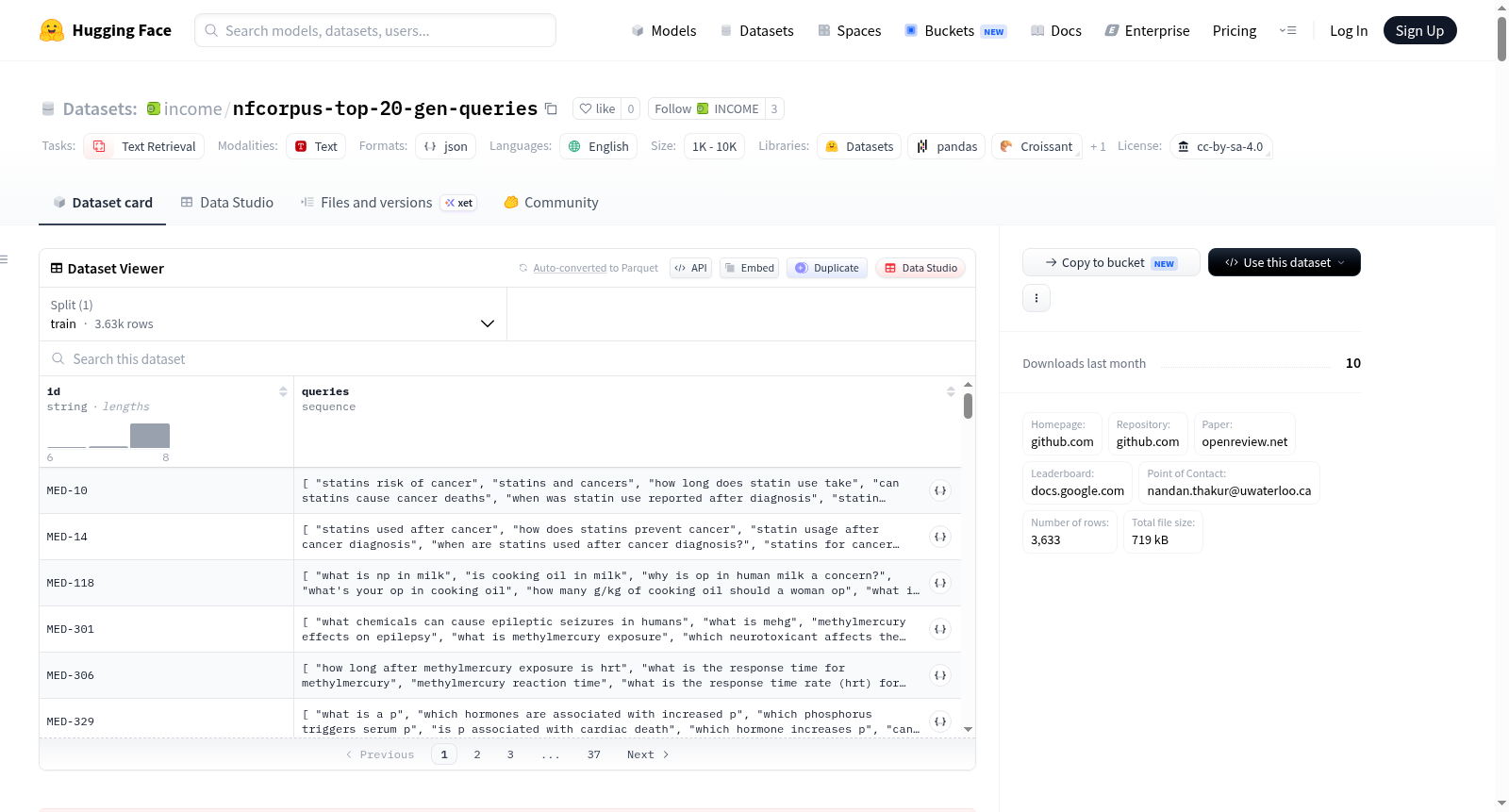
This HF dataset contains the top-20 synthetic queries generated for each passage in the above BEIR benchmark dataset.
- DocT5query model used: [BeIR/query-gen-msmarco-t5-base-v1](https://huggingface.co/BeIR/query-gen-msmarco-t5-base-v1)
- id (str): unique document id in NFCorpus in the BEIR benchmark (`corpus.jsonl`).
- Questions generated: 20
- Code used for generation: [evaluate_anserini_docT5query_parallel.py](https://github.com/beir-cellar/beir/blob/main/examples/retrieval/evaluation/sparse/evaluate_anserini_docT5query_parallel.py)
Below contains the old dataset card for the BEIR benchmark.
# Dataset Card for BEIR Benchmark
## Table of Contents
- [Dataset Description](#dataset-description)
- [Dataset Summary](#dataset-summary)
- [Supported Tasks and Leaderboards](#supported-tasks-and-leaderboards)
- [Languages](#languages)
- [Dataset Structure](#dataset-structure)
- [Data Instances](#data-instances)
- [Data Fields](#data-fields)
- [Data Splits](#data-splits)
- [Dataset Creation](#dataset-creation)
- [Curation Rationale](#curation-rationale)
- [Source Data](#source-data)
- [Annotations](#annotations)
- [Personal and Sensitive Information](#personal-and-sensitive-information)
- [Considerations for Using the Data](#considerations-for-using-the-data)
- [Social Impact of Dataset](#social-impact-of-dataset)
- [Discussion of Biases](#discussion-of-biases)
- [Other Known Limitations](#other-known-limitations)
- [Additional Information](#additional-information)
- [Dataset Curators](#dataset-curators)
- [Licensing Information](#licensing-information)
- [Citation Information](#citation-information)
- [Contributions](#contributions)
## Dataset Description
- **Homepage:** https://github.com/UKPLab/beir
- **Repository:** https://github.com/UKPLab/beir
- **Paper:** https://openreview.net/forum?id=wCu6T5xFjeJ
- **Leaderboard:** https://docs.google.com/spreadsheets/d/1L8aACyPaXrL8iEelJLGqlMqXKPX2oSP_R10pZoy77Ns
- **Point of Contact:** nandan.thakur@uwaterloo.ca
### Dataset Summary
BEIR is a heterogeneous benchmark that has been built from 18 diverse datasets representing 9 information retrieval tasks:
- Fact-checking: [FEVER](http://fever.ai), [Climate-FEVER](http://climatefever.ai), [SciFact](https://github.com/allenai/scifact)
- Question-Answering: [NQ](https://ai.google.com/research/NaturalQuestions), [HotpotQA](https://hotpotqa.github.io), [FiQA-2018](https://sites.google.com/view/fiqa/)
- Bio-Medical IR: [TREC-COVID](https://ir.nist.gov/covidSubmit/index.html), [BioASQ](http://bioasq.org), [NFCorpus](https://www.cl.uni-heidelberg.de/statnlpgroup/nfcorpus/)
- News Retrieval: [TREC-NEWS](https://trec.nist.gov/data/news2019.html), [Robust04](https://trec.nist.gov/data/robust/04.guidelines.html)
- Argument Retrieval: [Touche-2020](https://webis.de/events/touche-20/shared-task-1.html), [ArguAna](tp://argumentation.bplaced.net/arguana/data)
- Duplicate Question Retrieval: [Quora](https://www.quora.com/q/quoradata/First-Quora-Dataset-Release-Question-Pairs), [CqaDupstack](http://nlp.cis.unimelb.edu.au/resources/cqadupstack/)
- Citation-Prediction: [SCIDOCS](https://allenai.org/data/scidocs)
- Tweet Retrieval: [Signal-1M](https://research.signal-ai.com/datasets/signal1m-tweetir.html)
- Entity Retrieval: [DBPedia](https://github.com/iai-group/DBpedia-Entity/)
All these datasets have been preprocessed and can be used for your experiments.
```python
```
### Supported Tasks and Leaderboards
The dataset supports a leaderboard that evaluates models against task-specific metrics such as F1 or EM, as well as their ability to retrieve supporting information from Wikipedia.
The current best performing models can be found [here](https://eval.ai/web/challenges/challenge-page/689/leaderboard/).
### Languages
All tasks are in English (`en`).
## Dataset Structure
All BEIR datasets must contain a corpus, queries and qrels (relevance judgments file). They must be in the following format:
- `corpus` file: a `.jsonl` file (jsonlines) that contains a list of dictionaries, each with three fields `_id` with unique document identifier, `title` with document title (optional) and `text` with document paragraph or passage. For example: `{"_id": "doc1", "title": "Albert Einstein", "text": "Albert Einstein was a German-born...."}`
- `queries` file: a `.jsonl` file (jsonlines) that contains a list of dictionaries, each with two fields `_id` with unique query identifier and `text` with query text. For example: `{"_id": "q1", "text": "Who developed the mass-energy equivalence formula?"}`
- `qrels` file: a `.tsv` file (tab-seperated) that contains three columns, i.e. the `query-id`, `corpus-id` and `score` in this order. Keep 1st row as header. For example: `q1 doc1 1`
### Data Instances
A high level example of any beir dataset:
```python
corpus = {
"doc1" : {
"title": "Albert Einstein",
"text": "Albert Einstein was a German-born theoretical physicist. who developed the theory of relativity, \
one of the two pillars of modern physics (alongside quantum mechanics). His work is also known for \
its influence on the philosophy of science. He is best known to the general public for his mass–energy \
equivalence formula E = mc2, which has been dubbed 'the world's most famous equation'. He received the 1921 \
Nobel Prize in Physics 'for his services to theoretical physics, and especially for his discovery of the law \
of the photoelectric effect', a pivotal step in the development of quantum theory."
},
"doc2" : {
"title": "", # Keep title an empty string if not present
"text": "Wheat beer is a top-fermented beer which is brewed with a large proportion of wheat relative to the amount of \
malted barley. The two main varieties are German Weißbier and Belgian witbier; other types include Lambic (made\
with wild yeast), Berliner Weisse (a cloudy, sour beer), and Gose (a sour, salty beer)."
},
}
queries = {
"q1" : "Who developed the mass-energy equivalence formula?",
"q2" : "Which beer is brewed with a large proportion of wheat?"
}
qrels = {
"q1" : {"doc1": 1},
"q2" : {"doc2": 1},
}
```
### Data Fields
Examples from all configurations have the following features:
### Corpus
- `corpus`: a `dict` feature representing the document title and passage text, made up of:
- `_id`: a `string` feature representing the unique document id
- `title`: a `string` feature, denoting the title of the document.
- `text`: a `string` feature, denoting the text of the document.
### Queries
- `queries`: a `dict` feature representing the query, made up of:
- `_id`: a `string` feature representing the unique query id
- `text`: a `string` feature, denoting the text of the query.
### Qrels
- `qrels`: a `dict` feature representing the query document relevance judgements, made up of:
- `_id`: a `string` feature representing the query id
- `_id`: a `string` feature, denoting the document id.
- `score`: a `int32` feature, denoting the relevance judgement between query and document.
### Data Splits
| Dataset | Website| BEIR-Name | Type | Queries | Corpus | Rel D/Q | Down-load | md5 |
| -------- | -----| ---------| --------- | ----------- | ---------| ---------| :----------: | :------:|
| MSMARCO | [Homepage](https://microsoft.github.io/msmarco/)| ``msmarco`` | ``train``<br>``dev``<br>``test``| 6,980 | 8.84M | 1.1 | [Link](https://public.ukp.informatik.tu-darmstadt.de/thakur/BEIR/datasets/msmarco.zip) | ``444067daf65d982533ea17ebd59501e4`` |
| TREC-COVID | [Homepage](https://ir.nist.gov/covidSubmit/index.html)| ``trec-covid``| ``test``| 50| 171K| 493.5 | [Link](https://public.ukp.informatik.tu-darmstadt.de/thakur/BEIR/datasets/trec-covid.zip) | ``ce62140cb23feb9becf6270d0d1fe6d1`` |
| NFCorpus | [Homepage](https://www.cl.uni-heidelberg.de/statnlpgroup/nfcorpus/) | ``nfcorpus`` | ``train``<br>``dev``<br>``test``| 323 | 3.6K | 38.2 | [Link](https://public.ukp.informatik.tu-darmstadt.de/thakur/BEIR/datasets/nfcorpus.zip) | ``a89dba18a62ef92f7d323ec890a0d38d`` |
| BioASQ | [Homepage](http://bioasq.org) | ``bioasq``| ``train``<br>``test`` | 500 | 14.91M | 8.05 | No | [How to Reproduce?](https://github.com/UKPLab/beir/blob/main/examples/dataset#2-bioasq) |
| NQ | [Homepage](https://ai.google.com/research/NaturalQuestions) | ``nq``| ``train``<br>``test``| 3,452 | 2.68M | 1.2 | [Link](https://public.ukp.informatik.tu-darmstadt.de/thakur/BEIR/datasets/nq.zip) | ``d4d3d2e48787a744b6f6e691ff534307`` |
| HotpotQA | [Homepage](https://hotpotqa.github.io) | ``hotpotqa``| ``train``<br>``dev``<br>``test``| 7,405 | 5.23M | 2.0 | [Link](https://public.ukp.informatik.tu-darmstadt.de/thakur/BEIR/datasets/hotpotqa.zip) | ``f412724f78b0d91183a0e86805e16114`` |
| FiQA-2018 | [Homepage](https://sites.google.com/view/fiqa/) | ``fiqa`` | ``train``<br>``dev``<br>``test``| 648 | 57K | 2.6 | [Link](https://public.ukp.informatik.tu-darmstadt.de/thakur/BEIR/datasets/fiqa.zip) | ``17918ed23cd04fb15047f73e6c3bd9d9`` |
| Signal-1M(RT) | [Homepage](https://research.signal-ai.com/datasets/signal1m-tweetir.html)| ``signal1m`` | ``test``| 97 | 2.86M | 19.6 | No | [How to Reproduce?](https://github.com/UKPLab/beir/blob/main/examples/dataset#4-signal-1m) |
| TREC-NEWS | [Homepage](https://trec.nist.gov/data/news2019.html) | ``trec-news`` | ``test``| 57 | 595K | 19.6 | No | [How to Reproduce?](https://github.com/UKPLab/beir/blob/main/examples/dataset#1-trec-news) |
| ArguAna | [Homepage](http://argumentation.bplaced.net/arguana/data) | ``arguana``| ``test`` | 1,406 | 8.67K | 1.0 | [Link](https://public.ukp.informatik.tu-darmstadt.de/thakur/BEIR/datasets/arguana.zip) | ``8ad3e3c2a5867cdced806d6503f29b99`` |
| Touche-2020| [Homepage](https://webis.de/events/touche-20/shared-task-1.html) | ``webis-touche2020``| ``test``| 49 | 382K | 19.0 | [Link](https://public.ukp.informatik.tu-darmstadt.de/thakur/BEIR/datasets/webis-touche2020.zip) | ``46f650ba5a527fc69e0a6521c5a23563`` |
| CQADupstack| [Homepage](http://nlp.cis.unimelb.edu.au/resources/cqadupstack/) | ``cqadupstack``| ``test``| 13,145 | 457K | 1.4 | [Link](https://public.ukp.informatik.tu-darmstadt.de/thakur/BEIR/datasets/cqadupstack.zip) | ``4e41456d7df8ee7760a7f866133bda78`` |
| Quora| [Homepage](https://www.quora.com/q/quoradata/First-Quora-Dataset-Release-Question-Pairs) | ``quora``| ``dev``<br>``test``| 10,000 | 523K | 1.6 | [Link](https://public.ukp.informatik.tu-darmstadt.de/thakur/BEIR/datasets/quora.zip) | ``18fb154900ba42a600f84b839c173167`` |
| DBPedia | [Homepage](https://github.com/iai-group/DBpedia-Entity/) | ``dbpedia-entity``| ``dev``<br>``test``| 400 | 4.63M | 38.2 | [Link](https://public.ukp.informatik.tu-darmstadt.de/thakur/BEIR/datasets/dbpedia-entity.zip) | ``c2a39eb420a3164af735795df012ac2c`` |
| SCIDOCS| [Homepage](https://allenai.org/data/scidocs) | ``scidocs``| ``test``| 1,000 | 25K | 4.9 | [Link](https://public.ukp.informatik.tu-darmstadt.de/thakur/BEIR/datasets/scidocs.zip) | ``38121350fc3a4d2f48850f6aff52e4a9`` |
| FEVER | [Homepage](http://fever.ai) | ``fever``| ``train``<br>``dev``<br>``test``| 6,666 | 5.42M | 1.2| [Link](https://public.ukp.informatik.tu-darmstadt.de/thakur/BEIR/datasets/fever.zip) | ``5a818580227bfb4b35bb6fa46d9b6c03`` |
| Climate-FEVER| [Homepage](http://climatefever.ai) | ``climate-fever``|``test``| 1,535 | 5.42M | 3.0 | [Link](https://public.ukp.informatik.tu-darmstadt.de/thakur/BEIR/datasets/climate-fever.zip) | ``8b66f0a9126c521bae2bde127b4dc99d`` |
| SciFact| [Homepage](https://github.com/allenai/scifact) | ``scifact``| ``train``<br>``test``| 300 | 5K | 1.1 | [Link](https://public.ukp.informatik.tu-darmstadt.de/thakur/BEIR/datasets/scifact.zip) | ``5f7d1de60b170fc8027bb7898e2efca1`` |
| Robust04 | [Homepage](https://trec.nist.gov/data/robust/04.guidelines.html) | ``robust04``| ``test``| 249 | 528K | 69.9 | No | [How to Reproduce?](https://github.com/UKPLab/beir/blob/main/examples/dataset#3-robust04) |
## Dataset Creation
### Curation Rationale
[Needs More Information]
### Source Data
#### Initial Data Collection and Normalization
[Needs More Information]
#### Who are the source language producers?
[Needs More Information]
### Annotations
#### Annotation process
[Needs More Information]
#### Who are the annotators?
[Needs More Information]
### Personal and Sensitive Information
[Needs More Information]
## Considerations for Using the Data
### Social Impact of Dataset
[Needs More Information]
### Discussion of Biases
[Needs More Information]
### Other Known Limitations
[Needs More Information]
## Additional Information
### Dataset Curators
[Needs More Information]
### Licensing Information
[Needs More Information]
### Citation Information
Cite as:
```
@inproceedings{
thakur2021beir,
title={{BEIR}: A Heterogeneous Benchmark for Zero-shot Evaluation of Information Retrieval Models},
author={Nandan Thakur and Nils Reimers and Andreas R{\"u}ckl{\'e} and Abhishek Srivastava and Iryna Gurevych},
booktitle={Thirty-fifth Conference on Neural Information Processing Systems Datasets and Benchmarks Track (Round 2)},
year={2021},
url={https://openreview.net/forum?id=wCu6T5xFjeJ}
}
```
### Contributions
Thanks to [@Nthakur20](https://github.com/Nthakur20) for adding this dataset.Top-20 generated queries for every passage in NFCorpus
# Dataset Card for BEIR Benchmark
## Table of Contents
- [Dataset Description](#dataset-description)
- [Dataset Summary](#dataset-summary)
- [Supported Tasks and Leaderboards](#supported-tasks-and-leaderboards)
- [Languages](#languages)
- [Dataset Structure](#dataset-structure)
- [Data Instances](#data-instances)
- [Data Fields](#data-fields)
- [Data Splits](#data-splits)
- [Dataset Creation](#dataset-creation)
- [Curation Rationale](#curation-rationale)
- [Source Data](#source-data)
- [Annotations](#annotations)
- [Personal and Sensitive Information](#personal-and-sensitive-information)
- [Considerations for Using the Data](#considerations-for-using-the-data)
- [Social Impact of Dataset](#social-impact-of-dataset)
- [Discussion of Biases](#discussion-of-biases)
- [Other Known Limitations](#other-known-limitations)
- [Additional Information](#additional-information)
- [Dataset Curators](#dataset-curators)
- [Licensing Information](#licensing-information)
- [Citation Information](#citation-information)
- [Contributions](#contributions)
## Dataset Description
- **Homepage:** https://github.com/UKPLab/beir
- **Repository:** https://github.com/UKPLab/beir
- **Paper:** https://openreview.net/forum?id=wCu6T5xFjeJ
- **Leaderboard:** https://docs.google.com/spreadsheets/d/1L8aACyPaXrL8iEelJLGqlMqXKPX2oSP_R10pZoy77Ns
- **Point of Contact:** nandan.thakur@uwaterloo.ca
### Dataset Summary
BEIR is a heterogeneous benchmark that has been built from 18 diverse datasets representing 9 information retrieval tasks:
- Fact-checking: [FEVER](http://fever.ai), [Climate-FEVER](http://climatefever.ai), [SciFact](https://github.com/allenai/scifact)
- Question-Answering: [NQ](https://ai.google.com/research/NaturalQuestions), [HotpotQA](https://hotpotqa.github.io), [FiQA-2018](https://sites.google.com/view/fiqa/)
- Bio-Medical IR: [TREC-COVID](https://ir.nist.gov/covidSubmit/index.html), [BioASQ](http://bioasq.org), [NFCorpus](https://www.cl.uni-heidelberg.de/statnlpgroup/nfcorpus/)
- News Retrieval: [TREC-NEWS](https://trec.nist.gov/data/news2019.html), [Robust04](https://trec.nist.gov/data/robust/04.guidelines.html)
- Argument Retrieval: [Touche-2020](https://webis.de/events/touche-20/shared-task-1.html), [ArguAna](tp://argumentation.bplaced.net/arguana/data)
- Duplicate Question Retrieval: [Quora](https://www.quora.com/q/quoradata/First-Quora-Dataset-Release-Question-Pairs), [CqaDupstack](http://nlp.cis.unimelb.edu.au/resources/cqadupstack/)
- Citation-Prediction: [SCIDOCS](https://allenai.org/data/scidocs)
- Tweet Retrieval: [Signal-1M](https://research.signal-ai.com/datasets/signal1m-tweetir.html)
- Entity Retrieval: [DBPedia](https://github.com/iai-group/DBpedia-Entity/)
All these datasets have been preprocessed and can be used for your experiments.
```python
```
### Supported Tasks and Leaderboards
The dataset supports a leaderboard that evaluates models against task-specific metrics such as F1 or EM, as well as their ability to retrieve supporting information from Wikipedia.
The current best performing models can be found [here](https://eval.ai/web/challenges/challenge-page/689/leaderboard/).
### Languages
All tasks are in English (`en`).
## Dataset Structure
All BEIR datasets must contain a corpus, queries and qrels (relevance judgments file). They must be in the following format:
- `corpus` file: a `.jsonl` file (jsonlines) that contains a list of dictionaries, each with three fields `_id` with unique document identifier, `title` with document title (optional) and `text` with document paragraph or passage. For example: `{"_id": "doc1", "title": "Albert Einstein", "text": "Albert Einstein was a German-born...."}`
- `queries` file: a `.jsonl` file (jsonlines) that contains a list of dictionaries, each with two fields `_id` with unique query identifier and `text` with query text. For example: `{"_id": "q1", "text": "Who developed the mass-energy equivalence formula?"}`
- `qrels` file: a `.tsv` file (tab-seperated) that contains three columns, i.e. the `query-id`, `corpus-id` and `score` in this order. Keep 1st row as header. For example: `q1 doc1 1`
### Data Instances
A high level example of any beir dataset:
```python
corpus = {
"doc1" : {
"title": "Albert Einstein",
"text": "Albert Einstein was a German-born theoretical physicist. who developed the theory of relativity, \
one of the two pillars of modern physics (alongside quantum mechanics). His work is also known for \
its influence on the philosophy of science. He is best known to the general public for his mass–energy \
equivalence formula E = mc2, which has been dubbed 'the world's most famous equation'. He received the 1921 \
Nobel Prize in Physics 'for his services to theoretical physics, and especially for his discovery of the law \
of the photoelectric effect', a pivotal step in the development of quantum theory."
},
"doc2" : {
"title": "", # Keep title an empty string if not present
"text": "Wheat beer is a top-fermented beer which is brewed with a large proportion of wheat relative to the amount of \
malted barley. The two main varieties are German Weißbier and Belgian witbier; other types include Lambic (made\
with wild yeast), Berliner Weisse (a cloudy, sour beer), and Gose (a sour, salty beer)."
},
}
queries = {
"q1" : "Who developed the mass-energy equivalence formula?",
"q2" : "Which beer is brewed with a large proportion of wheat?"
}
qrels = {
"q1" : {"doc1": 1},
"q2" : {"doc2": 1},
}
```
### Data Fields
Examples from all configurations have the following features:
### Corpus
- `corpus`: a `dict` feature representing the document title and passage text, made up of:
- `_id`: a `string` feature representing the unique document id
- `title`: a `string` feature, denoting the title of the document.
- `text`: a `string` feature, denoting the text of the document.
### Queries
- `queries`: a `dict` feature representing the query, made up of:
- `_id`: a `string` feature representing the unique query id
- `text`: a `string` feature, denoting the text of the query.
### Qrels
- `qrels`: a `dict` feature representing the query document relevance judgements, made up of:
- `_id`: a `string` feature representing the query id
- `_id`: a `string` feature, denoting the document id.
- `score`: a `int32` feature, denoting the relevance judgement between query and document.
### Data Splits
| Dataset | Website| BEIR-Name | Type | Queries | Corpus | Rel D/Q | Down-load | md5 |
| -------- | -----| ---------| --------- | ----------- | ---------| ---------| :----------: | :------:|
| MSMARCO | [Homepage](https://microsoft.github.io/msmarco/)| ``msmarco`` | ``train``<br>``dev``<br>``test``| 6,980 | 8.84M | 1.1 | [Link](https://public.ukp.informatik.tu-darmstadt.de/thakur/BEIR/datasets/msmarco.zip) | ``444067daf65d982533ea17ebd59501e4`` |
| TREC-COVID | [Homepage](https://ir.nist.gov/covidSubmit/index.html)| ``trec-covid``| ``test``| 50| 171K| 493.5 | [Link](https://public.ukp.informatik.tu-darmstadt.de/thakur/BEIR/datasets/trec-covid.zip) | ``ce62140cb23feb9becf6270d0d1fe6d1`` |
| NFCorpus | [Homepage](https://www.cl.uni-heidelberg.de/statnlpgroup/nfcorpus/) | ``nfcorpus`` | ``train``<br>``dev``<br>``test``| 323 | 3.6K | 38.2 | [Link](https://public.ukp.informatik.tu-darmstadt.de/thakur/BEIR/datasets/nfcorpus.zip) | ``a89dba18a62ef92f7d323ec890a0d38d`` |
| BioASQ | [Homepage](http://bioasq.org) | ``bioasq``| ``train``<br>``test`` | 500 | 14.91M | 8.05 | No | [How to Reproduce?](https://github.com/UKPLab/beir/blob/main/examples/dataset#2-bioasq) |
| NQ | [Homepage](https://ai.google.com/research/NaturalQuestions) | ``nq``| ``train``<br>``test``| 3,452 | 2.68M | 1.2 | [Link](https://public.ukp.informatik.tu-darmstadt.de/thakur/BEIR/datasets/nq.zip) | ``d4d3d2e48787a744b6f6e691ff534307`` |
| HotpotQA | [Homepage](https://hotpotqa.github.io) | ``hotpotqa``| ``train``<br>``dev``<br>``test``| 7,405 | 5.23M | 2.0 | [Link](https://public.ukp.informatik.tu-darmstadt.de/thakur/BEIR/datasets/hotpotqa.zip) | ``f412724f78b0d91183a0e86805e16114`` |
| FiQA-2018 | [Homepage](https://sites.google.com/view/fiqa/) | ``fiqa`` | ``train``<br>``dev``<br>``test``| 648 | 57K | 2.6 | [Link](https://public.ukp.informatik.tu-darmstadt.de/thakur/BEIR/datasets/fiqa.zip) | ``17918ed23cd04fb15047f73e6c3bd9d9`` |
| Signal-1M(RT) | [Homepage](https://research.signal-ai.com/datasets/signal1m-tweetir.html)| ``signal1m`` | ``test``| 97 | 2.86M | 19.6 | No | [How to Reproduce?](https://github.com/UKPLab/beir/blob/main/examples/dataset#4-signal-1m) |
| TREC-NEWS | [Homepage](https://trec.nist.gov/data/news2019.html) | ``trec-news`` | ``test``| 57 | 595K | 19.6 | No | [How to Reproduce?](https://github.com/UKPLab/beir/blob/main/examples/dataset#1-trec-news) |
| ArguAna | [Homepage](http://argumentation.bplaced.net/arguana/data) | ``arguana``| ``test`` | 1,406 | 8.67K | 1.0 | [Link](https://public.ukp.informatik.tu-darmstadt.de/thakur/BEIR/datasets/arguana.zip) | ``8ad3e3c2a5867cdced806d6503f29b99`` |
| Touche-2020| [Homepage](https://webis.de/events/touche-20/shared-task-1.html) | ``webis-touche2020``| ``test``| 49 | 382K | 19.0 | [Link](https://public.ukp.informatik.tu-darmstadt.de/thakur/BEIR/datasets/webis-touche2020.zip) | ``46f650ba5a527fc69e0a6521c5a23563`` |
| CQADupstack| [Homepage](http://nlp.cis.unimelb.edu.au/resources/cqadupstack/) | ``cqadupstack``| ``test``| 13,145 | 457K | 1.4 | [Link](https://public.ukp.informatik.tu-darmstadt.de/thakur/BEIR/datasets/cqadupstack.zip) | ``4e41456d7df8ee7760a7f866133bda78`` |
| Quora| [Homepage](https://www.quora.com/q/quoradata/First-Quora-Dataset-Release-Question-Pairs) | ``quora``| ``dev``<br>``test``| 10,000 | 523K | 1.6 | [Link](https://public.ukp.informatik.tu-darmstadt.de/thakur/BEIR/datasets/quora.zip) | ``18fb154900ba42a600f84b839c173167`` |
| DBPedia | [Homepage](https://github.com/iai-group/DBpedia-Entity/) | ``dbpedia-entity``| ``dev``<br>``test``| 400 | 4.63M | 38.2 | [Link](https://public.ukp.informatik.tu-darmstadt.de/thakur/BEIR/datasets/dbpedia-entity.zip) | ``c2a39eb420a3164af735795df012ac2c`` |
| SCIDOCS| [Homepage](https://allenai.org/data/scidocs) | ``scidocs``| ``test``| 1,000 | 25K | 4.9 | [Link](https://public.ukp.informatik.tu-darmstadt.de/thakur/BEIR/datasets/scidocs.zip) | ``38121350fc3a4d2f48850f6aff52e4a9`` |
| FEVER | [Homepage](http://fever.ai) | ``fever``| ``train``<br>``dev``<br>``test``| 6,666 | 5.42M | 1.2| [Link](https://public.ukp.informatik.tu-darmstadt.de/thakur/BEIR/datasets/fever.zip) | ``5a818580227bfb4b35bb6fa46d9b6c03`` |
| Climate-FEVER| [Homepage](http://climatefever.ai) | ``climate-fever``|``test``| 1,535 | 5.42M | 3.0 | [Link](https://public.ukp.informatik.tu-darmstadt.de/thakur/BEIR/datasets/climate-fever.zip) | ``8b66f0a9126c521bae2bde127b4dc99d`` |
| SciFact| [Homepage](https://github.com/allenai/scifact) | ``scifact``| ``train``<br>``test``| 300 | 5K | 1.1 | [Link](https://public.ukp.informatik.tu-darmstadt.de/thakur/BEIR/datasets/scifact.zip) | ``5f7d1de60b170fc8027bb7898e2efca1`` |
| Robust04 | [Homepage](https://trec.nist.gov/data/robust/04.guidelines.html) | ``robust04``| ``test``| 249 | 528K | 69.9 | No | [How to Reproduce?](https://github.com/UKPLab/beir/blob/main/examples/dataset#3-robust04) |
## Dataset Creation
### Curation Rationale
[Needs More Information]
### Source Data
#### Initial Data Collection and Normalization
[Needs More Information]
#### Who are the source language producers?
[Needs More Information]
### Annotations
#### Annotation process
[Needs More Information]
#### Who are the annotators?
[Needs More Information]
### Personal and Sensitive Information
[Needs More Information]
## Considerations for Using the Data
### Social Impact of Dataset
[Needs More Information]
### Discussion of Biases
[Needs More Information]
### Other Known Limitations
[Needs More Information]
## Additional Information
### Dataset Curators
[Needs More Information]
### Licensing Information
[Needs More Information]
### Citation Information
Cite as:
```
@inproceedings{
thakur2021beir,
title={{BEIR}: A Heterogeneous Benchmark for Zero-shot Evaluation of Information Retrieval Models},
author={Nandan Thakur and Nils Reimers and Andreas R{\"u}ckl{\'e} and Abhishek Srivastava and Iryna Gurevych},
booktitle={Thirty-fifth Conference on Neural Information Processing Systems Datasets and Benchmarks Track (Round 2)},
year={2021},
url={https://openreview.net/forum?id=wCu6T5xFjeJ}
}
```
### Contributions
Thanks to [@Nthakur20](https://github.com/Nthakur20) for adding this dataset.
提供机构:
income原始信息汇总
数据集概述
- 名称: BEIR Benchmark
- 别名: BEIR
- 语言: 英语 (
en) - 许可证: CC-BY-SA-4.0
- 多语言性: 单语
- 任务类别: 文本检索
- 数据集大小:
msmarco: 1M<n<10Mtrec-covid: 100k<n<1Mnfcorpus: 1K<n<10Knq: 1M<n<10Mhotpotqa: 1M<n<10Mfiqa: 10K<n<100Karguana: 1K<n<10Ktouche-2020: 100K<n<1Mcqadupstack: 100K<n<1Mquora: 100K<n<1Mdbpedia: 1M<n<10Mscidocs: 10K<n<100Kfever: 1M<n<10Mclimate-fever: 1M<n<10Mscifact: 1K<n<10K
数据集结构
-
文件格式:
corpus:.jsonl(jsonlines)queries:.jsonl(jsonlines)qrels:.tsv(tab-separated)
-
数据实例:
corpus: 包含_id,title,text字段queries: 包含_id,text字段qrels: 包含query-id,corpus-id,score字段
数据集创建
- 源数据: 来自18个不同数据集,涵盖9种信息检索任务
- 数据预处理: 所有数据集已预处理,可直接用于实验
使用考虑
- 任务支持: 支持模型评估,包括F1和EM等任务特定指标
- 语言: 所有任务均为英语
附加信息
-
引用信息:
@inproceedings{ thakur2021beir, title={{BEIR}: A Heterogeneous Benchmark for Zero-shot Evaluation of Information Retrieval Models}, author={Nandan Thakur and Nils Reimers and Andreas R{"u}ckl{e} and Abhishek Srivastava and Iryna Gurevych}, booktitle={Thirty-fifth Conference on Neural Information Processing Systems Datasets and Benchmarks Track (Round 2)}, year={2021}, url={https://openreview.net/forum?id=wCu6T5xFjeJ} }
搜集汇总
数据集介绍
构建方式
在信息检索领域,合成查询生成是提升模型训练数据多样性的关键技术。本数据集基于BEIR基准测试中的NFCorpus子集,利用DocT5query模型(BeIR/query-gen-msmarco-t5-base-v1)为每个文档段落生成前20个合成查询。该生成过程依托于Anserini框架中的并行评估脚本(evaluate_anserini_docT5query_parallel.py),确保高效且可复现。每个文档通过其唯一标识符(id)与生成的20个查询相关联,从而构建出丰富的查询-文档配对资源。
特点
本数据集的核心特色在于其合成查询的多样性与针对性。每个NFCorpus文档均配备20个由T5模型生成的查询,这些查询不仅覆盖了文档的核心语义,还通过生成式方法引入了不同的表述角度,有效扩充了原始查询空间。作为BEIR基准的一部分,该数据集继承了NFCorpus在生物医学信息检索领域的专业背景,同时通过合成查询增强了模型在零样本场景下的泛化能力。数据集采用JSON Lines格式存储,结构简洁,便于集成到各类检索系统中。
使用方法
使用本数据集时,研究人员可将其直接用于信息检索模型的训练与评估。通过加载包含文档ID与对应合成查询的数据集,用户能够构建查询-文档相关性训练对。典型应用场景包括基于对比学习的检索模型微调,或作为数据增强手段提升现有稀疏或密集检索器的性能。建议结合BEIR基准的原始语料库(corpus.jsonl)和相关性判断文件(qrels)进行使用,以充分利用其合成查询与真实标注的互补优势,推动模型在生物医学检索任务上的表现提升。
背景与挑战
背景概述
在信息检索领域,零样本迁移学习能力日益受到关注,而BEIR基准测试的提出为评估模型泛化性能提供了关键框架。该数据集名为income/nfcorpus-top-20-gen-queries,由Nandan Thakur等来自滑铁卢大学和达姆施塔特工业大学的研究人员于2021年创建,隶属于BEIR基准测试项目。其核心研究问题聚焦于利用DocT5query模型为NFCorpus语料库中的每个段落生成20条合成查询,以增强检索模型的训练数据多样性。NFCorpus本身专注于生物医学信息检索,涵盖约3600篇文档和323个查询,在医学文献检索领域具有重要影响力。该数据集通过生成式查询扩展,为提升检索系统在专业领域的表现提供了宝贵资源,推动了信息检索模型在零样本场景下的评估与发展。
当前挑战
该数据集面临的挑战首先体现在生物医学信息检索的领域特性上,医学文献中充斥着专业术语、缩写及复杂的概念关系,使得检索模型需具备精准的语义理解能力,而传统检索方法往往难以应对这种高度专业化的查询与文档匹配问题。其次,在构建过程中,合成查询的生成质量是一大难点,DocT5query模型虽能产生多样化的查询表述,但生成的查询可能偏离原始文档的核心语义,引入噪声或冗余信息,从而影响检索系统的鲁棒性。此外,NFCorpus语料库规模较小(仅数千篇文档),限制了生成式查询的覆盖范围,且缺乏足够的标注数据来验证合成查询的有效性,增加了模型评估与优化的复杂性。
常用场景
经典使用场景
在信息检索领域,该数据集作为BEIR基准测试中NFCorpus子集的增强版本,通过DocT5query模型为每篇生物医学文献生成20条合成查询,广泛应用于零样本检索模型的性能评估。研究者利用这些合成查询与原始语料库构建检索任务,测试模型在未见领域中的泛化能力,尤其关注生物医学文本的语义匹配精度。该场景的核心价值在于模拟真实用户查询的多样性,弥补原始NFCorpus查询数量有限的不足,为评估检索系统在低资源领域的鲁棒性提供了标准化测试平台。
衍生相关工作
该数据集衍生了多项经典工作,包括基于DocT5query的文档扩展方法研究,以及利用合成查询训练稠密检索模型的探索。其中,BEIR基准的提出者进一步验证了生成式查询在提升检索系统零样本泛化能力上的有效性。后续工作如SPLADE、ColBERT等模型均采用类似策略优化稀疏与稠密检索的融合。此外,该数据集还催生了查询生成质量评估指标的研究,推动了生成式预训练模型在信息检索领域的应用边界拓展,成为检索增强生成技术的重要基石。
数据集最近研究
最新研究方向
在信息检索领域,尤其是面向生物医学文本的零样本检索任务中,合成查询生成技术正成为前沿研究方向。该数据集基于BEIR基准中的NFCorpus子集,利用DocT5query模型为每个段落生成20条合成查询,旨在缓解标注数据稀缺问题并提升检索模型的泛化能力。这一方法紧密关联当前大语言模型在少样本与零样本场景下的应用热潮,通过高质量查询扩增,显著增强了密集检索与稀疏检索模型在专业领域(如医学文献)中的表现。其意义在于为低资源检索任务提供可扩展的解决方案,推动信息检索系统向更高效、更鲁棒的方向演进。
以上内容由遇见数据集搜集并总结生成


