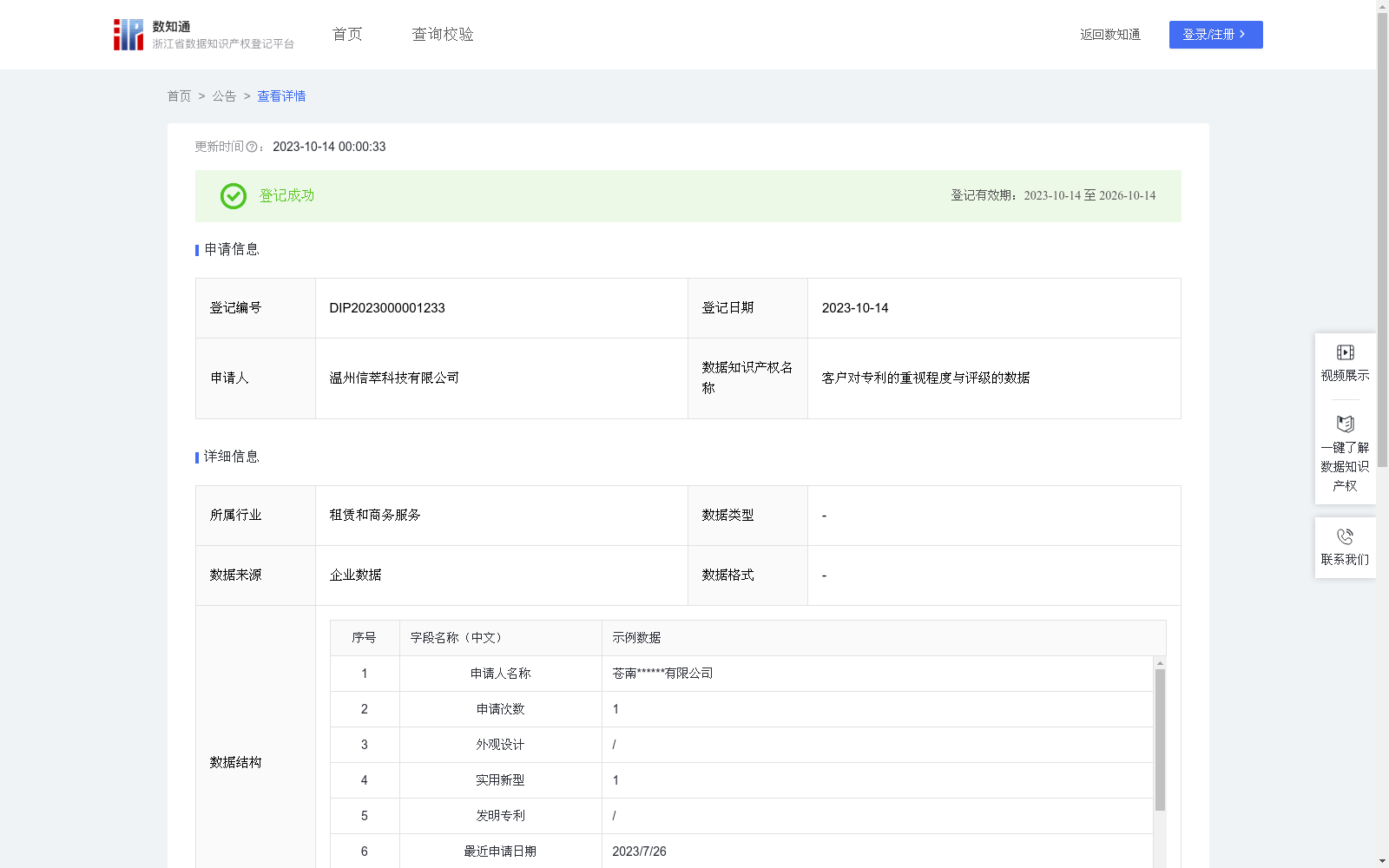
客户对专利的重视程度与评级的数据
收藏资源简介:
该数据通过捕捉客户专利申请次数、专利总量、专利类别和申请时间对企业进行评级;评级高的客户为优质客户,并为其提供精准化的专利服务。其算法规则包括:一、数据采集:采集企业名称,申请次数,申请的专利类别,最近申请日期,最近一次申请的专利类别。二、数据处理:对采集到的数据进行整合,便于分析使用。 三、算法加工:设定参数:申请次数为A,计分为申请次数*1;申请的专利类别为B,计分为外观设计*1,实用新型*3,发明专利*10;最近申请日期为T,计分为2023为10分,2022为5分,2021为1分,2021及以下不计分;最近一次申请的专利为C,外观为2分,实用新型为6分,发明专利为20分。2)根据实际业务情况,设置并求出阈,可以是平均值、中位数等,示例使用A、B、T和C的设定分值。2)专利价值分通过B+T+C得出,且评分越高企业专利价值越高,重视程度分通过A-总申请次数的平均值,且评分越高企业对专利重视程度越高;通过对专利价值分和重视程度分相加得出总分,更加总分不同将企业分成不同档位如A为60以上,B为60-30之间,C为30-0之间,D为0以下;客户类型中占比最多的是C级别企业,该类型企业对专利重视程度不高。其次占比较多的是B级别企业,该类型企业其拥有的专利价值不高,多为外观设计或者实用新型,其拥有发明专利的数量较少。
This dataset rates enterprises by capturing their number of patent applications, total patent holdings, patent categories, and application timestamps. High-rated clients are classified as high-quality customers, who will be provided with targeted patent services. The algorithm rules are as follows: 1. Data Collection: Collect enterprise name, number of applications, applied patent categories, most recent application date, and patent category of the most recent application. 2. Data Processing: Integrate the collected data to facilitate subsequent analysis and utilization. 3. Algorithm Processing: a. Parameter Setting: - Denote the number of applications as A, with the score calculated as the number of applications × 1; - Denote the applied patent categories as B, with scores of 1 for design patents, 3 for utility models, and 10 for invention patents; - Denote the most recent application date as T, with scores of 10 for the year 2023, 5 for 2022, 1 for 2021, and no points for years 2021 and earlier; - Denote the most recent application patent as C, with scores of 2 for design patents, 6 for utility models, and 20 for invention patents. b. Threshold Configuration: Set and calculate thresholds (e.g., mean, median) based on actual business scenarios, with the example utilizing the preset scores of A, B, T, and C. c. Score Calculation: - Patent value score is calculated as B + T + C: a higher score indicates a higher patent value of the enterprise; - Importance score is calculated as A minus the mean value of total application counts: a higher score indicates the enterprise attaches greater importance to patents; - Total score is obtained by summing the patent value score and the importance score. d. Tier Classification: Divide enterprises into different tiers based on the total score: Tier A for scores above 60, Tier B for scores between 30 and 60, Tier C for scores between 0 and 30, and Tier D for scores below 0. Tier C enterprises account for the largest share of all customer types, and such enterprises have low attention to patents. The second largest share is occupied by Tier B enterprises, which generally have low patent value, mostly owning design patents or utility models with only a small number of invention patents.