基于实时协作流的标注任务智能分配核心数据集
收藏资源简介:
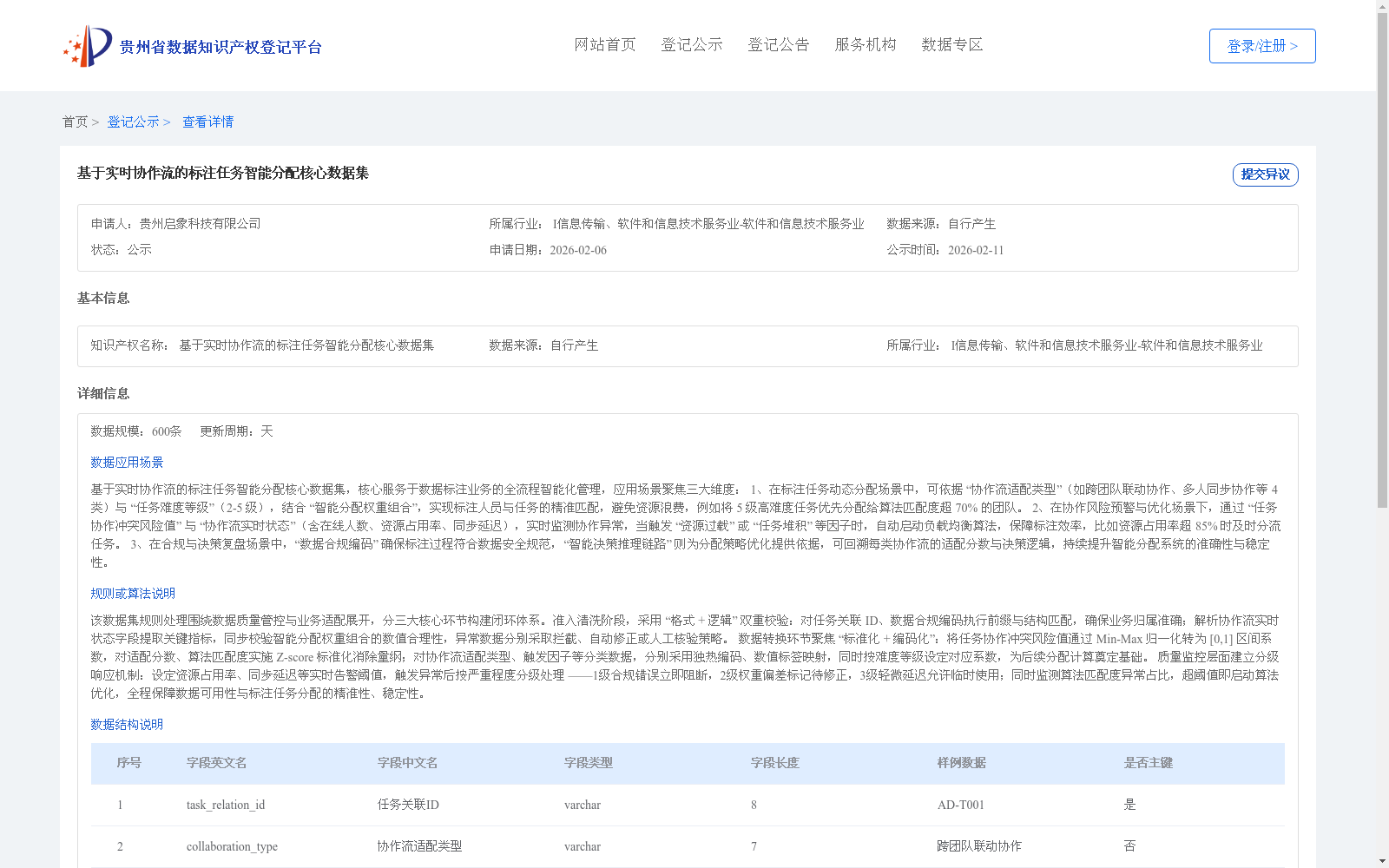
该数据集规则处理围绕数据质量管控与业务适配展开,分三大核心环节构建闭环体系。准入清洗阶段,采用 “格式 + 逻辑” 双重校验:对任务关联 ID、数据合规编码执行前缀与结构匹配,确保业务归属准确;解析协作流实时状态字段提取关键指标,同步校验智能分配权重组合的数值合理性,异常数据分别采取拦截、自动修正或人工核验策略。 数据转换环节聚焦 “标准化 + 编码化”:将任务协作冲突风险值通过 Min-Max 归一化转为 [0,1] 区间系数,对适配分数、算法匹配度实施 Z-score 标准化消除量纲;对协作流适配类型、触发因子等分类数据,分别采用独热编码、数值标签映射,同时按难度等级设定对应系数,为后续分配计算奠定基础。 质量监控层面建立分级响应机制:设定资源占用率、同步延迟等实时告警阈值,触发异常后按严重程度分级处理 ——1级合规错误立即阻断,2级权重偏差标记待修正,3级轻微延迟允许临时使用;同时监测算法匹配度异常占比,超阈值即启动算法优化,全程保障数据可用性与标注任务分配的精准性、稳定性。
This dataset's rule processing centers on data quality control and business adaptation, and constructs a closed-loop system through three core links. In the access and cleaning phase, a dual verification mechanism of "format + logic" is applied: the prefixes and structures of task-related IDs and data compliance codes are matched to ensure accurate business attribution; the real-time status field of the collaborative workflow is parsed to extract key indicators, and the numerical rationality of the intelligently assigned weight combination is synchronously verified. For abnormal data, interception, automatic correction or manual verification strategies are adopted respectively. The data conversion phase focuses on "standardization + encoding": the task collaboration conflict risk value is converted into a [0,1] interval coefficient via Min-Max normalization, while the adaptation score and algorithm matching degree are standardized by Z-score to eliminate dimensional differences; for classified data such as collaborative workflow adaptation types and trigger factors, one-hot encoding and numerical label mapping are used separately, and corresponding coefficients are set according to difficulty levels, laying a foundation for subsequent allocation calculations. The quality monitoring layer establishes a hierarchical response mechanism: real-time alarm thresholds are set for indicators such as resource occupancy rate and synchronization delay. Once an abnormality is triggered, it is processed hierarchically based on severity — Level 1 compliance errors are blocked immediately, Level 2 weight deviations are marked for correction, and Level 3 minor delays are allowed for temporary use; meanwhile, the abnormal proportion of algorithm matching degree is monitored, and algorithm optimization is initiated when the threshold is exceeded, so as to fully guarantee data availability as well as the accuracy and stability of annotation task allocation throughout the process.