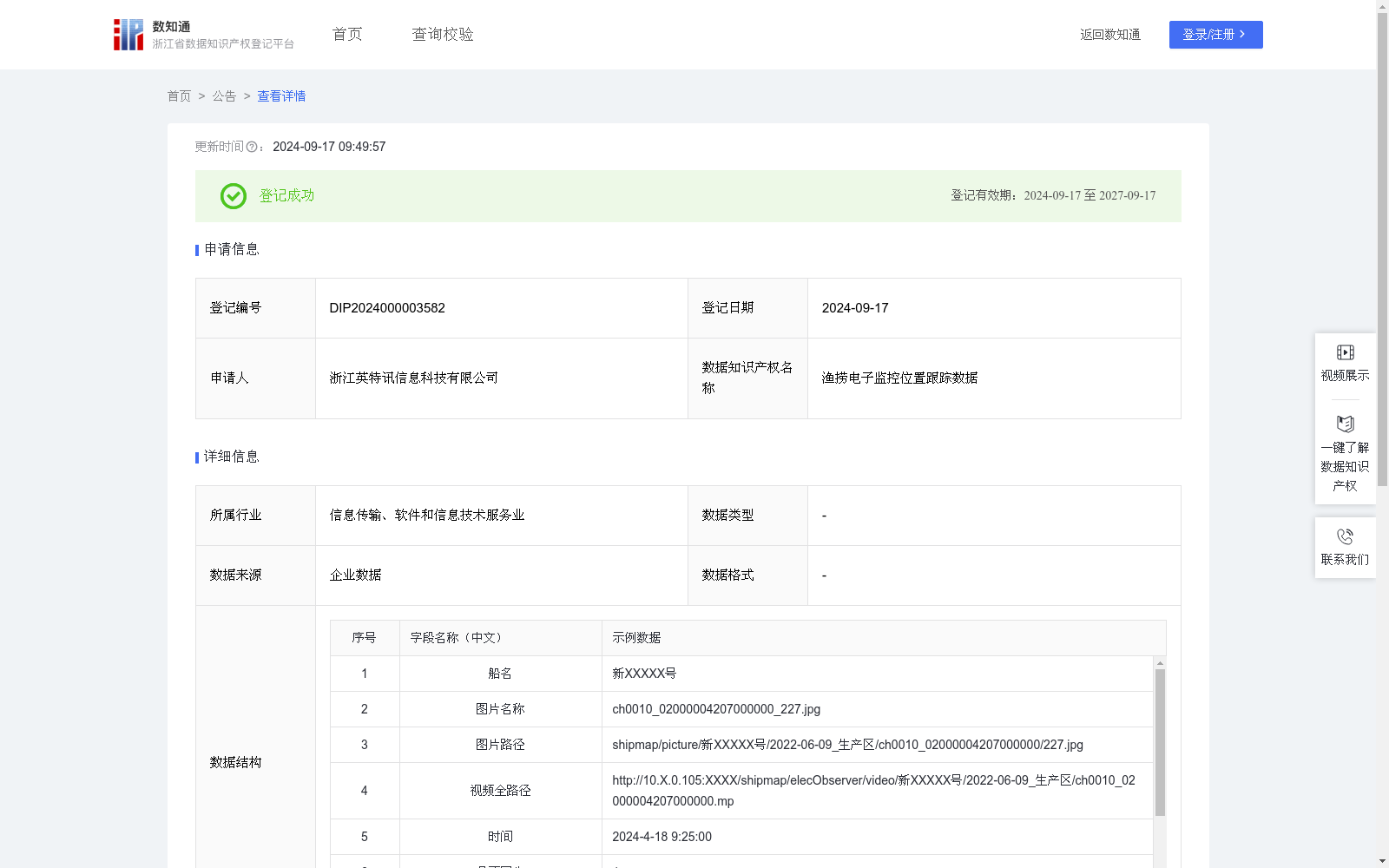
渔捞电子监控位置跟踪数据
收藏资源简介:
渔业监管部门需要对船端捕鱼行为进行监管,方式是在船端重要工作区域安装摄像头,岸端管理平台能够随时调取查看当前视频及历史视频。但视频量太大,捕鱼活动往往只持续一段时间,大量时间做的是无效工作,通过AI识别技术,将渔获信息识别并入库,通过标注操作,将视频中有渔获的画面标识出来,减轻监管部门工作人员查看视频的工作量。1、数据采集:通过摄像头采集船端捕鱼活动视频,并将数据保存至船端存储设备。 2、数据导入:将船端存储设备拿到岸端,连接到系统内网中,通过系统界面导入到电子监控岸端管理平台,并按船舶名称分类。 3、渔获模型训练:将安装在船端的摄像头视频按一定频率截取画面,选取有鱼的图片作为训练素材,导入到AI识别模型中,之后在模型训练界面手动将图片中鱼的部分框起来,训练2000张以上即可识别该鱼种,完成模型的训练。4、鱼种识别:视频服务器按照一定频率截取视频中的画面,训练过的AI模型识别画面中的渔获,识别出来后,返回识别结果,即“鱼位置”字段,"score"表示相似度,"top"表示左上角坐标y值,"left"左上角坐标x值,"bottom"表示右下角坐标y值,"right"表示右下角坐标x值。 5、数据应用:系统前端根据鱼位置的坐标数据在原图中用矩形框起来,管理人员可以浏览识别出的图片,也可以根据识别记录的时间跳转到对应时间点的视频中,从而过滤掉无效画面,提高工作效率。
Fisheries Regulatory Authorities need to monitor onboard fishing activities. The current method installs cameras in key working areas onboard vessels, enabling the shore-side management platform to access and review real-time and historical videos at any time. However, the volume of video footage is extremely large, and fishing activities only last for a limited duration, with most time spent on ineffective work. By leveraging AI recognition technology, catch information can be identified and stored in a database, and manual annotation is used to mark frames containing catches in the videos, thereby reducing the workload of regulatory staff when reviewing videos. 1. Data Collection: Collect videos of onboard fishing activities via cameras, and store the collected data in vessel-side storage devices. 2. Data Import: Transport the vessel-side storage devices to the shore, connect them to the system's internal network, import the data into the electronic monitoring shore-side management platform via the system interface, and classify the data by vessel name. 3. Catch Recognition Model Training: Extract frames from the videos captured by the onboard cameras at a specified frequency, select images containing fish as training samples, and import them into the AI recognition model. Then, manually draw bounding boxes around the fish regions in the images via the model training interface. Training on more than 2,000 images allows the model to recognize the target fish species, completing the model training. 4. Fish Species Recognition: The video server extracts frames from the videos at a specified frequency, and the trained AI model recognizes the catches in the frames. After recognition, the model returns the recognition results, which include the "fish location" field. Specifically, "score" represents the similarity confidence, "top" represents the y-coordinate of the top-left corner, "left" represents the x-coordinate of the top-left corner, "bottom" represents the y-coordinate of the bottom-right corner, and "right" represents the x-coordinate of the bottom-right corner. 5. Data Application: The system frontend draws rectangular bounding boxes on the original image based on the coordinate data of the fish locations. Managers can browse the identified images, and also jump to the video at the corresponding time point via the timestamp of the recognition record, thus filtering out ineffective frames and improving work efficiency.