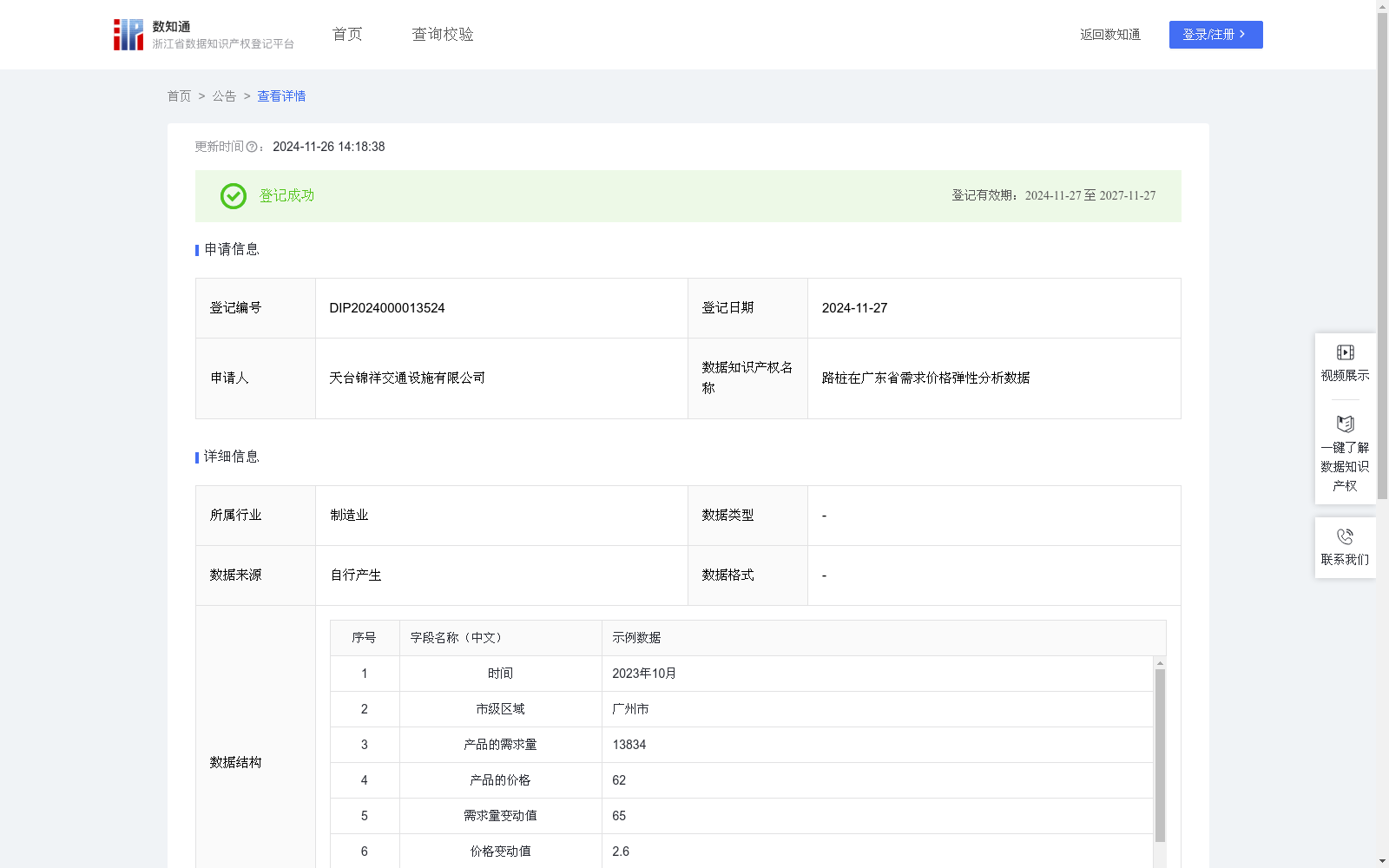
路桩在广东省需求价格弹性分析数据
收藏资源简介:
路桩主要用于交通安管管制,我县路桩产品在全国拥有较高的市场份额,为更好了解广东省各市对路桩的市场需求情况,需要对相关路桩需求弹性数据进行采集计算。相关行业的所有企业可以根据本数据分析的结果制定营销策略。如果路桩需求量变动的比率大于价格变动的比率,那么路桩需求富有弹性,说明顾客对于路桩价格变化的敏感程度大,弹性越大,需求对价格变化越敏感,本行业所有企业可以在该市适当的降低路桩价格来提高销量,获得较多的收益。如果路桩需求缺乏弹性,本行业所有企业可以在该市适当的提高路桩价格来提高价格,打造品牌效应。该项数据对本行业所有企业在广东省的市场营销决策有重要参考价值。算法规则简要说明:1.数据采集:采集相关路桩在某一时间段广东省的的需求数据和价格数据,按照市级进行整理归纳,得到该路桩的需求量变动数值和价格变化数值。 2.算法规则:对采集得到的数据按照如下公式进行计算:需求弹性系数Ed=-(△Q/Q)÷(△P/P),得到需求弹性系数。式中:Q表示产品的需求量,单位为份;P表示产品的价格,单位为元;△Q表示需求量变动值,单位为份;△P表示价格变动值,单位为元。取需求弹性系数的绝对值|Ed|作为分析数据时的参考系数。 3.数据分析:根据|Ed|的数值可分析该路桩的需求价格弹性。(1)|Ed|=1(单位需求价格弹性),说明需求量变动幅度与价格变动幅度相同;(2)1<|Ed|(需求富有弹性),说明需求量变动幅度大于价格变动幅度;(3)|Ed|<1(需求缺乏弹性),说明需求量变动幅度小于价格变动幅度。
Bollards are primarily used for traffic safety management and control. Our county's bollard products hold a relatively high national market share. To gain a better understanding of municipal bollard market demand across Guangdong Province, it is necessary to collect and calculate relevant bollard demand elasticity data. All enterprises in the relevant industry can formulate their marketing strategies based on the outcomes of this data analysis. If the ratio of change in bollard demand exceeds the ratio of price change, the demand for bollards is deemed price elastic, meaning customers are highly sensitive to fluctuations in bollard prices. The higher the elasticity, the more sensitive demand is to price changes. All enterprises in this industry can appropriately reduce bollard prices in the corresponding city to boost sales volume and achieve greater revenues. If the demand for bollards is price inelastic, all enterprises in this industry can appropriately increase bollard prices in the corresponding city to enhance total revenues and build brand influence. This data holds significant reference value for all enterprises in this industry when making marketing decisions within Guangdong Province. Brief Algorithm Rules: 1. Data Collection: Collect demand and price data of relevant bollards in Guangdong Province over a specified time period, organize and aggregate the data at the municipal level to obtain the change values of bollard demand volume and price changes. 2. Algorithm Calculation: Compute the collected data using the following formula to derive the demand elasticity coefficient Ed: Ed = -(ΔQ/Q) ÷ (ΔP/P) Where: Q denotes the product demand volume, with the unit being unit(s); P denotes the product price, with the unit being yuan; ΔQ denotes the change in demand volume, with the unit being unit(s); ΔP denotes the change in price, with the unit being yuan. Take the absolute value of the demand elasticity coefficient |Ed| as the reference coefficient for data analysis. 3. Data Analysis: Analyze the price elasticity of demand for bollards based on the value of |Ed|: (1) |Ed| = 1 (Unitary price elasticity of demand): The magnitude of change in demand is identical to that of price change; (2) 1 < |Ed| (Price elastic demand): The magnitude of change in demand is greater than that of price change; (3) |Ed| < 1 (Price inelastic demand): The magnitude of change in demand is smaller than that of price change.