
Diethyldithiocarbamate-Cu<sub>4</sub>O<sub>3</sub> nanocomplex induced mitochondrial and telomerase dysfunction in non-small cell lung cancer
收藏DataCite Commons2025-06-02 更新2025-09-08 收录
下载链接:
https://tandf.figshare.com/articles/dataset/Diethyldithiocarbamate-Cu_sub_4_sub_O_sub_3_sub_nanocomplex_induced_mitochondrial_and_telomerase_dysfunction_in_non-small_cell_lung_cancer/29087223
下载链接
链接失效反馈官方服务:
资源简介:
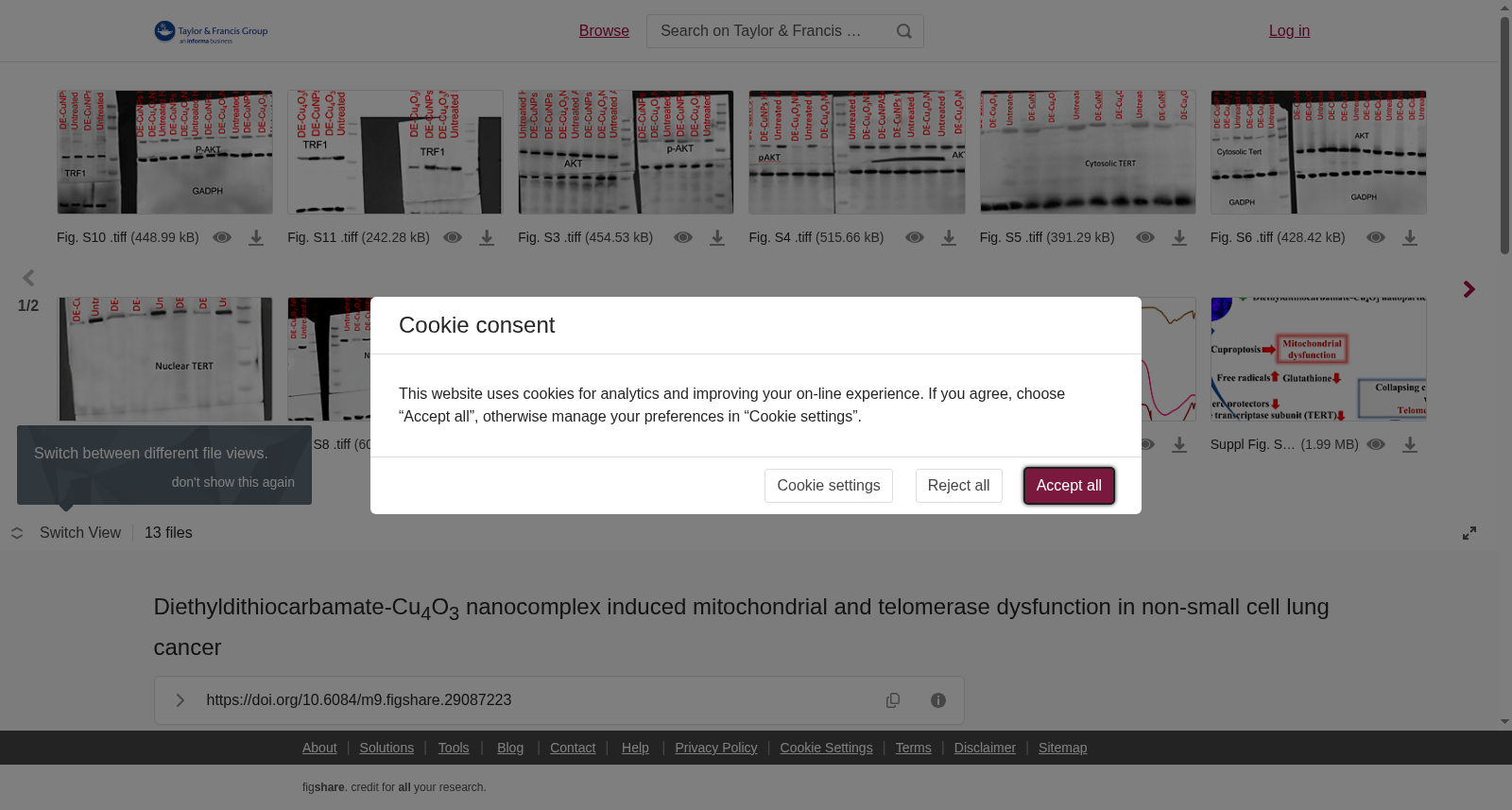
Targeting cancer stem cells (CSCs)-mediated aggressive features of non-small cell lung cancer (NSCLC) is a promising anticancer approach. This can be accomplished via suppressing critical mediators, such as functional mitochondria, aldehyde dehydrogenase (ALDH)1A, and telomere protectors (telomerase reverse transcriptase (TERT) and telomere repeat binding factor (TRF)1). Copper nanocomplexes (diethyldithiocarbamate (DE)-Cu<sub>4</sub>O<sub>3</sub> nanoparticles (NPs) and DE-Cu NPs) were prepared using the simplest green chemistry method and assessed for inducing mitochondrial dysfunction-dependent non-apoptotic pathway (cuproptosis) and repressing CSC markers. DE-Cu<sub>4</sub>O<sub>3</sub> NPs had higher growth inhibition for NSCLC (A549, H520, and H1299) spheroids than DE-Cu NPs. DE-Cu<sub>4</sub>O<sub>3</sub> NPs had higher uptake rate and prooxidant effect resulting in lower mitochondrial membrane potential and mitochondrial DNA copy number, as well as stronger inhibition of telomerase and ALDH1A than DE-Cu NPs. This caused dramatic redox imbalance and lowering AKT pathway (activator of telomere stabilizers and stemness)-mediated repression of TERT and TRF1 protein levels as well as phosphorylated NF-κB subunit (p65) led to collapsing telomeres, as evidenced by downregulating TERT regulators and confocal microscopy. In animal study, this active nanocomplex revealed powerful and selective therapeutic tumor-targeting effects, with no evidence of toxicity to healthy tissues. DE-Cu<sub>4</sub>O<sub>3</sub> nanocomplex is deemed as promising nanomedicine for NSCLC.
靶向癌症干细胞(cancer stem cells, CSCs)介导的非小细胞肺癌(non-small cell lung cancer, NSCLC)侵袭性表型是一种极具前景的抗癌策略。该策略可通过抑制关键介质实现,例如功能性线粒体、醛脱氢酶(aldehyde dehydrogenase, ALDH)1A以及端粒保护因子:端粒酶逆转录酶(telomerase reverse transcriptase, TERT)和端粒重复结合因子(telomere repeat binding factor, TRF)1。研究采用最简绿色化学方法制备了铜纳米复合物(二乙基二硫代氨基甲酸盐(diethyldithiocarbamate, DE)-Cu₄O₃纳米颗粒(nanoparticles, NPs)与DE-Cu NPs),并评估其诱导线粒体功能障碍依赖性非凋亡通路(铜死亡(cuproptosis))以及抑制癌症干细胞标志物的能力。相较于DE-Cu NPs,DE-Cu₄O₃ NPs对非小细胞肺癌(A549、H520与H1299)细胞球的生长抑制效果更强。DE-Cu₄O₃ NPs具有更高的细胞摄取率与促氧化效应,可导致更低的线粒体膜电位与线粒体DNA拷贝数,同时相较于DE-Cu NPs,其对端粒酶与ALDH1A的抑制作用更为显著。这引发了显著的氧化还原失衡,并降低了作为端粒稳定因子与干细胞干性激活剂的AKT通路活性,进而介导了TERT与TRF1蛋白水平的抑制;同时磷酸化NF-κB亚基(p65)可诱导端粒崩解,该结论通过下调TERT调控因子与共聚焦显微镜成像得到了验证。在动物实验中,该活性纳米复合物展现出强效且具有选择性的肿瘤靶向治疗效果,未观察到对健康组织的毒性反应。DE-Cu₄O₃纳米复合物被认为是一种极具前景的非小细胞肺癌纳米药物。
提供机构:
Taylor & Francis创建时间:
2025-05-16
搜集汇总
数据集介绍
以上内容由遇见数据集搜集并总结生成

暂无相关数据集


