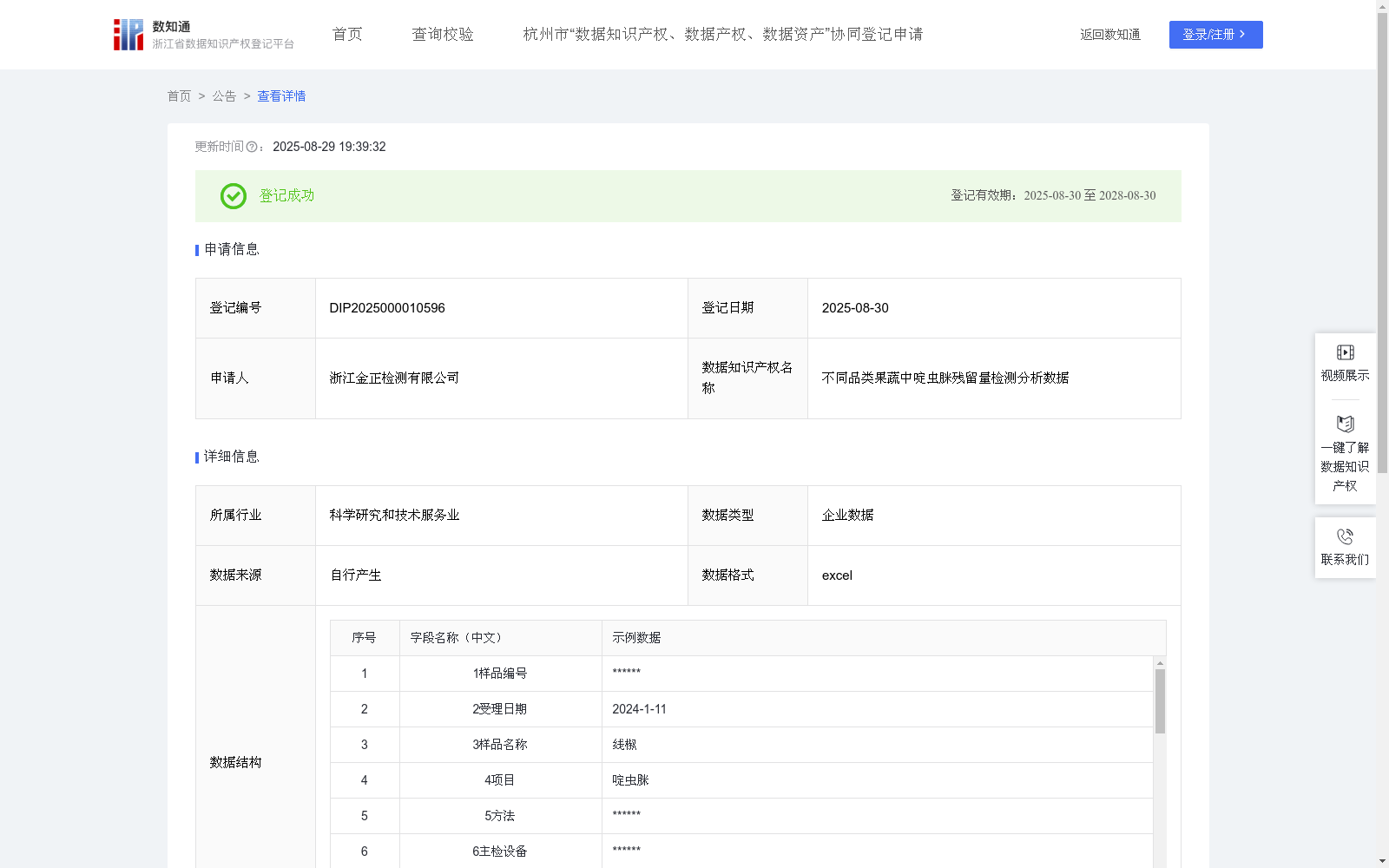
不同品类果蔬中啶虫脒残留量检测分析数据
收藏资源简介:
农药残留是植物源性食品的主要安全问题之一,近年来果蔬中啶虫脒农药残留也常有检出,啶虫脒是一种氯代烟碱类杀虫剂,具有触杀、胃毒和内吸作用,对蚜虫等有较好防效。虽然啶虫脒的毒性相对较低,但如果短时间内摄入大量啶虫脒,仍可能导致急性中毒,在严重的情况下,可能会出现意识障碍或昏迷。长期食用啶虫脒超标的食品,尽管不会立即引起急性中毒,但可能会对身体健康产生累积效应。这包括对神经系统、内分泌系统等的潜在影响,以及可能增加患某些疾病的风险。 因此通过对果蔬中啶虫脒残留量的检测分析,能够进一步了解各品类果蔬中啶虫脒残留情况和风险情况。通过合格率了解易超标的风险品种,通过不合格占比了解年度重点监管品类,从而加强对果蔬中啶虫脒等农药残留情况的关注,为种植业合理使用农残具有指导意义,也为监管单位进行农药残留专项监管提供数据支持。1、数据采集:根据要求采集果蔬样品并进行样品制备,依据检测方法进行定量分析,获得检测结果值。2、数据处理:通过定量分析获得结果值,依据GB 2763设定标准值,当结果值≤标准值时,判定合格;否则判定不合格;该细类当年合格率=该细类当年检测合格批次数A/该细类当年检测批次N*100%,保留两位小数;总不合格数M为当年果蔬中噻虫嗪不合格数之和,该细类不合格占比=该细类不合格数X/总不合格数M*100%,保留两位小数;该品种不合格占比=该品种不合格数Y/总不合格数M*100%,保留两位小数。当该细类当年合格率≥99.0%时,风险评价=LR,当99%>该细类当年合格率≥95%时,风险评价=MR,当该细类当年合格率<95%时,风险评价=HR。3、数据应用:对各果蔬中噻虫嗪残留量进行检测分析,可以了解不同品类果蔬中啶虫脒残留情况,通过风险评价了解易超标的风险品种,通过不合格占比了解年度监管品类不合格总体情况,从而加强对果蔬中噻虫嗪等农药残留情况的关注,为生产单位合理使用农残具有参考意义,也为监管单位进行农药残留专项监管提供数据支持。
Pesticide residues are one of the major safety issues for plant-derived foods. In recent years, acetamiprid residues in fruits and vegetables have been frequently detected. Acetamiprid is a chloronicotinyl insecticide with contact toxicity, stomach toxicity and systemic action, which exhibits good control efficacy against aphids and other pests. Although the toxicity of acetamiprid is relatively low, acute poisoning may still occur if a large amount of acetamiprid is ingested within a short period, and in severe cases, disturbance of consciousness or coma may develop. Long-term consumption of foods exceeding acetamiprid limits may not cause immediate acute poisoning, but may produce cumulative effects on human health, including potential impacts on the nervous and endocrine systems, and may increase the risk of developing certain diseases. Therefore, detection and analysis of acetamiprid residues in fruits and vegetables can further clarify the residue status and risk profile of acetamiprid in different categories of fruits and vegetables. The risk-prone varieties that easily exceed the standard can be identified via the pass rate, and the key annual regulatory categories can be determined via the non-conforming proportion, thereby strengthening the attention to pesticide residues such as acetamiprid in fruits and vegetables. This provides guidance for the rational use of pesticides in the planting industry, and also offers data support for regulatory authorities to carry out special supervision on pesticide residues. 1. Data Collection: Collect fruit and vegetable samples and prepare them according to requirements, perform quantitative analysis in accordance with the detection methods to obtain the detection result values. 2. Data Processing: Obtain the result values through quantitative analysis, and set the standard values in accordance with GB 2763. A sample is judged as qualified when the result value ≤ the standard value, otherwise it is judged as non-conforming. The annual pass rate of the subgroup is calculated as (number of qualified batches A of the subgroup in the current year / total number of tested batches N of the subgroup in the current year) × 100%, rounded to two decimal places. The total number of non-conforming items M is the sum of non-conforming counts of thiamethoxam in fruits and vegetables in the current year. The non-conforming proportion of the subgroup is calculated as (non-conforming count X of the subgroup / total non-conforming count M) × 100%, rounded to two decimal places. The non-conforming proportion of the variety is calculated as (non-conforming count Y of the variety / total non-conforming count M) × 100%, rounded to two decimal places. When the annual pass rate of the subgroup ≥ 99.0%, the risk assessment is LR; when 99% > annual pass rate ≥ 95%, the risk assessment is MR; when the annual pass rate of the subgroup < 95%, the risk assessment is HR. 3. Data Application: Detection and analysis of thiamethoxam residues in various fruits and vegetables can help understand the acetamiprid residue status in different categories of fruits and vegetables. The risk-prone varieties that easily exceed the standard can be identified via the risk assessment, and the overall non-conforming status of annual regulatory categories can be understood via the non-conforming proportion, thereby strengthening the attention to pesticide residues such as thiamethoxam in fruits and vegetables. This provides reference for the rational use of pesticides by production units, and also offers data support for regulatory authorities to carry out special supervision on pesticide residues.