
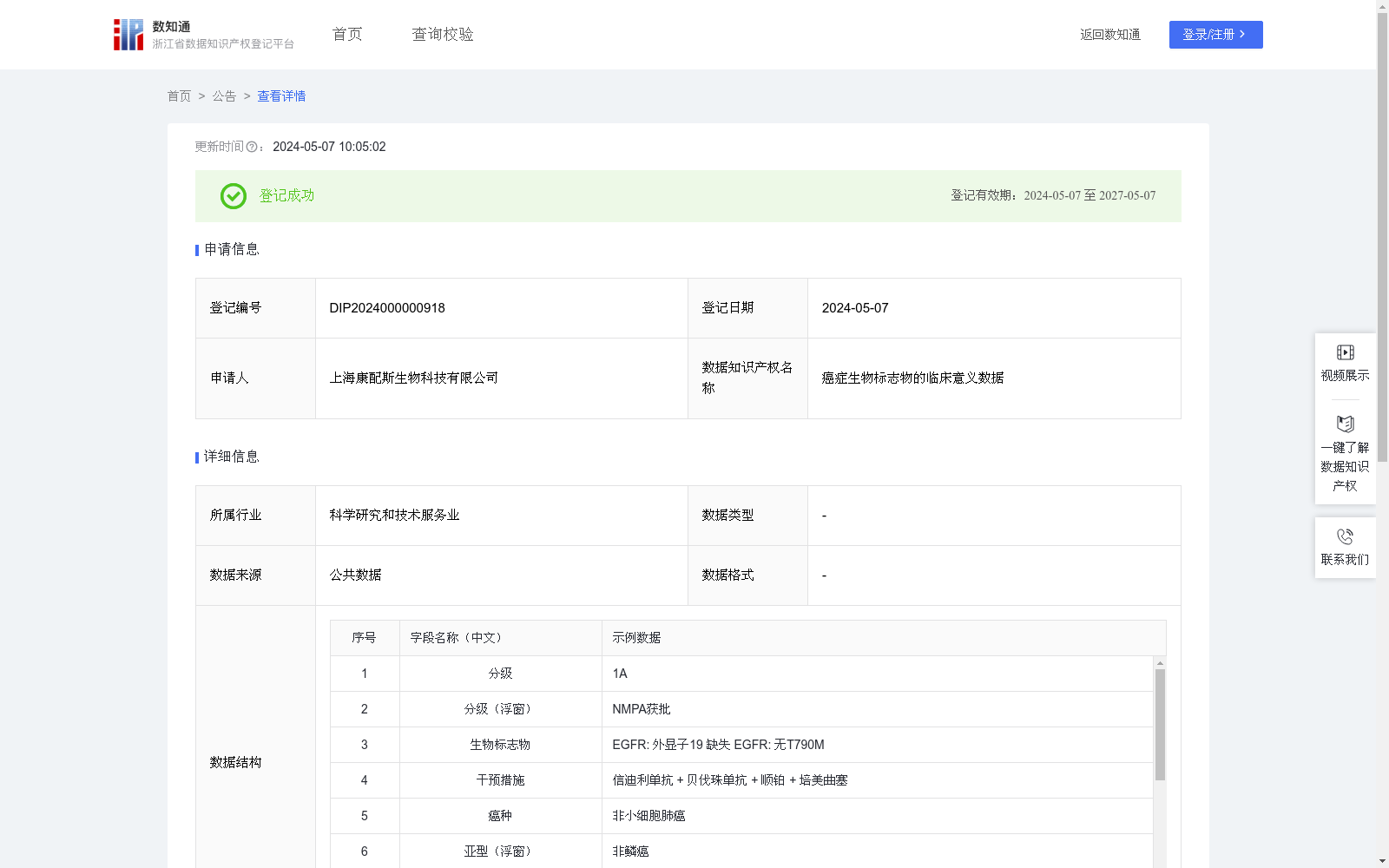
癌症生物标志物的临床意义数据
收藏浙江省数据知识产权登记平台2024-05-07 更新2024-05-08 收录
下载链接:
https://www.zjip.org.cn/home/announce/trends/33067
下载链接
链接失效反馈官方服务:
资源简介:
条件:适用于了解癌症诊疗过程中生物标志物检测的临床意义。具体可用于:1)生物标志物检测结果的医学解读;2)生物标志物检测开发时,辅助制定检测的靶点;3)癌症诊疗过程中,指导需要接受的生物标志物检测。
范围:癌症相关的生物标志物检测
对象:生物标志物检测供应商、临床医生、癌症患者或高风险人群、科研学术工作者
解决的主要问题:癌症生物标志物的数据库通过收集和整理获批药物、文献等不同来源的证据,可有效的规范和标准化生物标志物检测结果的解读。然而,目前的数据库依然存在一些问题:1)未有考虑到患者的治疗线数、治疗史要求等详细的适应症要求,容易造成错误的解读;2)未有考虑到多标志物同时检出的情况,只是单纯记录了单一标志物对癌症诊疗的指导意义;3)未有考虑到多种类标志物的临床意义,只单一的收集了基因或蛋白层面等的生物标志物,无法做到全面的解读分析。这些问题导致无法准确说明生物标志物检测的临床意义,从而增加了人工解读的成本,甚至可能引起误导并影响受检者的临床管理策略。本数据库主要针对上述问题优化了癌症生物标志物数据库的结构和内容,旨在帮助对相关检测的结果进行更精确的解读,辅助精准医疗真正惠及癌症患者。“干预措施”的内容需要统一为通用名,如有联合用药或增降剂量、序贯治疗等特殊要求,需按统一格式录入,确保不同癌种、场景下的临床意义具有互通性。
“生物标志物”的内容共分为5个种类,基因类、蛋白类、表观遗传类、感染类和复杂标志物类,需人工判断并进行标识;如有多种生物标志物同时检出具有特殊临床意义的情况,需分别单独录入,以准确区分单个和多个生物标志物的临床意义。
“分期”和“癌种”都需进行分层级记录,例如“不可切除>转移性>肝转移”和“实体瘤>呼吸系统肿瘤>肺癌>非小细胞肺癌”,确保筛选时所有相关分期和癌种的临床意义都能全面、准确的显示出来。
“治疗史”需分别录入“要求既往未接受的治疗”和“要求既往接受过的治疗”,并将“要求的治疗效果”等特殊情况记录到“治疗史(备注)”中,以准确区分不同的“治疗史”要求。
“支持依据”以DOI的形式链接到对应网页,确保唯一性。
“分级”需人工判读每条临床意义的内容,并给出相符的证据等级,包括1A、1B、2A、2B和3类,方便用户直观了解该临床意义的可靠性。
所有由编辑团队录入的临床意义都需要由临床专家组成的顾问团队进行复核,确保内容的医学解读准确无误。
Conditions: Applicable for understanding the clinical significance of biomarker testing during cancer diagnosis and treatment. Specifically, it can be used for:
1) Medical interpretation of biomarker test results;
2) Assisting in formulating detection targets during the development of biomarker tests;
3) Guiding required biomarker testing during cancer diagnosis and treatment.
Scope: Cancer-related biomarker testing
Target users: Biomarker test suppliers, clinicians, cancer patients or high-risk populations, and academic researchers
Core problems addressed: Existing cancer biomarker databases collect and organize evidence from multiple sources such as approved drugs and literature, which can effectively standardize the interpretation of biomarker test results. However, current databases still have several limitations:
1) They fail to consider detailed indication requirements such as the number of prior treatment lines and patients' treatment history, which may lead to incorrect interpretation;
2) They do not account for concurrent detection of multiple biomarkers, only simply recording the guiding significance of a single biomarker for cancer diagnosis and treatment;
3) They do not cover the clinical significance of multiple types of biomarkers, only collecting biomarkers at the gene or protein level alone, failing to conduct comprehensive interpretation and analysis.
These issues prevent accurate clarification of the clinical significance of biomarker testing, thereby increasing the cost of manual interpretation, and may even cause misguidance and affect the clinical management strategies of test recipients.
This database optimizes the structure and content of the cancer biomarker database targeting the above problems, aiming to help conduct more accurate interpretation of relevant test results and assist precision medicine in truly benefiting cancer patients.
The content of "interventions" shall be uniformly recorded under their generic names. If there are special requirements such as combined medication, dose adjustment, sequential therapy, etc., they shall be entered in a unified format to ensure the interoperability of clinical significance across different cancer types and scenarios.
The content of "biomarkers" is divided into 5 categories: genetic, protein, epigenetic, infectious, and complex biomarkers, which need to be identified through manual judgment. If concurrent detection of multiple biomarkers has special clinical significance, they shall be entered separately to accurately distinguish the clinical significance of single and multiple biomarkers.
Both "stage" and "cancer type" shall be recorded hierarchically, for example, "unresectable > metastatic > liver metastasis" and "solid tumor > respiratory tumor > lung cancer > non-small cell lung cancer", to ensure that the clinical significance of all relevant stages and cancer types can be displayed comprehensively and accurately during screening.
For "treatment history", "requirements for prior untreated therapy" and "requirements for prior received therapy" shall be entered separately, and special situations such as "required therapeutic effect" shall be recorded in "treatment history (notes)" to accurately distinguish different "treatment history" requirements.
The "supporting evidence" shall be linked to the corresponding webpage in the form of DOI to ensure uniqueness.
The "evidence level" shall be manually judged for each clinical significance entry, and the corresponding evidence grades including 1A, 1B, 2A, 2B and 3 shall be given, so that users can intuitively understand the reliability of the clinical significance.
All clinical significance entries entered by the editorial team shall be reviewed by an advisory team composed of clinical experts to ensure the accuracy of the medical interpretation.
提供机构:
上海康配斯生物科技有限公司创建时间:
2024-04-06
搜集汇总
数据集介绍
特点
该数据集包含7008条关于癌症生物标志物临床意义的数据,涵盖生物标志物、干预措施、癌种、治疗史等信息,旨在优化生物标志物检测结果的解读,辅助精准医疗。数据来源于公共数据,按需更新,适用于生物标志物检测供应商、临床医生、癌症患者及科研工作者。
以上内容由遇见数据集搜集并总结生成

暂无相关数据集


