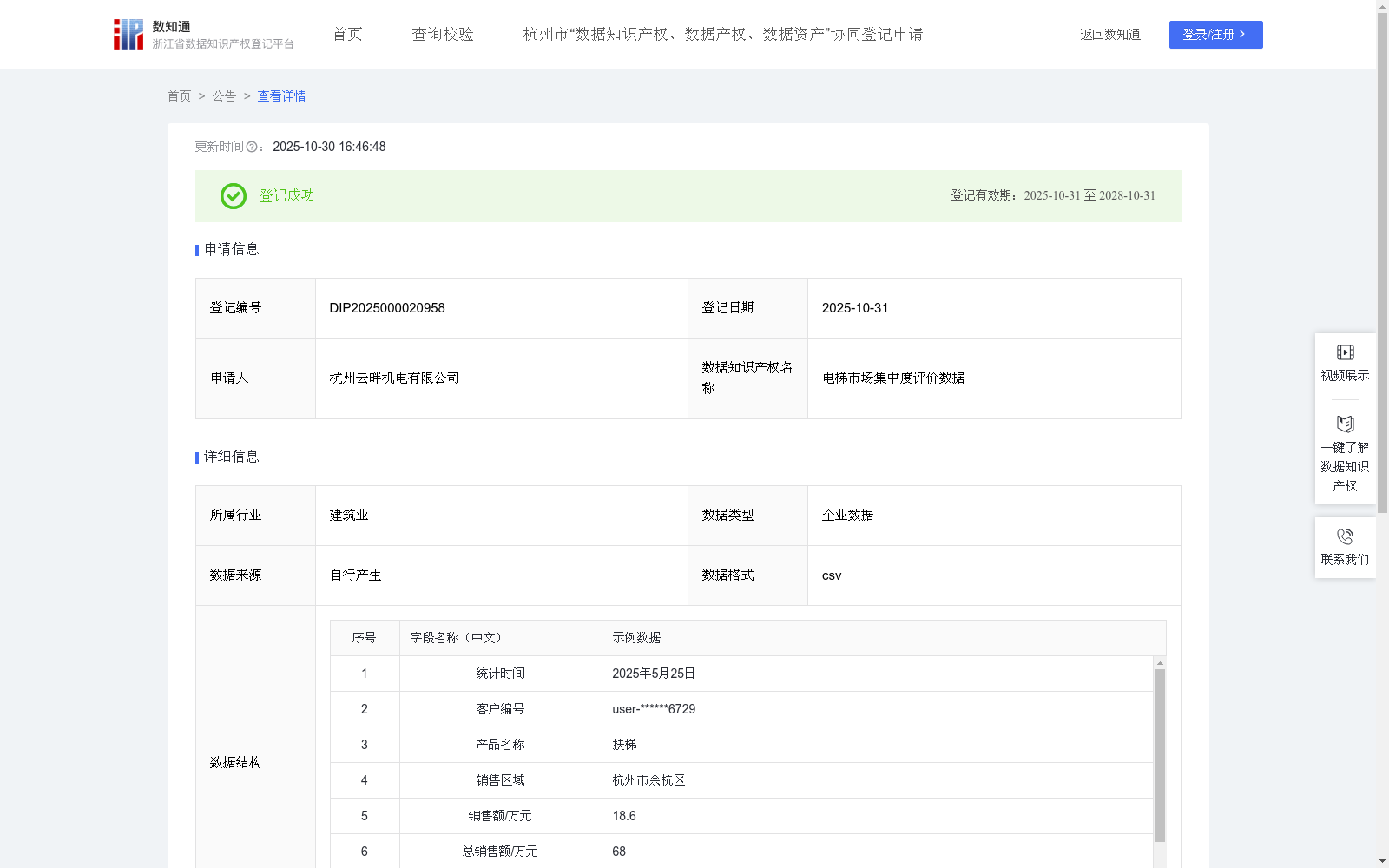
电梯市场集中度评价数据
收藏资源简介:
电梯市场集中度评价数据聚焦于分析电梯行业的竞争格局与市场份额分布,揭示了行业内主要整机制造商、维保服务商及区域市场参与者的集中程度与份额占比情况。对于电梯企业而言,这些数据有助于识别市场竞争态势,判断市场是处于寡头主导、集中竞争还是分散格局,进而制定差异化的市场进入、品牌定位与业务拓展策略,通过技术升级、服务优化或区域深耕提升市场份额。对于电梯零部台供应商、安装工程合作单位、维保外包服务商及物流配套企业而言,理解市场集中度有助于精准锁定核心客户群体,根据头部企业或区域主导者的分布调整合作方向与资源投入,优化供应链布局与服务响应机制,提升与主流厂商的协同效率,增强在细分市场的适应力与长期合作稳定性。1.数据采集:收集公司电梯的销售数据,具体包括:统计时间、客户编号、产品名称、销售区域、销售额/万元、总销售额/万元。 2.数据处理:去除异常值和重复数据,确保数据的准确性和可靠性。将客户的销售额数据转换为市场份额Si,即销售额占总销售额的比例。 3.具体计算过程和公式:(1)市场份额Si计算:市场份额Si = 销售额 / 总销售额;(2)市场集中度指数CR计算:市场集中度指数CR = ∑(Si^2),其中Si代表第i个客户的市场份额(销售额占总销售额的比例)。 4.数据分类分级应用:根据市场集中度指数CR的大小,市场集中度指数CR的取值范围为0到1,将市场集中度分为:高集中度(0.7≤CR≤1);中集中度(0.4≤CR<0.7);低集中度(0≤CR<0.4)。
The elevator market concentration evaluation data focuses on analyzing the competitive landscape and market share distribution of the elevator industry, revealing the concentration level and share proportion of major complete elevator manufacturers, maintenance service providers, and regional market participants within the industry. For elevator enterprises, this data helps identify market competition trends, judge whether the market is dominated by oligopolies, featured by concentrated competition or a decentralized pattern, and then formulate differentiated market entry, brand positioning and business expansion strategies, so as to improve market share through technological upgrading, service optimization or regional in-depth cultivation. For elevator component suppliers, installation engineering cooperation partners, maintenance outsourcing service providers and logistics supporting enterprises, understanding market concentration helps accurately lock in core customer groups, adjust cooperation directions and resource investment according to the distribution of leading enterprises or regional dominant players, optimize supply chain layout and service response mechanisms, improve collaboration efficiency with mainstream manufacturers, and enhance adaptability in segmented markets and long-term cooperation stability. 1. Data Collection: Collect sales data of the company's elevators, specifically including: statistical time, customer ID, product name, sales region, sales amount (unit: 10,000 yuan), total sales amount (unit: 10,000 yuan). 2. Data Processing: Remove outliers and duplicate data to ensure the accuracy and reliability of the dataset. Convert the sales data of customers into market share Si, which refers to the proportion of a customer's sales in the total market sales. 3. Specific Calculation Procedures and Formulas: (1) Market share Si calculation: Market share Si = Sales amount / Total sales amount; (2) Market concentration index CR calculation: Market concentration index CR = ∑(Si²), where Si represents the market share of the i-th customer (the proportion of their sales in the total market sales). 4. Data Classification and Grading Application: Based on the value of the market concentration index CR, which ranges from 0 to 1, the market concentration is categorized into three levels: High concentration (0.7 ≤ CR ≤ 1); Medium concentration (0.4 ≤ CR < 0.7); Low concentration (0 ≤ CR < 0.4).