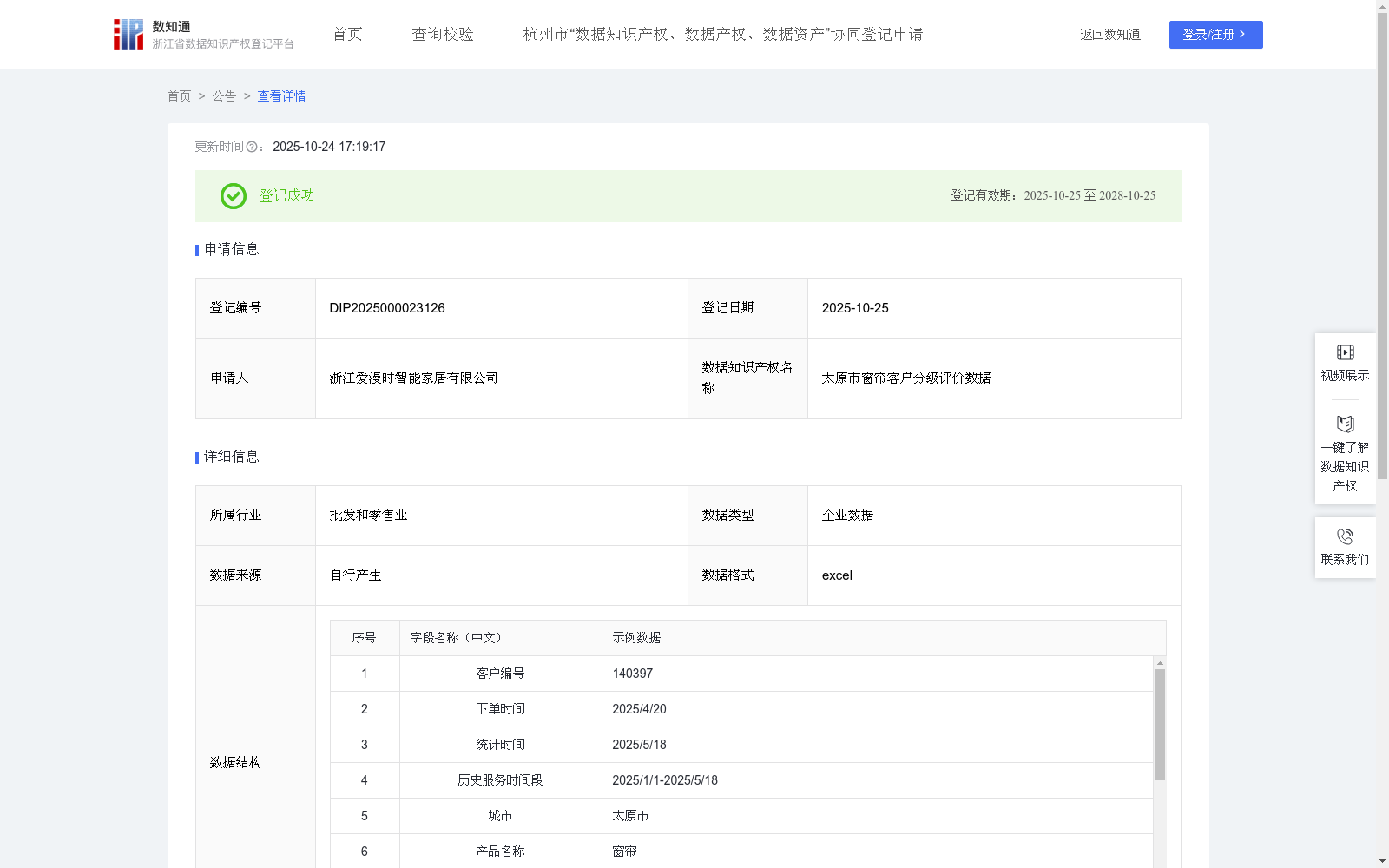
太原市窗帘客户分级评价数据
收藏资源简介:
通过收集和分析太原市客户对窗帘消费相关数据,使用RFM客户价值模型,了解客户对窗帘的购买力水平和消费偏好对客户进行等级评级,实现精准化运营,通过对客户价值管理,满足不同价值客户的个性化需求。对于A等级客户可每月1至2次与之沟通,对于B等级客户可每季度1至2次与之客户沟通,对于C等级客户可每半年1至2次与之沟通。另外可以为本地区客户群体高度重叠企业提供不同等级客户个性化服务的数据支持。1.数据采集:采集太原市客户对窗帘的相关交易数据。其中,采集数据中“下单时间”为距离统计时间最近的一次订单时间,“订单金额”指的是距离统计时间最近的这次订单金额,“历史购买总次数”“历史购买总金额”指的是历史服务时间段内统计得出的购买次数和购买金额。2.数据处理:对采集到本次订单金额(万元)、历史订单总金额(万元)等数据进行分类、合并、累加,便于分析使用,其中客户编号已进行脱敏转换处理。3.算法加工:R评分:根据用户下单时间距离统计时间的天数(D)划分为5个等级: 0≤D≤10为5分,10<D≤20为4分,20<D≤30为3分,30<D≤50为2分,50<D 为1分;F评分:消费频率评分根据历史购买总次数(S),划分为5个等级: 0<S≤2为1分,2<S≤5 为2分,5<S≤10 为3分,10<S≤15为4分,15<S为5分;M评分:根据历史购买总金额(Z),划分为5个等级,0<Z≤5为1分,5<Z≤10为2分,10<Z≤20为3分,20<Z≤40为4分,40<Z为5分;RFM综合评分(X)=0.3*R+0.4*F+0.6*M;会员等级分为ABC三级,0≤X≤3为C级,3<X≤6为B级,6<X 为A级
This dataset is constructed by collecting and analyzing curtain consumption-related data of customers in Taiyuan City, adopting the RFM customer value model to grade customers based on their purchasing power and consumption preferences, so as to realize precise operations and meet the personalized demands of customers with different value levels via customer value management. For Tier A customers, communicate with them 1 to 2 times per month; for Tier B customers, conduct communication 1 to 2 times per quarter; for Tier C customers, carry out communication 1 to 2 times every six months. Additionally, it can provide data support for enterprises with highly overlapping local customer groups to deliver personalized services for customers of different tiers. 1. Data Collection: Collect transaction data related to curtains for customers in Taiyuan City. Among the collected data, "order time" refers to the time of the most recent order relative to the statistical time, "order amount" refers to the amount of the most recent order relative to the statistical time, and "total historical purchase times" and "total historical purchase amount" refer to the total purchase times and total purchase amount calculated within the historical service period. 2. Data Processing: Classify, merge and accumulate the collected data including the current order amount (in ten thousand yuan) and total historical order amount (in ten thousand yuan) to facilitate analysis. Customer IDs have been processed with data desensitization and conversion. 3. Algorithm Processing: R Score: Divide the number of days (D) between the user's order time and the statistical time into 5 tiers: 0≤D≤10 for 5 points, 10<D≤20 for 4 points, 20<D≤30 for 3 points, 30<D≤50 for 2 points, and D>50 for 1 point. F Score: The consumption frequency score is divided into 5 tiers based on the total historical purchase times (S): 0<S≤2 for 1 point, 2<S≤5 for 2 points, 5<S≤10 for 3 points, 10<S≤15 for 4 points, and S>15 for 5 points. M Score: Divided into 5 tiers based on the total historical purchase amount (Z): 0<Z≤5 for 1 point, 5<Z≤10 for 2 points, 10<Z≤20 for 3 points, 20<Z≤40 for 4 points, and Z>40 for 5 points. RFM Comprehensive Score (X) = 0.3*R + 0.4*F + 0.6*M. Customer membership tiers are divided into three levels: Tier C for 0≤X≤3, Tier B for 3<X≤6, and Tier A for X>6.