污泥掺烧精准喷氨数据
收藏资源简介:
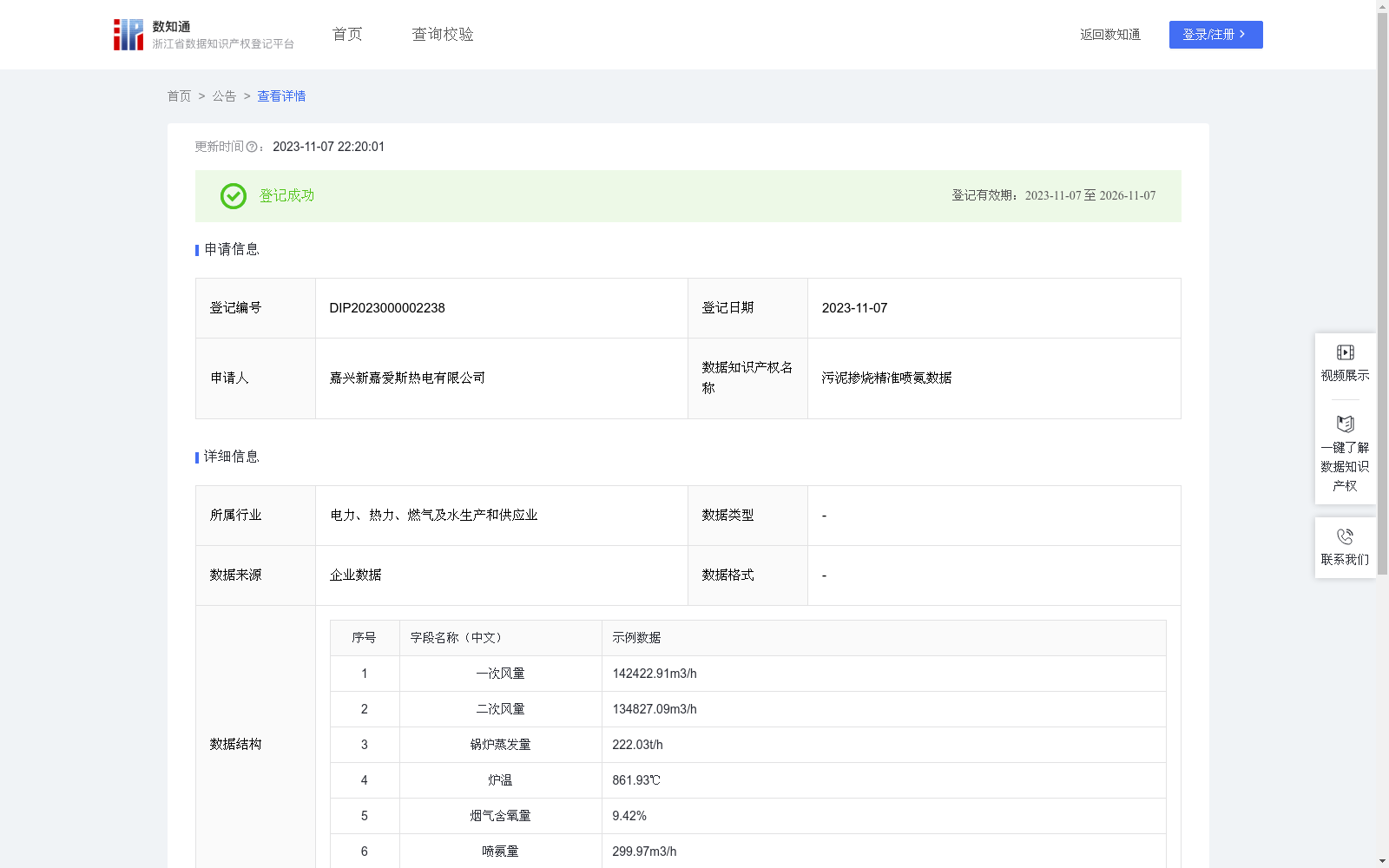
通过污泥掺烧精准喷氨数据,可以准确控制喷氨量,以此降低污泥掺烧烟气氮氧化物排放值的波动,使得污泥掺烧烟气氮氧化物排放量符合污染物排放标准;同时精准喷氨可以减少氨逃逸,缓解下游设备的积灰与腐蚀,降低烟气运行阻力,节约风机能耗。此外,精准喷氨有效减少了氨水的使用量,降低了运行成本,提升了生产效率。根据DCS系统中的锅炉蒸发量H、一次风量V1、二次风量V2、烟气含氧量O、炉温T,利用氮氧化物预测模型算法测算喷氨流量L,算法可简单表示为L=αH+θV1+ηV2+λO+μT;α、θ、η、λ、μ是由污泥掺烧、锅炉参数等多因素决定的半经验系数,属于商业秘密,故不作详细列举。
Precise ammonia injection data derived from sludge co-combustion processes enables accurate control of ammonia injection volume, thereby reducing fluctuations in nitrogen oxide (NOₓ) emission levels from sludge co-combustion flue gas and ensuring that NOₓ emissions comply with national pollutant discharge standards. Meanwhile, precise ammonia injection can reduce ammonia slip, alleviate ash deposition and corrosion on downstream equipment, lower flue gas operating resistance, and save fan energy consumption. Furthermore, this precise ammonia injection strategy effectively cuts down ammonia water consumption, reduces operational costs, and enhances production efficiency. Based on the boiler evaporation capacity H, primary air flow V1, secondary air flow V2, flue gas oxygen content O, and furnace temperature T collected from the DCS (Distributed Control System), the ammonia injection flow L is calculated via a NOₓ prediction model algorithm, which can be simply expressed as L=αH+θV1+ηV2+λO+μT. The coefficients α, θ, η, λ, and μ are semi-empirical values determined by multiple factors such as sludge co-combustion conditions and boiler parameters, which are trade secrets and thus not elaborated in detail.