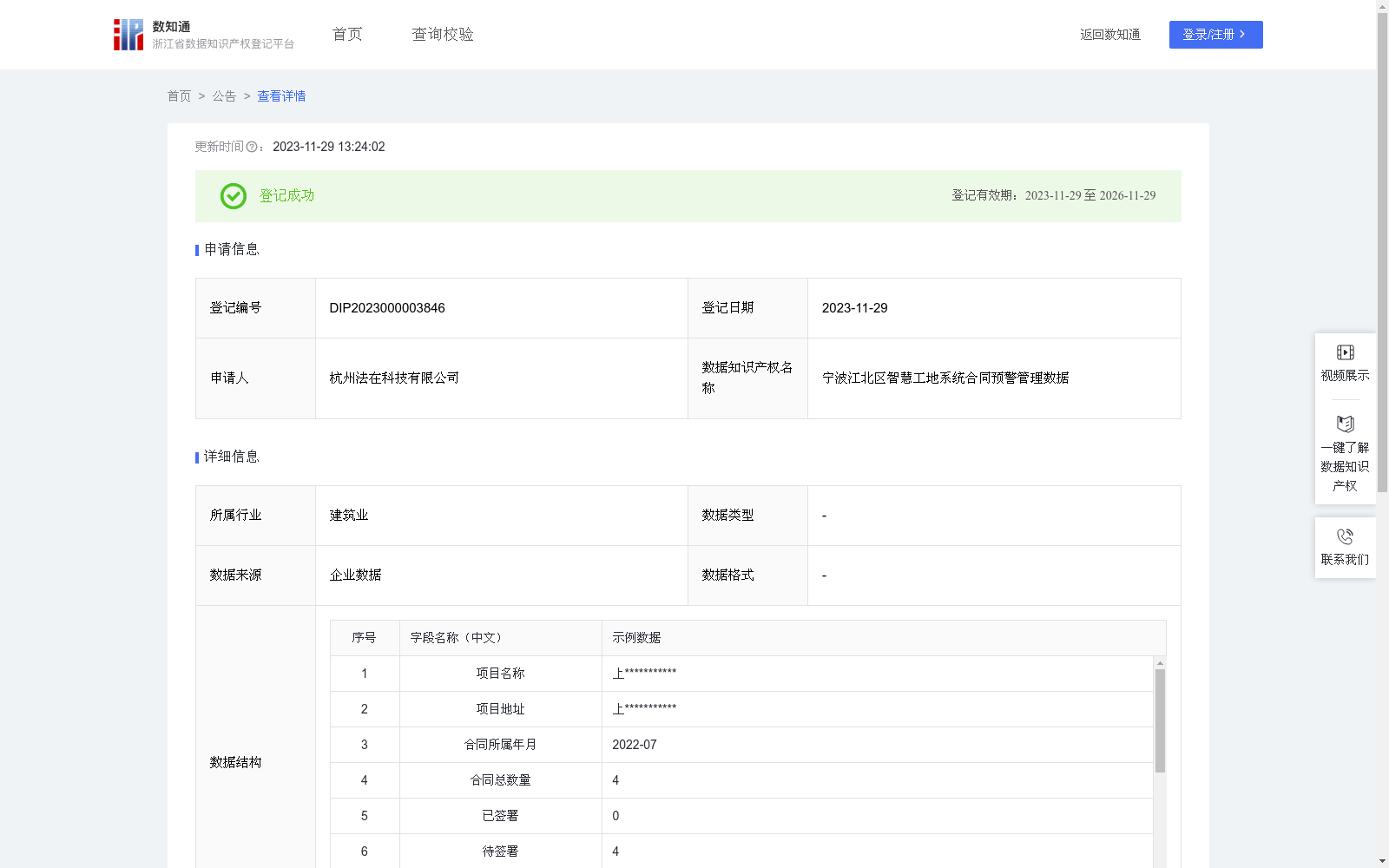
宁波江北区智慧工地系统合同预警管理数据
收藏资源简介:
采集宁波江北区范围内合同信息线下通过设备和手动录入的方式采集数据到数据库作为原始数据源。最后通过BI工具,按区域工种进行分类统计,利用折线图体现每个地区工种的合同风险走势情况。推送给班组长、企业、劳务公司、监管部门。(1)数据采集:采集宁波江北区范围内合同信息线下通过设备和手动录入的方式采集数据到数据库作为原始数据源。 (2)数据处理:首先对采集的合同确认数据进行清洗,包括合同为0的或者为null的。然后对数据在时间维度按年,项目维度按企业,区域维度按区域,进行最细级别粒度的聚合。计算各工地的合同确认总数量,已签署数为已经确认合同的数量,待签署数为未确认合同数量, 离职申请中数为已签署合同申请离职中数量,已离职数为已签署合同离职数量,超时未处理数量指合同发起后七天未完成的数量,超时未处理比例=超时未处理数量/总数量,超时未离职数量指提出离职七天未完成数量,超时未离职比例=超时未离职数/已离职数。 (3)数据分析: 低风险数=0%<超时未处理比例<5%、0%<超时未离职比例<5%,中风险数=5%<超时未处理比例<10%、5%<超时未离职比例<10%,高风险数=超时未处理比例>10%、超时未离职比例>10%。
This dataset centers on contract information within Jiangbei District, Ningbo. The original data source is obtained by collecting contract information into the database via offline devices and manual entry. Thereafter, Business Intelligence (BI) tools are employed to perform classified statistics based on regions and job types, with line charts used to demonstrate the contract risk trends of each region and job type. The analysis results will be distributed to team leaders, enterprises, labor service companies and regulatory authorities. (1) Data Collection: Contract information within Jiangbei District, Ningbo is collected into the database via offline devices and manual entry as the original data source. (2) Data Processing: First, clean the collected contract confirmation data, eliminating entries with 0 or null contract values. Then conduct aggregation at the finest granularity across three dimensions: time dimension (by year), project dimension (by enterprise) and regional dimension (by district). Calculate the following indicators for each construction site: total number of contract confirmations, where the number of signed contracts refers to confirmed contracts, the number of pending signatures refers to unconfirmed contracts, the number of active resignation applications refers to the quantity of signed contracts under resignation review, and the number of resigned employees refers to the quantity of signed contracts that have completed resignation procedures. The number of overdue unprocessed contracts refers to contracts that have not been completed within 7 days after initiation; the overdue unprocessing rate is calculated as (number of overdue unprocessed contracts / total number of contract confirmations). The number of overdue unresigned applications refers to resignation applications that have not been completed within 7 days after submission; the overdue unresignation rate is calculated as (number of overdue unresigned applications / number of resigned employees). (3) Data Analysis: Classify the risk levels according to the two ratios as follows: Low-risk count corresponds to cases where 0% < overdue unprocessing rate < 5% and 0% < overdue unresignation rate < 5%; Medium-risk count corresponds to cases where 5% < overdue unprocessing rate < 10% and 5% < overdue unresignation rate < 10%; High-risk count corresponds to cases where overdue unprocessing rate > 10% and overdue unresignation rate > 10%.