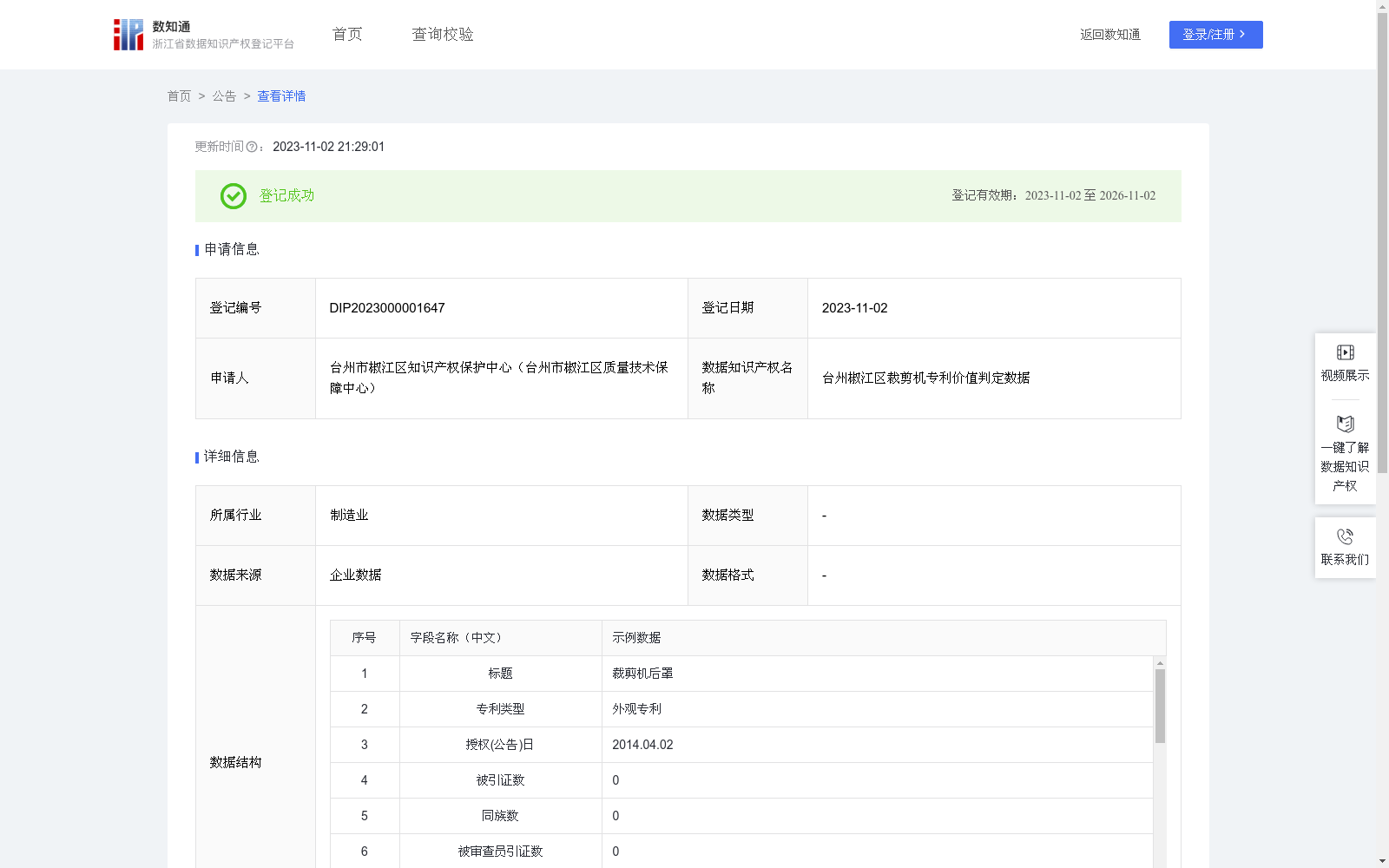
台州椒江区裁剪机专利价值判定数据
收藏资源简介:
根据自有算法对专利数据进行了评价和分类,可用于横向、纵向了解椒江区裁剪机产业专利数据变化情况,有助于了解裁剪机知识产权工作成果;通过对各企业/个人裁剪机专利数据的对比,可了解各企业/个人的技术创新能力、创新水平差异;了解裁剪机的技术发展趋势,有助于企业避免重复研发,避免企业开发的技术侵犯他人的知识产权。本数据基于 AHP 模型,目标层为专利价值,指标层将专利价值指标体系分为市场、技术、法律、战略、经济五大价值维度,指标层向下分准则层,包括:技术价值:IPC小类数、被审查员引证数、被引证数、授权日;经济价值:布局国家数、剩余有效期、许可次数、质押次数;法律价值:权项数、说明书页数、引用非专利文献数量;战略价值:发明人数量、同族数、被引证数;市场价值:IPC分类号、专利类型。利用主观赋值方法,将每一层次的各要素两两比较 ,采用1~9级价值标度方法,(例如布局国家数比质押次数稍重要,比许可次数一般重要,比剩余价值强烈重要,获得价值标度结果7,5,3,1,再根据布局国家数次*相应价值标度计算得分,大于10按10分计算,以此类推,得到指标层各分值,再根据五类价值之和定义为专利综合价值,利用IFS函数对专利进行价值判定,=IFS(xx>45, "超高价值专利",xx>20, "高价值专利",xx>10, "一般价值专利",xx>0, "无价值专利",),用于区分超高价值专利、高价值专利、一般价值专利和无价值专利,为椒江区裁剪机产业技术人员提供研发决策依据和技术规避作优先参考。
This dataset evaluates and classifies patent data via a proprietary algorithm, enabling horizontal and vertical analysis of changes in patent data for the cutting machine industry in Jiaojiang District, and facilitating understanding of the intellectual property (IP) achievements of the industry. By comparing the cutting machine patent data of various enterprises and individuals, differences in their technological innovation capabilities and innovation levels can be identified; grasping the technological development trends of cutting machines helps enterprises avoid redundant R&D and the risk of infringing others' intellectual property rights with their developed technologies. This dataset is built on the Analytic Hierarchy Process (AHP) model, where the goal layer is set as patent value, and the indicator layer divides the patent value index system into five core value dimensions: market, technological, legal, strategic and economic. The indicator layer further decomposes into the criteria layer, with specific indicators as follows: - Technological value: number of IPC subclasses, number of examiner citations, number of received citations, grant date - Economic value: number of filing countries, remaining validity period, number of licensing transactions, number of pledge transactions - Legal value: number of claims, number of pages in the specification, number of non-patent literature citations - Strategic value: number of inventors, number of patent family members, number of received citations - Market value: IPC classification numbers, patent type A subjective weighting method is adopted, under which elements at each level are compared pairwise using the 1-9 rating scale method. For example, if the number of filing countries is slightly more important than the number of pledge transactions, moderately more important than the number of licensing transactions, and strongly more important than the remaining validity period, the corresponding rating scale values are 7, 5, 3 and 1 respectively. Scores for each indicator in the indicator layer are calculated by multiplying the count of the indicator by its corresponding rating scale value, with scores exceeding 10 capped at 10, and similar calculations are applied to other indicators to obtain the scores of each indicator layer. The sum of the five value dimensions is defined as the comprehensive patent value. The IFS function is used to determine patent value with the formula: =IFS(xx>45, "Ultra-high Value Patent",xx>20, "High Value Patent",xx>10, "General Value Patent",xx>0, "No Value Patent"), which is used to distinguish ultra-high, high, general and no value patents, providing R&D decision-making basis and priority reference for technical avoidance for technicians in the cutting machine industry of Jiaojiang District.