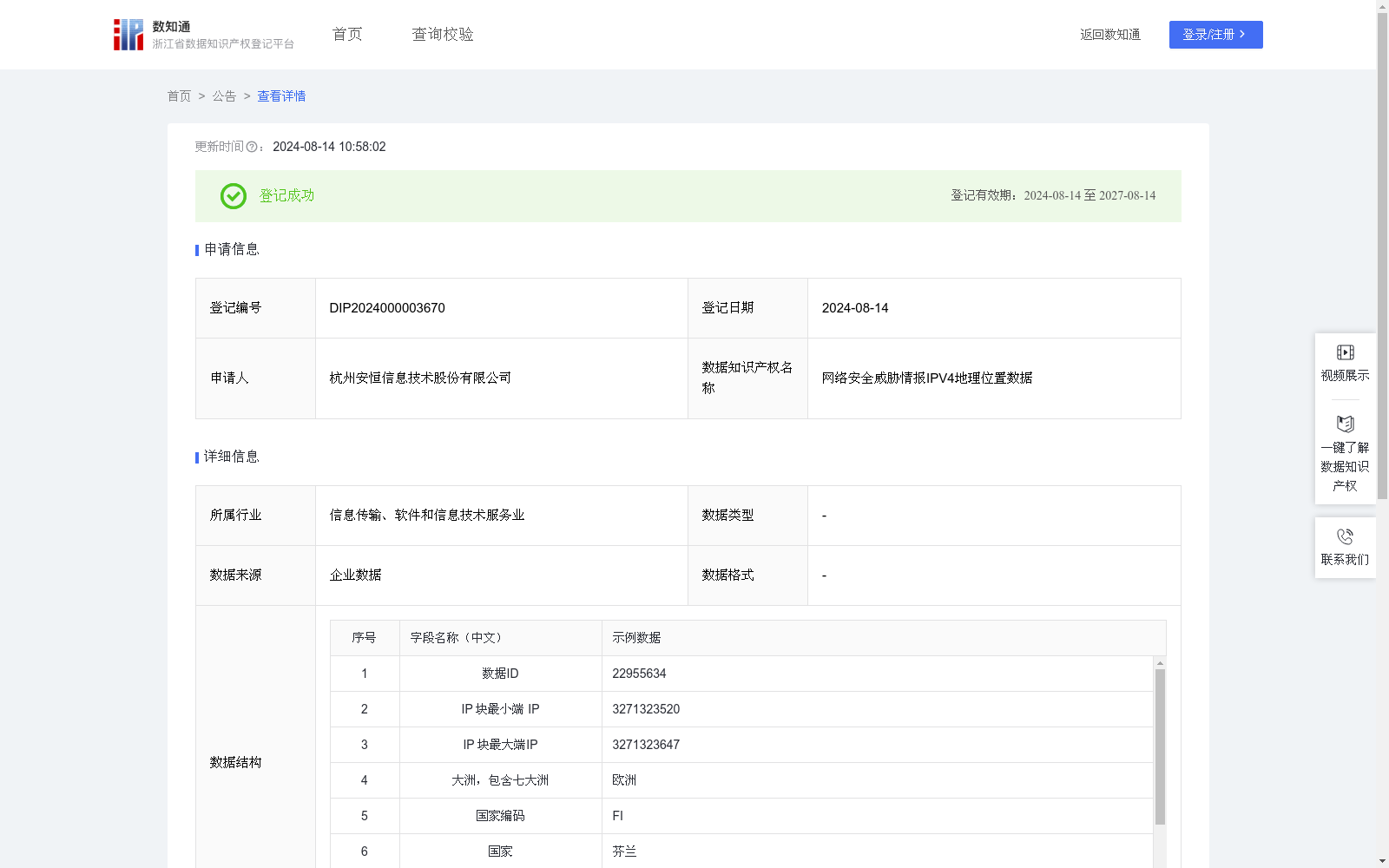
网络安全威胁情报IPV4地理位置数据
收藏资源简介:
安全管理 - 安全管理平台/态势感知 场景描述:在安全管理平台或态势感知系统中,通过整合威胁IP的地理位置数据,可以构建全面的网络安全态势图。这张图不仅展示了当前的网络安全状况,还能揭示潜在的安全威胁趋势和地理分布特征。安全团队可以基于这些信息,制定更加精准的防御策略和应急响应计划。 应用价值:增强对网络安全态势的感知能力,提高决策效率和准确性,为网络安全策略的制定和执行提供有力支持。 安全管理 - 漏洞扫描与漏洞管理 场景描述:在企业进行定期或不定期的网络安全扫描过程中,发现潜在的安全漏洞后,需要迅速评估这些漏洞可能带来的风险。此时,结合威胁IP的地理位置数据,安全团队能够识别出哪些区域的IP地址频繁尝试利用这些漏洞,从而有针对性地加强这些区域的防御措施,比如通过IP黑名单、地理围栏等手段限制或阻断来自高风险地区的访问。数据加工:将IP地址数据统一格式,IP块采用最大之和最小值表示,如将IPv4地址转换为标准的点分十进制表示。将每个部分的数值转换为十进制。算法公式是:IPdecimal=(w×16777216)+(x×65536)+(y×256)+z,其中IPdecimal为IP的数值表示,w、x、y和z分别是IP地址的四个部分。例如:IP:192.168.0.1的取值为w:192,x:168,y:0,z:1;IPdecimal=(192×16777216)+(168×65536)+(0×256)+1=3232235521;维护一个包含IP地址与地理位置对应关系的数据库。定期更新以保证数据的准确性。为了提高匹配效率,采用数据哈希、二分查找等数据结构或算法优化查找过程。
Security Management - Security Management Platform/Situation Awareness Scenario Description: In security management platforms or cybersecurity situation awareness systems, a comprehensive cybersecurity situation map can be constructed by integrating geolocation data of threatening IP addresses. This map not only displays the current cybersecurity status, but also reveals potential cybersecurity threat trends and geospatial distribution characteristics. Security teams can develop more precise defense strategies and emergency response plans based on this information. Application Value: Enhance the perception of cybersecurity situation, improve decision-making efficiency and accuracy, and provide strong support for the formulation and implementation of cybersecurity strategies. Security Management - Vulnerability Scanning and Vulnerability Management Scenario Description: During regular or irregular cybersecurity scanning conducted by enterprises, after potential security vulnerabilities are identified, it is necessary to rapidly assess the risks posed by these vulnerabilities. At this point, by combining the geolocation data of threatening IP addresses, security teams can identify which regions' IP addresses frequently attempt to exploit these vulnerabilities, thus strengthening defense measures in these regions in a targeted manner, such as restricting or blocking access from high-risk regions through means like IP blacklists and geofencing. Data Processing: Unify the format of IP address data, where IP blocks are represented by their maximum and minimum values. For example, convert IPv4 addresses to the standard dotted decimal notation, and convert the value of each segment to a decimal number. The algorithm formula is: IPdecimal = (w × 16777216) + (x × 65536) + (y × 256) + z, where IPdecimal is the numerical representation of the IP address, and w, x, y, and z are the four segments of the IP address respectively. For example: For IP: 192.168.0.1, the values are w: 192, x: 168, y: 0, z: 1; IPdecimal = (192 × 16777216) + (168 × 65536) + (0 × 256) + 1 = 3232235521. Maintain a database that records the correspondence between IP addresses and their geolocations, and update it regularly to ensure data accuracy. To improve matching efficiency, adopt data structures or algorithms such as data hashing and binary search to optimize the search process.