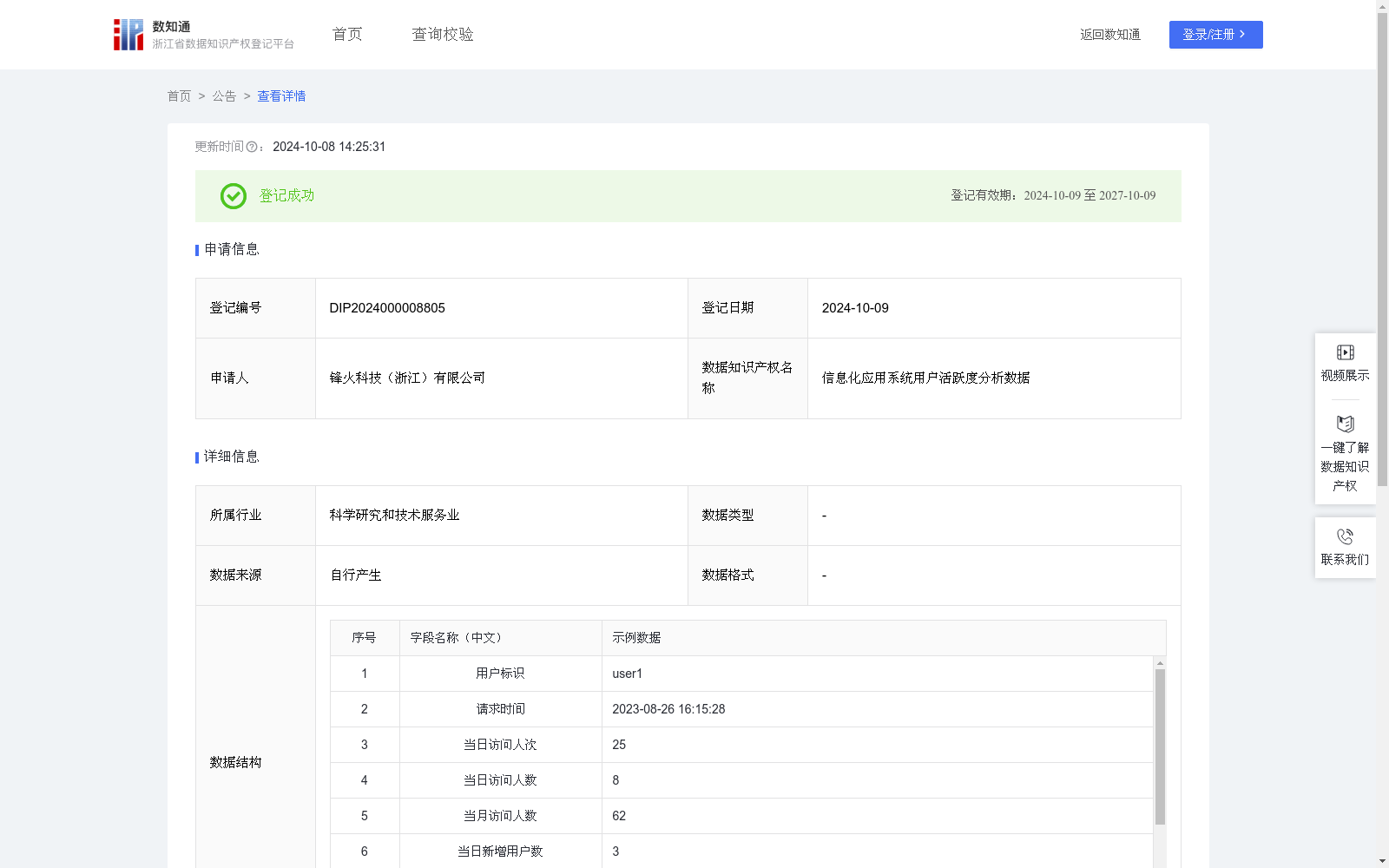
信息化应用系统用户活跃度分析数据
收藏资源简介:
通过算法模型自动计算出用户当日访问人次、当日访问人数、当月访问人数、当日新增用户数、当月新增用户数、累计用户数、当日活跃率、当月活跃率等数据,为信息化项目的使用情况提供数据支撑,提高绩效评价指标的客观性和公平性,最终为财政和信息化项目主管部门对信息化项目的下年度经费保障提供指导。1.数据采集:利用日志采集anget插件安装到各个信息化应用系统的数据库中,定时采集应用产生的日志信息中的用户标识(账号ID)和登录时间。2.数据处理:由于anget插件具备数据质量校验功能,不符合质量的数据不会采集,因此数据质量均符合日志规范。3.数据展示:(1)当日访问人次:采集当日用户登录系统后产生的日志数据中的的用户标识,并不去重复值计算累计登录过系统的账号数量即为当日访问人次。(2)当日访问人数:采集当日用户登录系统后产生的日志数据中的的用户标识,并去掉重复值计算累计登录过系统的账号数量即为当日访问人数。(3)当日新增用户数访问人数:采集当日用户登录系统后产生的日志数据中的的用户标识(账号数据),并和历史采集的用户标识进行比对,如历史未出现的用户标识累计值即为当日新增用户数访问人数。(4)累计用户数:截至到当日内有登录系统的用户标识总数(去重处理)。(5)当日活跃率:当日访问人数/累计用户数。(6)当月活跃率:当月访问人数/累计用户数。
This dataset automatically calculates metrics including non-deduplicated daily visit trips, daily unique visitors, monthly unique visitors, daily new users, monthly new users, total cumulative users, daily activity rate, and monthly activity rate via algorithmic models. It provides data support for assessing the usage status of informatization projects, enhances the objectivity and fairness of performance evaluation indicators, and ultimately offers guidance for competent authorities in charge of finance and informatization projects to allocate annual funding for such projects in the next fiscal year. 1. Data Collection: Deploy log collection agent plugins into the databases of various informatization application systems, and regularly collect user identifiers (account IDs) and login timestamps from the log data generated by the applications. 2. Data Processing: The agent plugin is equipped with data quality verification functions, so only data that meets quality requirements is collected, ensuring that all collected data conforms to log specifications. 3. Data Display: (1) Non-deduplicated daily visit trips: Count all user identifiers (including duplicates) extracted from the log data generated by user logins to the system on the current day; this value is the non-deduplicated daily visit trips. (2) Daily unique visitors: Count the number of unique user identifiers extracted from the login log data on the current day after removing duplicates; this value is the daily visit users. (3) Daily new users: Compare the user identifiers (account data) extracted from the login log data on the current day with the historically collected user identifiers. The total number of user identifiers that have not appeared in historical records is the daily new users. (4) Total cumulative users: The total number of unique user identifiers that have logged into the system as of the current day. (5) Daily activity rate: Daily unique visitors / Total cumulative users. (6) Monthly activity rate: Monthly unique visitors / Total cumulative users.