
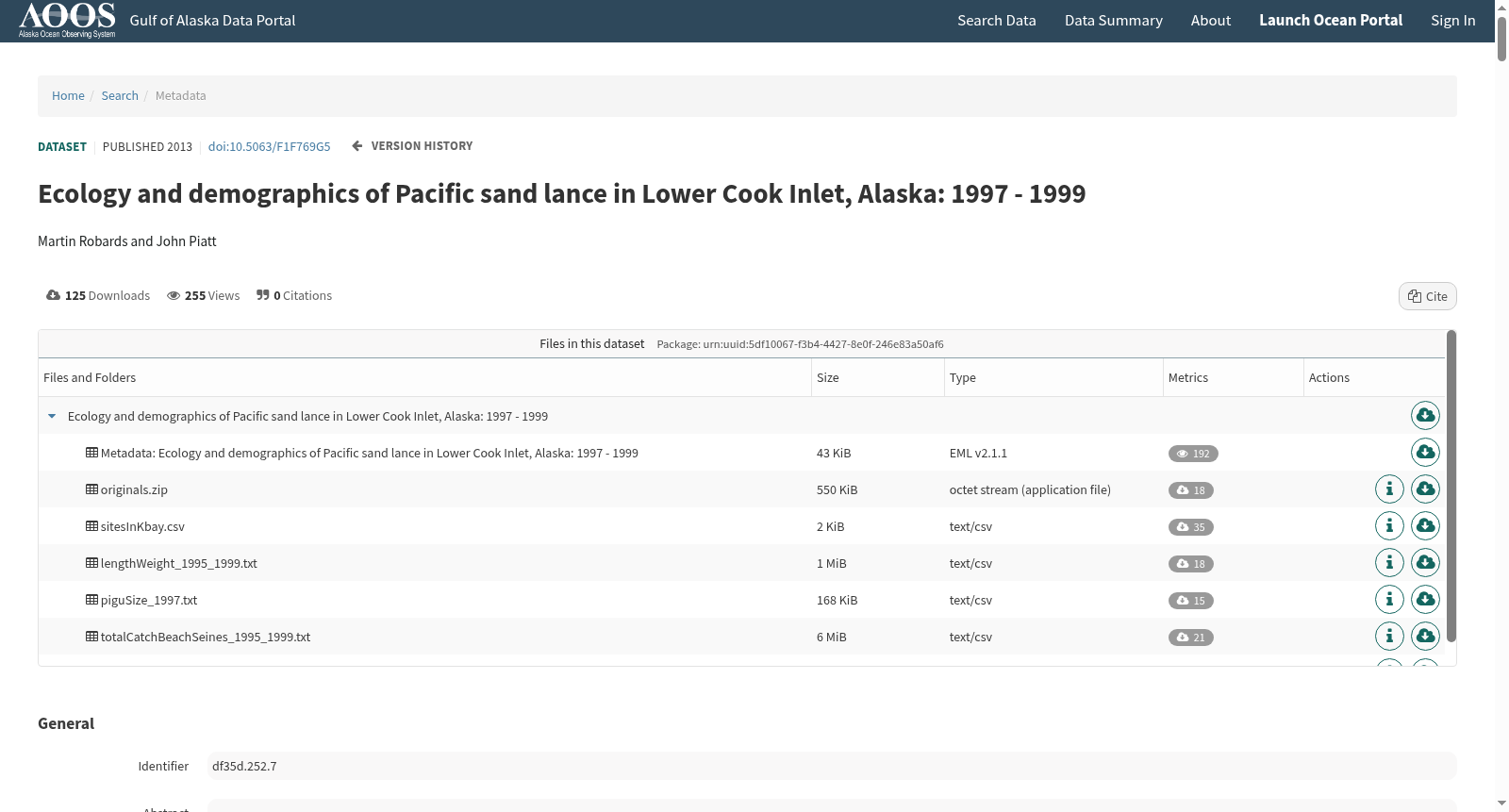
Ecology and demographics of Pacific sand lance in Lower Cook Inlet, Alaska: 1997 - 1999
收藏Mendeley Data2024-01-31 更新2024-06-27 收录
下载链接:
https://goa.nceas.ucsb.edu/#view/doi:10.5063/F1F769G5
下载链接
链接失效反馈官方服务:
资源简介:
Study History: The purpose of this study was to characterize the basic ecology, distribution, and demographics of sand lance in lower Cook Inlet. Recent declines of upper trophic level species in the northern Gulf of Alaska have been linked to decreasing availability of forage fishes. Sand lance is the most important forage fish in most nearshore areas of the northern Gulf. Despite its importance to commercial fish, seabirds, and marine mammals, little is known or published on the basic biology of this key prey species. Therefore, restoration project /306 was established to work in coordination with restoration APEX project /163M to help characterize the relationship between seabird population dynamics and forage fish abundance. Abstract: Distinct sand lance populations occur within the relatively small geographic area of Lower Cook Inlet, Alaska. Marked meso-scale differences in abundance, growth, and mortality exist as a consequence of differing oceanographic regimes. Growth rate within populations (between years) was positively correlated with temperature. However, this did not extend to inter-population comparisons where differing growth rates were better correlated to marine productivity. Most sand lance reached maturity in their second year. Field observations and indices of maturity, gonad development, and ova-size distribution all indicated that sand lance spawn once each year. Sand lance spawned intertidally in late September and October on fine gravel/sandy beaches. Embryos developed over 67 days through periods of intertidal exposure and sub-freezing air temperatures. Mean dry-weight energy value of sand lance cycles seasonally, peaking in spring and early summer, and subsequently declining by about 25% during late summer and fall. Sand lance enter the winter with close to their minimum whole body energy content. Publications: Robards, M.D. and J.F. Piatt. 2000. Ecology and demographics of Pacific Sand Lance, Ammodytes hexapterus Pallas, in lower Cook Inlet, Alaska. Exxon Valdez Oil Spill Restoration Project Final Report (Restoration Project 99306), U.S. Geological Survey, Alaska Science Center, Anchorage, Alaska. Robards, M.D., J.F. Piatt, and G.A. Rose. 1999. Maturation, Fecundity, and Intertidal Spawning of Pacific Sand Lance (Ammodytes hexapterus) in the Northern Gulf of Alaska. Journal of Fish Biology 54: 1050-1068. Robards, M.D., J.A. Anthony, G.A. Rose, and J.F. Piatt. 1999. Changes in proximate composition and somatic energy content for Pacific sand lance (Ammodytes hexapterus) relative to maturity, season, and location. Journal of Experimental Marine Biology and Ecology 242: 245-258. Robards, M.D. G.A. Rose, and J.F. Piatt. 1999. Somatic growth and otolith development of Pacific sand lance (Ammodytes hexapterus) under different oceanographic regimes. (Submitted to Fisheries Oceanography). Robards, M.R., J.F. Piatt, A.B. Kettle, and A.A. Abookire. 1999. Temporal and geographic variation in fish communities of Lower Cook Inlet, Alaska. Fishery Bulletin 97, 962-977. Robards, M.R., M.F. Willson, R.H. Armstrong, and J.F. Piatt. 1999. Sand Lance: A Review of Biology and Predator Relations and Annotated Bibliography. U.S. Forest Service, Pacific Northwest Research Station, Research Paper PNW-RP 521, September, 1999. Robards, M.D. and J.F. Piatt. 1999. Biology of the Genus Ammodytes – The Sand Lances. In: Robards, M.R., M.F. Willson, R.H. Armstrong, and J.F. Piatt (editors). Sand Lance: A Review of Biology and Predator Relations and Annotated Bibliography. U.S. Forest Service, Pacific Northwest Research Station, Research Paper PNW-RP 521, September, 1999. Willson, M.F., R.H. Armstrong, M.D. Robards, and J.F. Piatt. 1999. Sand lance as cornerstone species for predator populations. In: Robards, M.R., M.F. Willson, R.H. Armstrong, and J.F. Piatt (editors). Sand Lance: A Review of Biology and Predator Relations and Annotated Bibliography. U.S. Forest Service, Pacific Northwest Research Station, Research Paper PNW-RP 521, September, 1999. Willson, M.F., R.H. Armstrong, M.D. Robards, and J.F. Piatt. 1999. An annotated bibliography of sand lance. In: Robards M.R., M.F. Willson, R.H. Armstrong, and J.F. Piatt (editors). Sand Lance: A Review of Biology and Predator Relations and Annotated Bibliography. U.S. Forest Service, Pacific Northwest Research Station, Research Paper PNW-RP 521, September, 1999.
研究背景:本研究旨在阐明阿拉斯加下库克湾(Lower Cook Inlet)玉筋鱼(sand lance)的基础生态学、分布格局及种群动态特征。阿拉斯加湾北部的高营养级鱼类种群近期出现衰退,这与饵料鱼资源量下降密切相关。玉筋鱼是阿拉斯加湾北部多数近岸海域最重要的饵料鱼类,尽管其对商业鱼类、海鸟及海洋哺乳动物均具有关键生态价值,但目前针对这一关键猎物种的基础生物学研究仍十分匮乏,相关发表文献极少。为此,本研究依托修复项目/306,并与修复APEX项目/163M协同开展,以解析海鸟种群动态与饵料鱼丰度之间的关联机制。
摘要:在阿拉斯加下库克湾这一相对狭小的地理范围内,存在多个分化显著的玉筋鱼种群。不同海洋环流环境导致种群间在丰度、生长速率及死亡率上呈现显著的中尺度差异。种群内部的生长速率(年际间)与水温呈正相关,但这一规律并不适用于种群间的比较——种群间生长速率的差异与海洋生产力的关联更为紧密。多数玉筋鱼在第二个生长季达到性成熟。野外观测及性成熟指标、性腺发育状况与卵径分布的分析结果均表明,玉筋鱼每年仅产卵一次。该物种于9月末至10月在潮间带的细砾/砂质海滩产卵,胚胎需历经67天的潮间带暴露与亚冰点气温环境完成发育。玉筋鱼的干重能量含量呈现季节性周期变化,于春季和夏初达到峰值,随后在夏末至秋季下降约25%。玉筋鱼进入冬季时,其整体机体能量含量接近全年最低值。
发表文献:
1. Robards, M.D. 与 J.F. Piatt. 2000. 阿拉斯加下库克湾太平洋玉筋鱼(Ammodytes hexapterus Pallas)的生态学与种群动态. 埃克森·瓦尔迪兹溢油修复项目最终报告(修复项目编号99306),美国地质调查局(U.S. Geological Survey)阿拉斯加科学中心,安克雷奇,阿拉斯加州。
2. Robards, M.D., J.F. Piatt, 与 G.A. Rose. 1999. 阿拉斯加湾北部太平洋玉筋鱼(Ammodytes hexapterus)的性成熟、繁殖力与潮间带产卵行为. 《鱼类生物学杂志》(Journal of Fish Biology)54卷:1050-1068。
3. Robards, M.D., J.A. Anthony, G.A. Rose, 与 J.F. Piatt. 1999. 太平洋玉筋鱼(Ammodytes hexapterus)的近似营养组成与机体能量含量变化:与性成熟、季节及分布位点的关联. 《实验海洋生物学与生态学杂志》(Journal of Experimental Marine Biology and Ecology)242卷:245-258。
4. Robards, M.D., G.A. Rose, 与 J.F. Piatt. 1999. 不同海洋环流环境下太平洋玉筋鱼(Ammodytes hexapterus)的个体生长与耳石发育. (已提交至《渔业海洋学》(Fisheries Oceanography))。
5. Robards, M.R., J.F. Piatt, A.B. Kettle, 与 A.A. Abookire. 1999. 阿拉斯加下库克湾鱼类群落的时间与地理分布变异. 《渔业通报》(Fishery Bulletin)97卷:962-977。
6. Robards, M.R., M.F. Willson, R.H. Armstrong, 与 J.F. Piatt. 1999. 玉筋鱼:生物学与捕食者关系综述及注释文献目录. 美国林务局(U.S. Forest Service)太平洋西北研究站,研究报告PNW-RP 521,1999年9月。
7. Robards, M.D. 与 J.F. Piatt. 1999. 玉筋鱼属(Genus Ammodytes)生物学——玉筋鱼研究综述. 收录于:Robards, M.R., M.F. Willson, R.H. Armstrong, 与 J.F. Piatt(主编). 玉筋鱼:生物学与捕食者关系综述及注释文献目录. 美国林务局太平洋西北研究站,研究报告PNW-RP 521,1999年9月。
8. Willson, M.F., R.H. Armstrong, M.D. Robards, 与 J.F. Piatt. 1999. 玉筋鱼作为捕食者种群的关键基石物种. 收录于:Robards, M.R., M.F. Willson, R.H. Armstrong, 与 J.F. Piatt(主编). 玉筋鱼:生物学与捕食者关系综述及注释文献目录. 美国林务局太平洋西北研究站,研究报告PNW-RP 521,1999年9月。
9. Willson, M.F., R.H. Armstrong, M.D. Robards, 与 J.F. Piatt. 1999. 玉筋鱼注释文献目录. 收录于:Robards M.R., M.F. Willson, R.H. Armstrong, 与 J.F. Piatt(主编). 玉筋鱼:生物学与捕食者关系综述及注释文献目录. 美国林务局太平洋西北研究站,研究报告PNW-RP 521,1999年9月。
创建时间:
2024-01-31
搜集汇总
数据集介绍
背景与挑战
背景概述
该数据集是关于阿拉斯加下库克湾太平洋沙鳗生态和人口统计学的研究,覆盖1997-1999年,旨在描述这一关键饵料鱼的基本生物学特征,以应对上层捕食者数量下降的生态挑战。研究通过实地采样和科学分析,揭示了沙鳗种群在丰度、生长和繁殖方面的差异,并提供了详细的站点、捕获和生物测量数据,支持生态系统管理和恢复项目。
以上内容由遇见数据集搜集并总结生成


