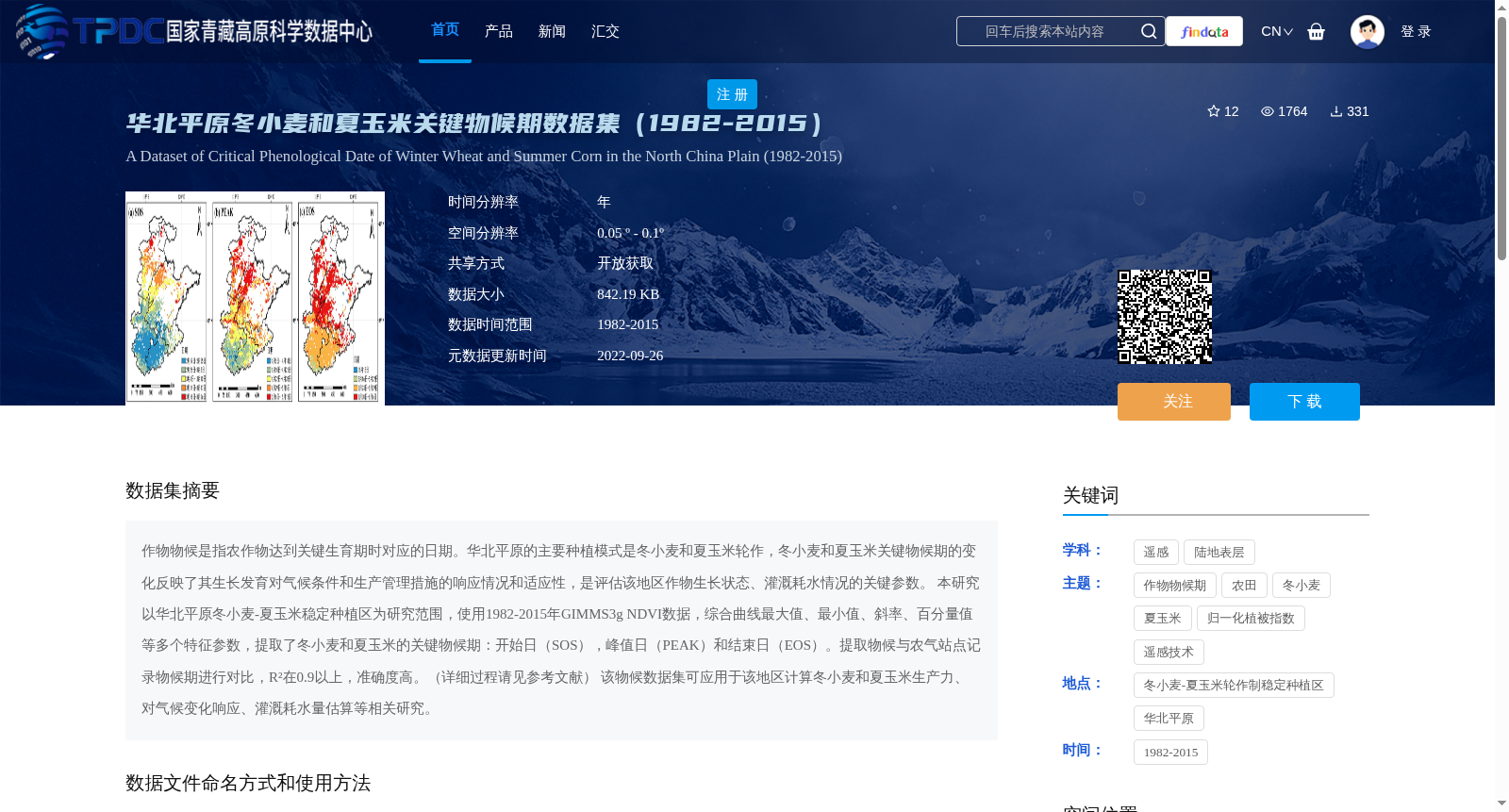
华北平原冬小麦和夏玉米关键物候期数据集(1982-2015)
收藏资源简介:
作物物候是指农作物达到关键生育期时对应的日期。华北平原的主要种植模式是冬小麦和夏玉米轮作,冬小麦和夏玉米关键物候期的变化反映了其生长发育对气候条件和生产管理措施的响应情况和适应性,是评估该地区作物生长状态、灌溉耗水情况的关键参数。 本研究以华北平原冬小麦-夏玉米稳定种植区为研究范围,使用1982-2015年GIMMS3g NDVI数据,综合曲线最大值、最小值、斜率、百分量值等多个特征参数,提取了冬小麦和夏玉米的关键物候期:开始日(SOS),峰值日(PEAK)和结束日(EOS)。提取物候与农气站点记录物候期进行对比,R²在0.9以上,准确度高。(详细过程请见参考文献) 该物候数据集可应用于该地区计算冬小麦和夏玉米生产力、对气候变化响应、灌溉耗水量估算等相关研究。
Crop phenology refers to the dates when crops reach their critical growth stages. The main cropping system in the North China Plain is winter wheat-summer maize rotation. Variations in the critical phenological stages of winter wheat and summer maize reflect the responses and adaptability of their growth and development to climatic conditions and agricultural management practices, and serve as key parameters for evaluating crop growth status and irrigation water consumption in this region. In this study, we focused on the stable winter wheat-summer maize cropping regions of the North China Plain, using GIMMS3g NDVI data from 1982 to 2015. By integrating multiple characteristic parameters including curve maximum, minimum, slope, and percentile values, we extracted the critical phenological stages of winter wheat and summer maize: Start of Season (SOS), Peak of Season (PEAK), and End of Season (EOS). The extracted phenological data were compared with phenological records from agro-meteorological stations, with a coefficient of determination (R²) above 0.9, indicating high accuracy. (For detailed procedures, please refer to the references.) This phenology dataset can be applied to relevant research in this region, such as calculating the productivity of winter wheat and summer maize, analyzing their responses to climate change, and estimating irrigation water consumption.