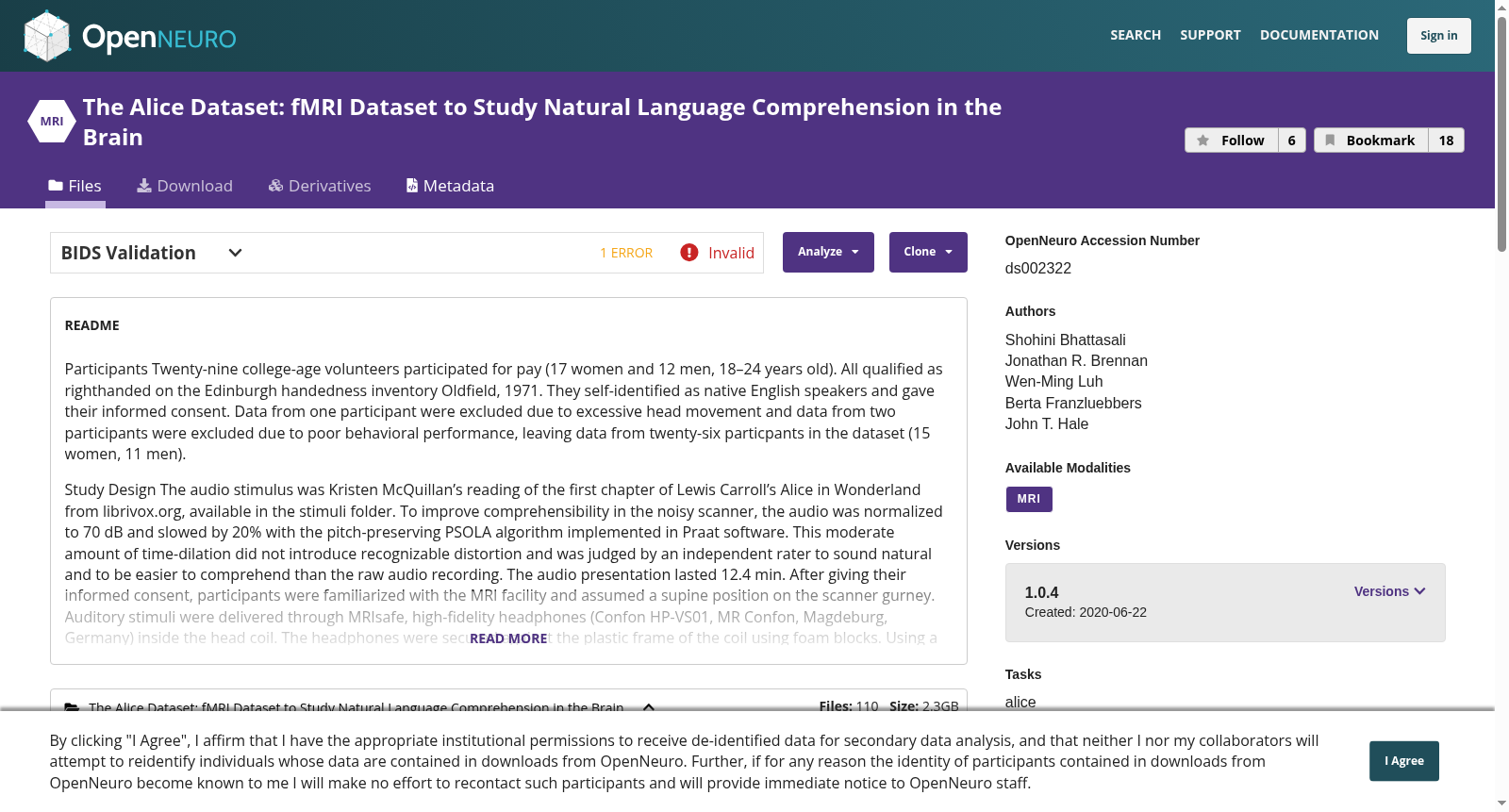
The Alice Dataset: fMRI Dataset to Study Natural Language Comprehension in the Brain
收藏资源简介:
Participants Twenty-nine college-age volunteers participated for pay (17 women and 12 men, 18–24 years old). All qualified as righthanded on the Edinburgh handedness inventory Oldfield, 1971. They self-identified as native English speakers and gave their informed consent. Data from one participant were excluded due to excessive head movement and data from two participants were excluded due to poor behavioral performance, leaving data from twenty-six particpants in the dataset (15 women, 11 men). Study Design The audio stimulus was Kristen McQuillan’s reading of the first chapter of Lewis Carroll’s Alice in Wonderland from librivox.org, available in the stimuli folder. To improve comprehensibility in the noisy scanner, the audio was normalized to 70 dB and slowed by 20% with the pitch-preserving PSOLA algorithm implemented in Praat software. This moderate amount of time-dilation did not introduce recognizable distortion and was judged by an independent rater to sound natural and to be easier to comprehend than the raw audio recording. The audio presentation lasted 12.4 min. After giving their informed consent, participants were familiarized with the MRI facility and assumed a supine position on the scanner gurney. Auditory stimuli were delivered through MRIsafe, high-fidelity headphones (Confon HP-VS01, MR Confon, Magdeburg, Germany) inside the head coil. The headphones were secured against the plastic frame of the coil using foam blocks. Using a spoken recitation of the US Constitution, an experimenter increased the volume stepwise until participants reported that they could hear clearly. Participants then listened passively to the audio storybook. Upon emerging from the scanner, participants completed a twelve-question multiple-choice questionnaire concerning events and situations described in the story. The entire session lasted less than an hour. Data collection and analysis Imaging was performed using a 3T MRI scanner (Discovery MR750, GE Healthcare, Milwaukee, WI) with a 32-channel head coil at the Cornell MRI Facility. Blood Oxygen Level Dependent (BOLD) signals were collected from twenty-nine participants. Thirteen participants were scanned using a T2-weighted echo planar imaging (EPI) sequence with: a repetition time of 2000 ms, echo time of 27 ms, flip angle of 77, image acceleration of 2X, field of view of 216 216 mm, and a matrix size of 72 72. Under these parameters we obtained 44 oblique slices with 3 mm isotropic voxels. Sixteen participants were scanned with a three-echo EPI sequence where the field of view was 240 240 mm resulting in 33 slices with an in-plane resolution of 3.75 mm2 and thickness 3.8 mm. Data from this second group provided are images from the second EPI echo, where the echo time was 27.5 ms. All other parameters were exactly the same. This selection of the second-echo images renders the two sets of functional images as comparable as possible. Preprocessing Preprocessing was done with SPM8. Data were spatially realigned based on 6-parameter rigid body transformation using the 2nd degree B-spline method. Functional (EPI) and structural (MP-RAGE) images were co-registered via mutual information and functional images were smoothed with a 3 mm isotropic gaussian filter. We used the ICBM template provided with SPM8 to put our data into MNI stereotaxic coordinates. The data were high pass filtered at 1/128 Hz and we discarded the first 10 functional volumes. These processed data are available in the derivatives directory and preprocessing.mat files are included to provide input parameters used.
Participants 29名大学生志愿者参与本实验并获取报酬(女性17名,男性12名,年龄18~24岁)。所有参与者均通过爱丁堡利手量表(Edinburgh handedness inventory, Oldfield, 1971)判定为右利手。他们自述为英语母语者,并签署了知情同意书。一名参与者因头部运动幅度过大被剔除数据,两名参与者因行为表现不佳被剔除数据,最终数据集纳入26名参与者的数据(女性15名,男性11名)。 Study Design 实验采用的听觉刺激为Kristen McQuillan在librivox.org平台朗读的路易斯·卡罗尔《爱丽丝梦游仙境》第一章音频,可于刺激材料文件夹中获取。为提升嘈杂扫描环境中的听觉可懂度,该音频被标准化至70分贝,并通过Praat软件中实现的基音保留型PSOLA算法将音频减速20%且保持基音不变。这种适度的时间拉伸未引入可察觉的失真,经独立评分员评定,其听感自然,且相较于原始音频更易于理解。音频播放总时长为12.4分钟。 签署知情同意书后,参与者先熟悉MRI扫描环境,随后仰卧于扫描床。听觉刺激通过安装于头部线圈内的MR安全型高保真耳机(Confon HP-VS01,德国马格德堡MR Confon公司)传递,并用泡沫块将耳机固定于线圈的塑料框架上。实验人员使用美国宪法的朗读录音逐步调整音量,直至参与者报告可以清晰听到声音。随后参与者被动聆听该有声故事书。扫描结束后,参与者完成一份包含12道选择题的问卷,内容涉及故事中描述的事件与场景。整个实验过程耗时不足1小时。 Data collection and analysis 成像扫描在康奈尔磁共振成像设施(Cornell MRI Facility)中完成,使用3T磁共振扫描仪(Discovery MR750,美国威斯康星州密尔沃基GE医疗集团)及32通道头部线圈。从29名参与者处采集血氧水平依赖(Blood Oxygen Level Dependent, BOLD)信号。其中13名参与者采用T2加权回波平面成像(echo planar imaging, EPI)序列进行扫描,参数如下:重复时间2000ms,回波时间27ms,翻转角77°,图像加速因子2倍,视野216×216mm,矩阵尺寸72×72。在此参数下,我们获得44层斜向切片,各向同性体素大小为3mm。剩余16名参与者采用三回波EPI序列扫描,视野为240×240mm,得到33层切片,面内分辨率为3.75mm²,层厚3.8mm。第二组参与者的数据采用第二回波EPI图像,其回波时间为27.5ms,其余参数与前述一致。选取第二回波图像可尽可能使两组功能成像数据具备可比性。 Preprocessing 预处理工作基于SPM8完成。数据基于6参数刚体变换,采用二阶B样条方法进行空间配准。将功能(EPI)图像与结构(MP-RAGE)图像通过互信息进行配准,并使用3mm各向同性高斯滤波器对功能图像进行平滑处理。我们采用SPM8自带的ICBM模板,将数据转换至MNI立体定向坐标空间。对数据进行1/128Hz的高通滤波,并舍弃前10帧功能成像数据。这些处理后的数据可于衍生文件目录中获取,同时包含preprocessing.mat文件以提供所用的输入参数。