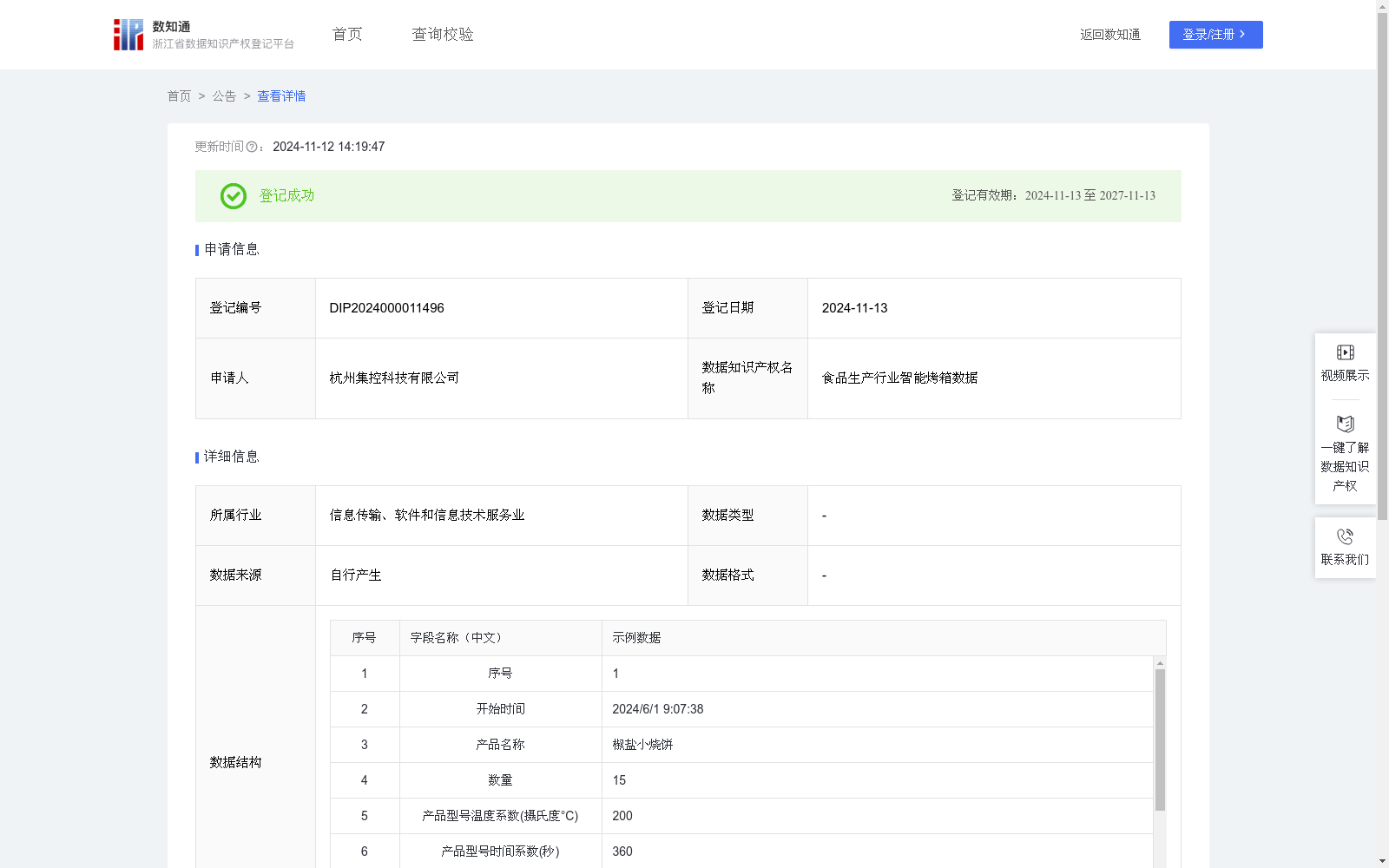
食品生产行业智能烤箱数据
收藏资源简介:
食品生产行业烤箱类产品,温度和时间的把控,至关重要,传统生产模式太过依赖人工去物理操作管理温度和时间,如果员工发和一变化,新员工一时难掌握所有产品的温度和时间。 现使用智能烘箱+智能系统相结合,系统自动控制烤箱的温度和时间,集合大数据分析,定期自动调整温度和时间。 有助于帮助生产企业、提升产量、提升品质、减少依赖人工操作。食品生产行业智能烤箱分析含量数据的算法规则包括以下几个方面: (1)数据采集:通过集控MES系统做好生产计划,并结合物联网数据采集系统,结合烤箱控制系统,采集作业数据。 (2)数据处理:对收集到数据进行归类、计算,便于分析使用,并计算温度系数修正【产品型号温度系数-(烤焦数量*10)】和时间系数修正【产品型号时间系数/烤结果软硬度】 (3)数据分析:通过按月份、产品、温度系数修正平均值和时间系数修正平均值。生成新的产品型号温度系数和新的产品型号时间系数。进一步地,通过长期数据跟踪和分析,供参考和一键应该功能,内部调整和生产的大数据模型。
For oven products in the food manufacturing industry, precise control of temperature and time is critical. Traditional production modes overly rely on manual physical operations to manage temperature and time parameters. When staff turnover occurs, new hires often struggle to quickly master the temperature and time settings for all product types. Currently, the combination of intelligent ovens and intelligent systems is adopted. The system automatically controls the oven's temperature and time, integrates big data analytics, and regularly and automatically adjusts these parameters. This solution helps manufacturing enterprises increase production output, improve product quality, and reduce reliance on manual operations. The algorithmic rules for data analysis by intelligent ovens in the food manufacturing industry are as follows: (1) Data Collection: Develop production plans via the centralized MES system, and combine with IoT-based data collection systems and oven control systems to collect operational data. (2) Data Processing: Classify and calculate the collected data to facilitate subsequent analysis, and calculate the temperature coefficient correction [Product Model Temperature Coefficient - (Number of Burnt Products × 10)] and time coefficient correction [Product Model Time Coefficient / Hardness of Baked Results]. (3) Data Analysis: Calculate the average values of temperature coefficient corrections and time coefficient corrections grouped by month and product model, then generate new temperature coefficients and time coefficients for each product model. Furthermore, through long-term data tracking and analysis, a big data model for internal production adjustment is established, which supports reference queries and one-click application functions.