juliensimon/dst-index
收藏资源简介:
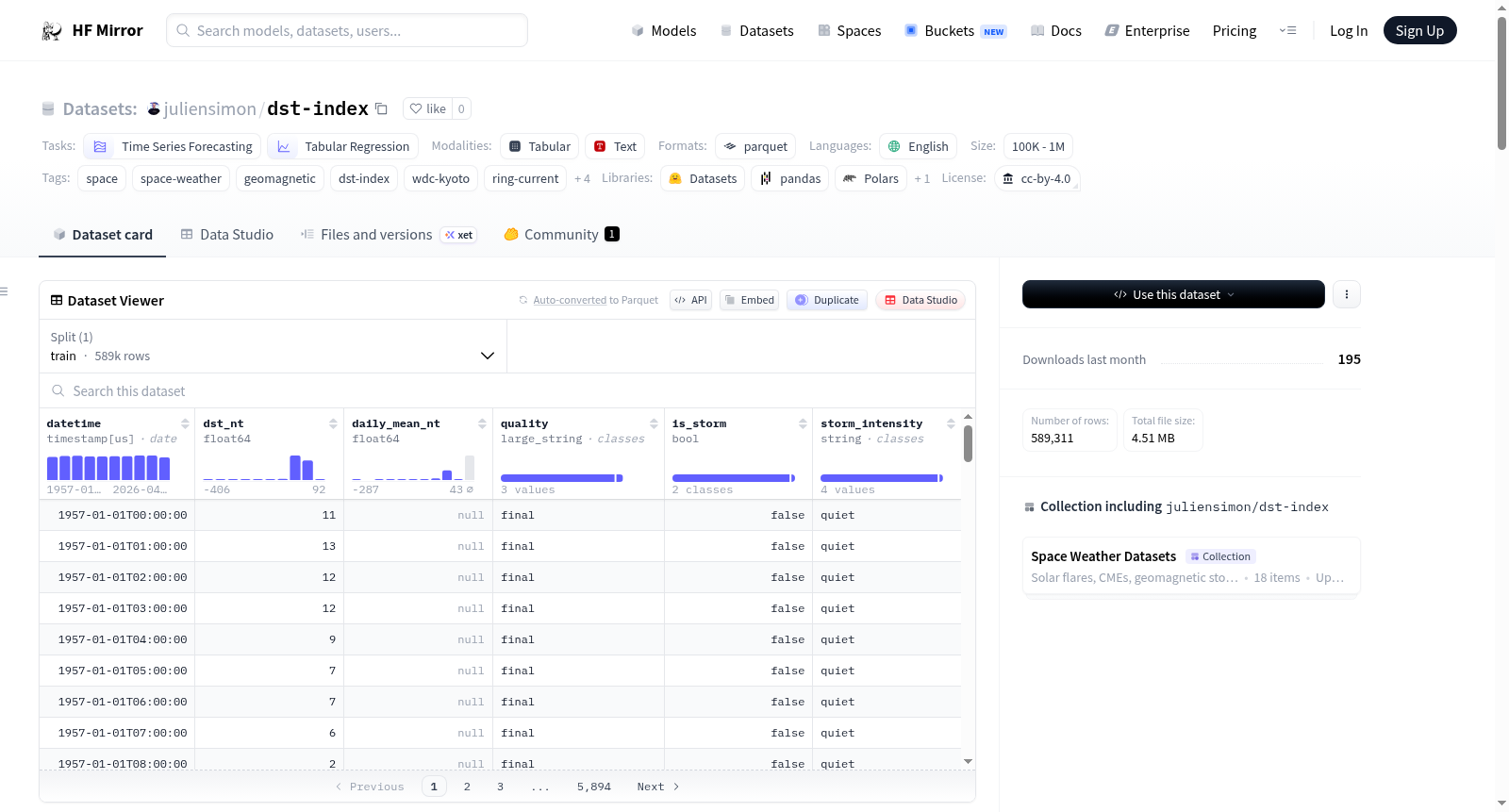
来自WDC Kyoto的每小时扰动风暴时间(Dst)指数——自1957年以来地磁风暴强度的标准测量。Dst指数测量环电流的强度——一种在磁层中流动的环形电流。在地磁风暴期间,环电流增强,Dst急剧下降(例如,主要风暴为-100至-500 nT)。该指数是卫星运营商和电网管理人员评估风暴严重程度的主要指标。Dst通过提供每小时分辨率(相对于3小时/每日)补充了Kp/Ap指数。环电流是一个由10-200 keV离子(主要是H+和O+)组成的环形带,被困在距离地球3-8个地球半径的内磁层中。在安静时期,环电流对地表磁场产生适度的抑制(Dst约为-20至+10 nT)。当CME或高速流到达并伴有持续的南向行星际磁场(Bz < 0)时,增强的对流电场将新鲜粒子从等离子体片注入环电流,导致Dst在风暴主相期间迅速下降。Dst源自四个低纬度磁力计站的水平场分量(H):Hermanus(南非)、Kakioka(日本)、Honolulu(夏威夷)和San Juan(波多黎各)。每小时的时间分辨率可以解析风暴主相(通常为6-12小时的快速下降)和恢复相(1-7天的逐渐回归基线)。Dst指数在卫星操作中有直接应用:经验模型将Dst偏移与增加的卫星表面充电、电子设备中的单事件翻转率以及加速轨道衰减的热层密度增加联系起来。该数据集适用于时间序列预测和表格回归任务。
Hourly Disturbance Storm Time (Dst) index from WDC Kyoto -- the standard measure of geomagnetic storm intensity since 1957. The Dst index measures the strength of the ring current -- a toroidal electric current flowing in the magnetosphere. During geomagnetic storms, the ring current intensifies and Dst drops sharply (e.g. -100 to -500 nT for major storms). This index is the primary metric used by satellite operators and power grid managers to assess storm severity. Dst complements the Kp/Ap indices by providing hourly resolution vs. 3-hourly/daily. The ring current is a toroidal band of 10-200 keV ions (primarily H+ and O+) trapped in the inner magnetosphere at geocentric distances of 3-8 Earth radii. During quiet times, the ring current produces a modest depression of the surface magnetic field (Dst around -20 to +10 nT). When a CME or high-speed stream arrives with sustained southward interplanetary magnetic field (Bz < 0), enhanced convection electric fields inject fresh particles from the plasma sheet into the ring current, causing Dst to plunge rapidly during the storm main phase. Dst is derived from the horizontal field component (H) at four low-latitude magnetometer stations: Hermanus (South Africa), Kakioka (Japan), Honolulu (Hawaii), and San Juan (Puerto Rico). The hourly cadence resolves the storm main phase (typically 6-12 hours of rapid decrease) and the recovery phase (1-7 days of gradual return to baseline). The Dst index has direct applications in satellite operations: empirical models relate Dst excursions to increased satellite surface charging, single-event upset rates in electronics, and thermospheric density enhancements that accelerate orbital decay. This dataset is suitable for time-series forecasting, tabular regression tasks.