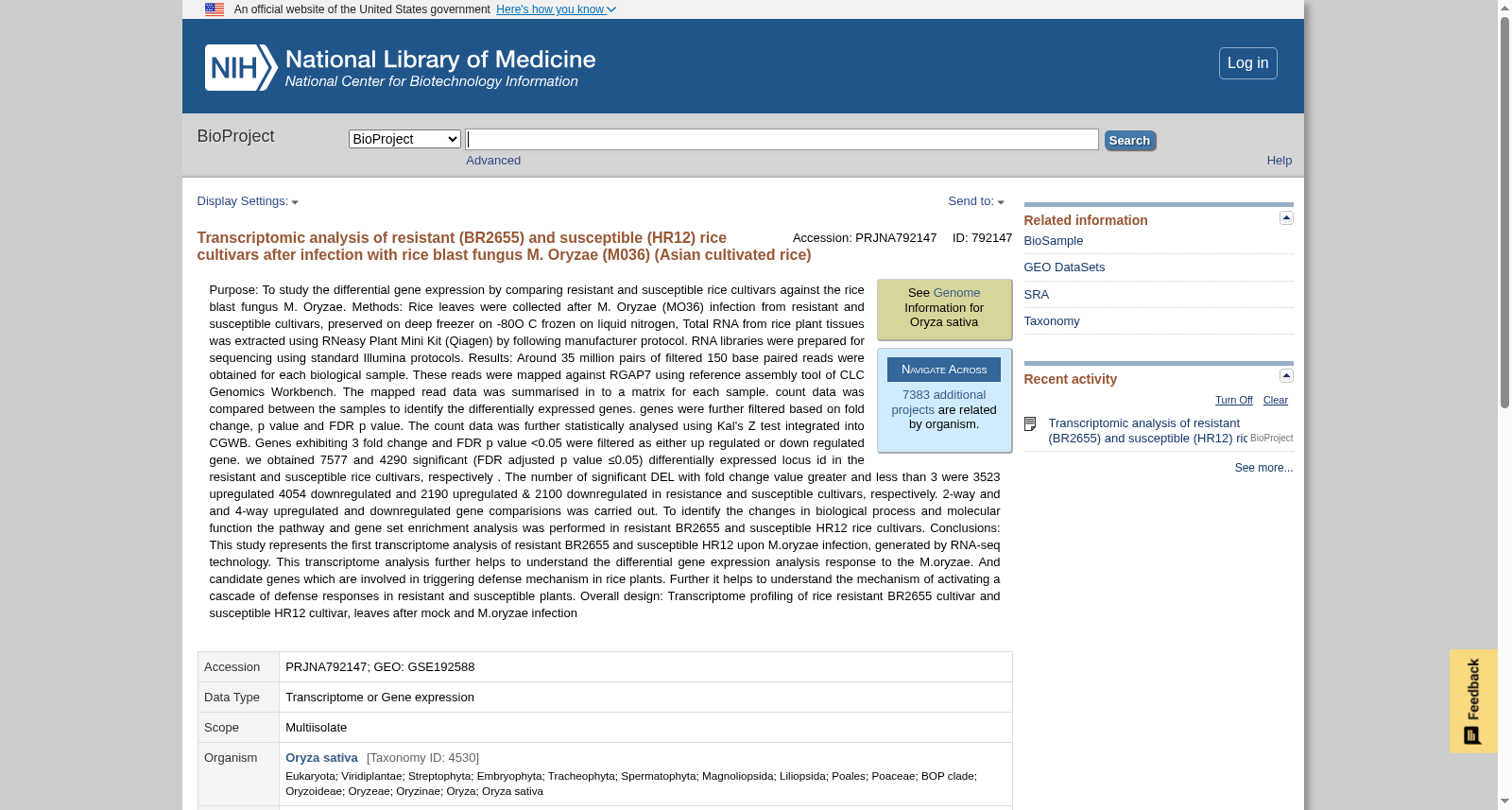
Transcriptomic analysis of resistant (BR2655) and susceptible (HR12) rice cultivars after infection with rice blast fungus M. Oryzae (M036). Transcriptomic analysis of resistant (BR2655) and susceptible (HR12) rice cultivars after infection with rice blast fungus M. Oryzae (M036)
收藏资源简介:
Purpose: To study the differential gene expression by comparing resistant and susceptible rice cultivars against the rice blast fungus M. Oryzae. Methods: Rice leaves were collected after M. Oryzae (MO36) infection from resistant and susceptible cultivars, preserved on deep freezer on -80O C frozen on liquid nitrogen, Total RNA from rice plant tissues was extracted using RNeasy Plant Mini Kit (Qiagen) by following manufacturer protocol. RNA libraries were prepared for sequencing using standard Illumina protocols. Results: Around 35 million pairs of filtered 150 base paired reads were obtained for each biological sample. These reads were mapped against RGAP7 using reference assembly tool of CLC Genomics Workbench. The mapped read data was summarised in to a matrix for each sample. count data was compared between the samples to identify the differentially expressed genes. genes were further filtered based on fold change, p value and FDR p value. The count data was further statistically analysed using Kal's Z test integrated into CGWB. Genes exhibiting 3 fold change and FDR p value <0.05 were filtered as either up regulated or down regulated gene. we obtained 7577 and 4290 significant (FDR adjusted p value ≤0.05) differentially expressed locus id in the resistant and susceptible rice cultivars, respectively . The number of significant DEL with fold change value greater and less than 3 were 3523 upregulated 4054 downregulated and 2190 upregulated & 2100 downregulated in resistance and susceptible cultivars, respectively. 2-way and and 4-way upregulated and downregulated gene comparisions was carried out. To identify the changes in biological process and molecular function the pathway and gene set enrichment analysis was performed in resistant BR2655 and susceptible HR12 rice cultivars. Conclusions: This study represents the first transcriptome analysis of resistant BR2655 and susceptible HR12 upon M.oryzae infection, generated by RNA-seq technology. This transcriptome analysis further helps to understand the differential gene expression analysis response to the M.oryzae. And candidate genes which are involved in triggering defense mechanism in rice plants. Further it helps to understand the mechanism of activating a cascade of defense responses in resistant and susceptible plants. Overall design: Transcriptome profiling of rice resistant BR2655 cultivar and susceptible HR12 cultivar, leaves after mock and M.oryzae infection
研究目的:本研究旨在通过对比抗稻瘟病与感稻瘟病水稻品种针对稻瘟病菌(M. Oryzae)的基因表达差异展开相关研究。 实验方法:分别从接种M. Oryzae(MO36)后的抗稻瘟病和感稻瘟病水稻品种中采集水稻叶片,经液氮速冻后置于-80℃超低温冰箱保存。采用RNeasy植物微量提取试剂盒(Qiagen),按照制造商提供的操作流程提取水稻组织总RNA。依照标准Illumina建库流程完成RNA测序文库的构建。 实验结果:每个生物学重复样本均获得约3500万对经过滤的150bp双端测序读段。使用CLC基因组工作台(CLC Genomics Workbench)的参考序列比对工具,将上述读段比对至RGAP7参考基因组。将比对结果汇总为各样本的基因计数矩阵,通过组间计数数据的比较鉴定差异表达基因。随后基于折叠变化、p值及错误发现率(FDR)校正p值对基因进行进一步筛选。利用整合在CLC基因组工作台中的Kal's Z检验对计数数据开展后续统计分析。将折叠变化≥3倍且FDR校正p值<0.05的基因筛选为上调或下调差异表达基因。本研究在抗稻瘟病和感稻瘟病水稻品种中分别获得7577个和4290个经FDR校正后p值≤0.05的显著差异表达基因座ID。其中,抗稻瘟病品种中折叠变化绝对值大于3的显著差异表达基因包括3523个上调基因与4054个下调基因;感稻瘟病品种中则分别为2190个上调基因与2100个下调基因。此外开展了双向及四向的上调、下调基因表达比较分析。为解析侵染后水稻在生物学过程与分子功能层面的变化,分别对接种稻瘟病菌后的抗稻瘟病品种BR2655与感稻瘟病品种HR12进行通路富集分析与基因集富集分析。 研究结论:本研究首次借助RNA测序技术完成了接种M. oryzae后的抗稻瘟病品种BR2655与感稻瘟病品种HR12的转录组分析。该转录组分析有助于进一步理解水稻针对M. oryzae侵染的差异基因表达响应模式,同时筛选出参与水稻防御机制的候选基因。此外,本研究可助力解析抗、感稻瘟病水稻品种激活防御反应级联的分子机制。 整体实验设计:对接经Mock对照处理及M. oryzae侵染后的抗稻瘟病水稻品种BR2655与感稻瘟病水稻品种HR12的叶片开展转录组谱分析。