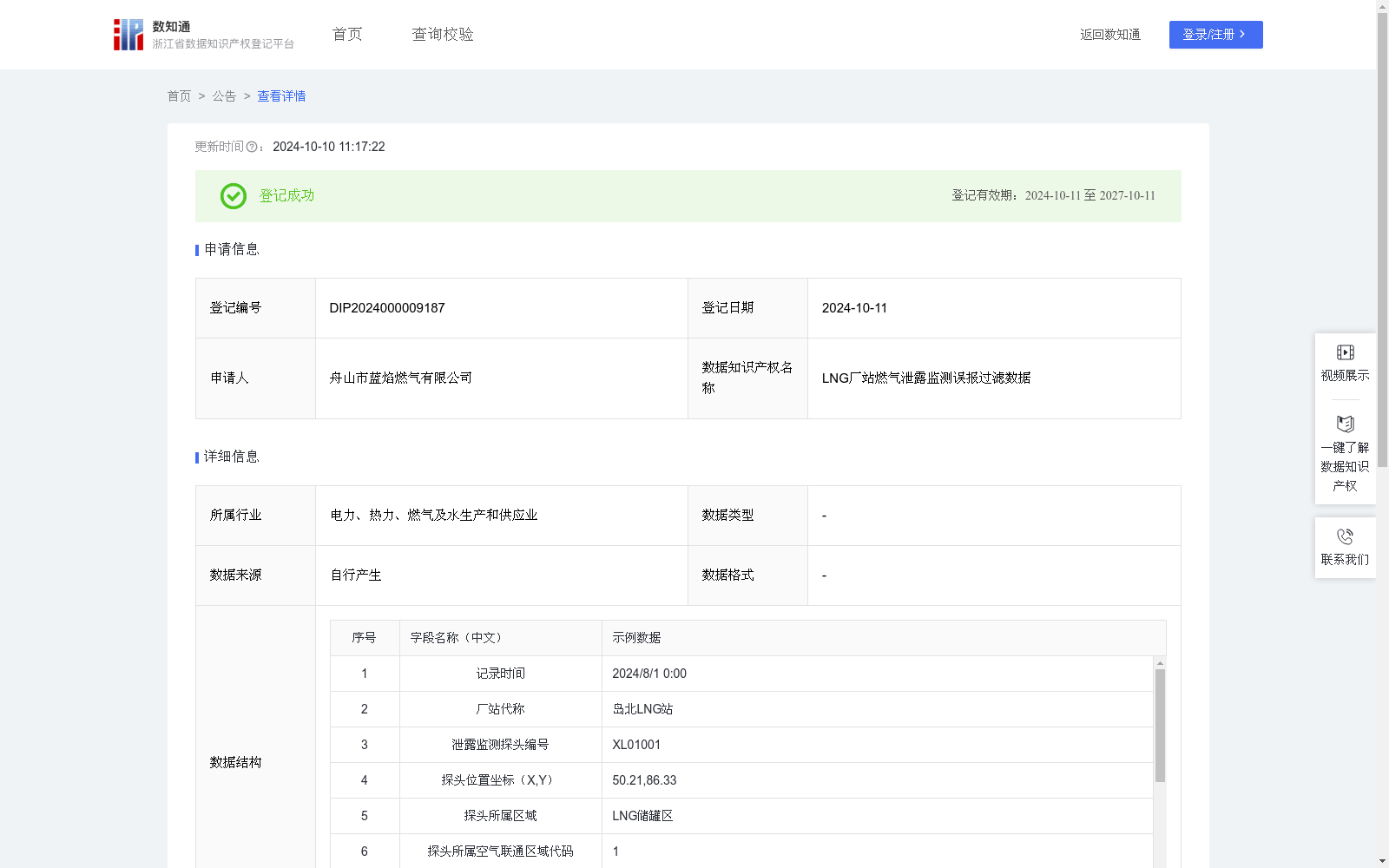
LNG厂站燃气泄露监测误报过滤数据
收藏资源简介:
通过整合LNG厂站燃气泄露传感器的记录编号、记录时间、厂站代称、泄露监测探头编号、探头位置坐标、探头所属区域、探头所属空气联通区域代码、泄露监测浓度、是否达到报警浓度、是否开启实时监测、是否为误报、是否预警、是否报警等数据,得出LNG厂站燃气泄露监测误报过滤数据;通过过滤误报,确保监测系统只对真正的泄露发出警报,减少因误报导致的不必要的应急响应和资源浪费,为LNG接收站、天然气燃气供应公司、海上油田、天然气加工企业、工业用户等提供安全数据参考,当出现泄露问题时更准确地识别潜在的泄漏风险,及时采取措施,防止事故发生。1.数据采集:通过对LNG厂站燃气泄露传感器的记录编号、记录时间、厂站代称、泄露监测探头编号、探头位置坐标、探头所属区域、探头所属空气联通区域代码、泄露监测浓度,进行采集整理汇总。 2.数据计算与预警判断:探头位置坐标根据场地建立坐标系进行确定;当泄露监测浓度大于1%LEL为达到报警浓度;当达到报警浓度时自动开启实时监测,替换原有的定时监测模式,以此产生持续的泄露监测浓度数据;当后续的泄露监测浓度在10秒内降低至1%LEL以下,则认为是误报,反之进入预警状态,通知相关人员排查;进入预警状态后筛选出与当前的泄露监测探头所属区域相同、所属空气联通区域代码相同的其他泄露监测探头,再通过探头位置坐标计算相对距离,选择与当前的泄露监测探头最近的10个泄露监测探头,均开启实时监测,当出现1个及以上的其他监测探头监测浓度大于1%LEL时,进入报警状态,再次通知相关人员,如其他监测探头监测浓度一直低于1%LEL,则维持预警状态,等待人工排查结果。 3.数据应用:通过过滤误报,确保监测系统只对真正的泄露发出警报,减少因误报导致的不必要的应急响应和资源浪费,识别潜在的泄漏风险,及时采取措施,防止事故发生。
This dataset focuses on false alarm filtering for gas leakage monitoring at LNG plants and stations. It is constructed by integrating various data from gas leakage sensors, including record ID, record timestamp, station alias, leakage monitoring probe ID, probe location coordinates, probe affiliated area, air-connected area code of the probe, leakage monitoring concentration, whether the alarm concentration threshold is reached, whether real-time monitoring is enabled, whether it is a false alarm, whether early warning is triggered, and whether an alarm is activated. By filtering out false alarms, the monitoring system is guaranteed to only issue alarms for genuine gas leaks, reducing unnecessary emergency responses and resource waste caused by false alarms. It provides reliable safety data references for stakeholders such as LNG receiving terminals, natural gas supply companies, offshore oilfields, natural gas processing enterprises and industrial users, enabling more accurate identification of potential leakage risks and timely intervention to prevent accidents. 1. Data Collection: Collect, organize and summarize the following data from LNG plant and station gas leakage sensors: record ID, record timestamp, station alias, leakage monitoring probe ID, probe location coordinates, probe affiliated area, air-connected area code of the probe, and leakage monitoring concentration. 2. Data Calculation and Early Warning Judgment: First, the probe location coordinates are determined based on the site-established coordinate system. When the leakage monitoring concentration exceeds 1% LEL (Lower Explosive Limit), the alarm concentration threshold is considered reached. Once the alarm threshold is triggered, real-time monitoring will be automatically enabled to replace the original timed monitoring mode, generating continuous leakage monitoring concentration data. If the subsequent leakage monitoring concentration drops below 1% LEL within 10 seconds, this incident is deemed a false alarm; otherwise, the system enters the early warning state and notifies relevant personnel to conduct on-site inspections. After entering the early warning state, other leakage monitoring probes that share the same affiliated area and the same air-connected area code as the current probe will be screened out. Then, the relative distances between these probes and the current probe are calculated based on their location coordinates, and the 10 closest probes are selected to enable real-time monitoring. If one or more of these selected probes detect a concentration greater than 1% LEL, the system enters the formal alarm state and notifies relevant personnel again. If the monitoring concentrations of all selected probes remain below 1% LEL, the system maintains the early warning state and waits for the results of manual inspections. 3. Data Application: By filtering out false alarms, the monitoring system is ensured to only issue alarms for genuine gas leaks, reducing unnecessary emergency responses and resource waste caused by false alarms, identifying potential leakage risks, taking timely measures to prevent accidents.