juliensimon/vlass-radio-sources
收藏资源简介:
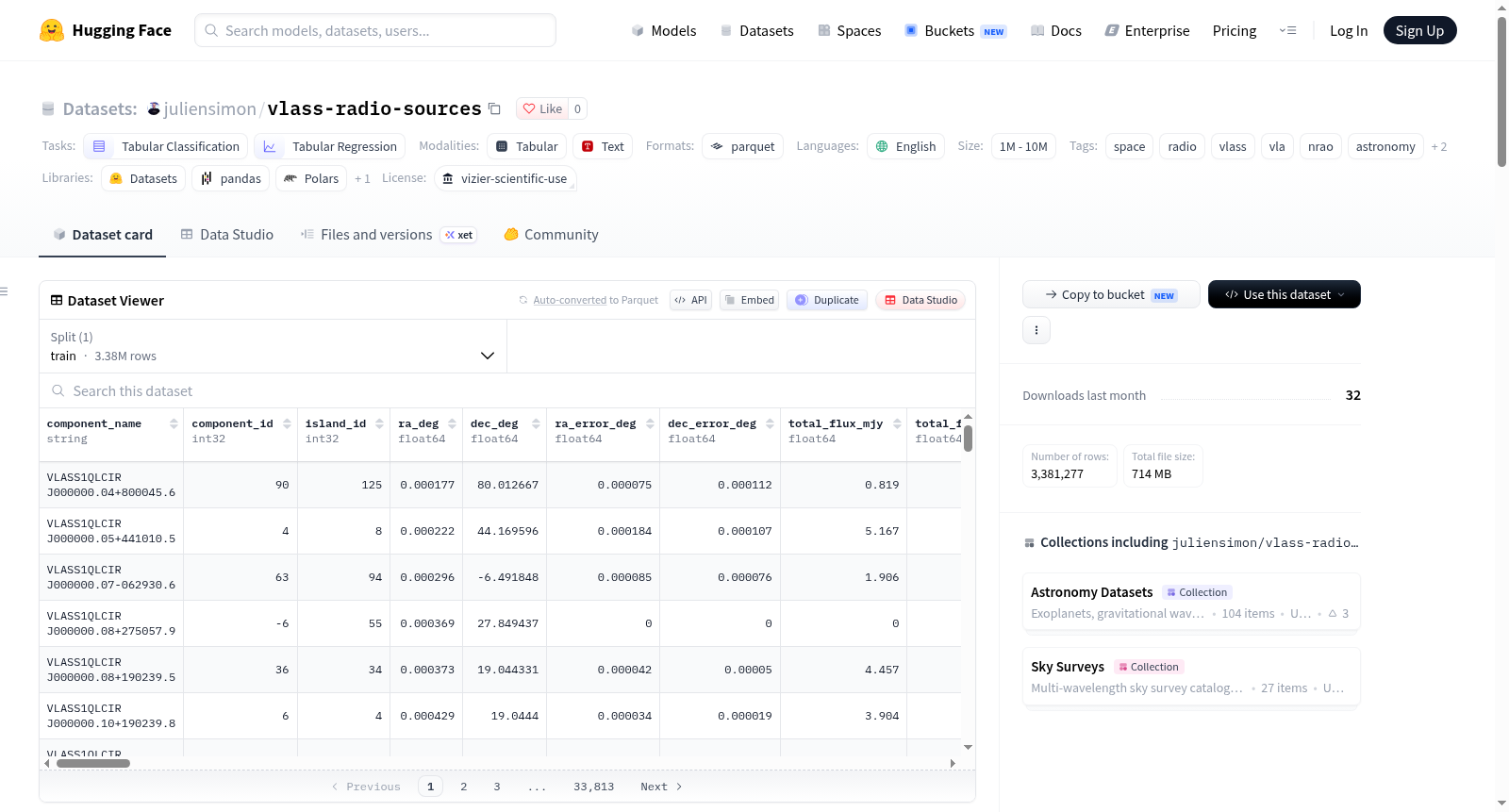
--- license: other license_name: vizier-scientific-use license_link: https://cds.unistra.fr/vizier-org/licences_vizier.html pretty_name: "VLASS Radio Sources (Epoch 1)" language: - en description: "Very Large Array Sky Survey (VLASS) Epoch 1 Quick Look component catalog with 3,381,277 radio source detections at 2-4 GHz (S-band)." task_categories: - tabular-classification - tabular-regression tags: - space - radio - vlass - vla - nrao - astronomy - open-data - tabular-data size_categories: - 1M<n<10M configs: - config_name: default data_files: - split: train path: data/vlass_radio_sources.parquet default: true --- # VLASS Radio Sources (Epoch 1) *Part of the [Astronomy Datasets](https://huggingface.co/collections/juliensimon/astronomy-datasets-69c24caf2f17e36128946743) collection on Hugging Face.* The Very Large Array Sky Survey (VLASS) Epoch 1 Quick Look component catalog from CIRADA, containing **3,381,277** radio source detections at S-band (2-4 GHz) with ~2.5 arcsecond resolution, covering the sky north of declination -40 degrees. VLASS is the modern successor to NVSS and FIRST, offering higher resolution and multi-epoch coverage. ## Dataset description VLASS is a synoptic all-sky radio survey using the Karl G. Jansky Very Large Array (VLA) in its B-configuration at S-band (2-4 GHz). The survey covers the entire sky visible to the VLA (declination > -40 deg, ~33,885 sq. deg.) in three epochs. This catalog contains Quick Look component detections from Epoch 1, processed by the Canadian Initiative for Radio Astronomy Data Analysis (CIRADA). Each row is a Gaussian component fitted to a radio detection using PyBDSF. Of the 3,381,277 total detections, **1,880,195** are in the curated main sample (duplicate-free, quality-filtered) and **1,826,680** are resolved sources. ## Key columns | Column | Type | Description | |--------|------|-------------| | `component_name` | string | IAU component name (VLASS1QLCIR JHHMMSS.ss+DDMMSS.s) | | `ra_deg` | float64 | Right ascension J2000 (degrees) | | `dec_deg` | float64 | Declination J2000 (degrees) | | `total_flux_mjy` | float64 | Integrated flux density at S-band (mJy) | | `peak_flux_mjy_beam` | float64 | Peak brightness at S-band (mJy/beam) | | `major_axis_arcsec` | float64 | Fitted major axis FWHM (arcsec) | | `minor_axis_arcsec` | float64 | Fitted minor axis FWHM (arcsec) | | `position_angle_deg` | float64 | Fitted position angle (degrees) | | `deconv_major_arcsec` | float64 | Deconvolved major axis (arcsec) | | `deconv_minor_arcsec` | float64 | Deconvolved minor axis (arcsec) | | `island_rms_mjy_beam` | float64 | Local rms noise (mJy/beam) | | `source_code` | string | Component type: S(ingle), C(omplex), M(ultiple), E(xtended) | | `nvss_distance_arcsec` | float64 | Angular separation from nearest NVSS source (arcsec) | | `first_distance_arcsec` | float64 | Angular separation from nearest FIRST source (arcsec) | | `duplicate_flag` | Int32 | Duplicate detection flag (0=unique) | | `quality_flag` | Int32 | Quality flag (0=good) | | `main_sample` | Int32 | Main sample membership (1=curated subset) | | `is_resolved` | bool | True if deconvolved major axis > 0 | Full schema includes 70 columns with uncertainties, beam properties, and image-plane measurements. ## Quick stats - **3,381,277** total component detections - **1,880,195** main sample sources (quality-filtered, duplicate-free) - **1,826,680** resolved sources (54.0%) - Median peak flux: 1238.00 mJy/beam - Declination range: -40.0 to 89.8 degrees - Frequency: S-band (2-4 GHz), ~2.5 arcsec resolution ## Usage ```python from datasets import load_dataset ds = load_dataset("juliensimon/vlass-radio-sources", split="train") df = ds.to_pandas() # Main sample only (quality-filtered) main = df[df["main_sample"] == 1] print(f"Main sample: {len(main):,} sources") # Flux distribution import matplotlib.pyplot as plt df["peak_flux_mjy_beam"].clip(upper=100).hist(bins=200, log=True) plt.xlabel("Peak flux (mJy/beam)") plt.ylabel("Count") plt.title("VLASS Source Flux Distribution") plt.show() # Sky density map plt.hexbin(df["ra_deg"], df["dec_deg"], gridsize=100, mincnt=1) plt.colorbar(label="Source count") plt.xlabel("RA (deg)") plt.ylabel("Dec (deg)") plt.title("VLASS Epoch 1 Sky Density") plt.show() # Cross-match proximity to NVSS/FIRST has_nvss = df["nvss_distance_arcsec"] < 10 print(f"Within 10 arcsec of NVSS source: {has_nvss.sum():,}") ``` ## Data source Gordon, Y.A., et al. (2021), *A Catalog of Very Large Array Sky Survey (VLASS) Epoch 1 Quick Look Components, Version 2.* Astrophysical Journal Supplement Series, 255, 30. Processed by CIRADA. Via VizieR CDS (J/ApJS/255/30). ## Related datasets - [NVSS Radio Source Catalog](https://huggingface.co/datasets/juliensimon/nvss-radio-catalog) — predecessor 1.4 GHz survey, 1.8M sources - [FIRST Radio Survey Catalog](https://huggingface.co/datasets/juliensimon/first-radio-catalog) — predecessor high-resolution 1.4 GHz survey ## Pipeline Source code: [juliensimon/space-datasets](https://github.com/juliensimon/space-datasets) ## Citation ```bibtex @dataset{vlass_radio_sources, author = {Simon, Julien}, title = {VLASS Radio Sources (Epoch 1)}, year = {2026}, publisher = {Hugging Face}, url = {https://huggingface.co/datasets/juliensimon/vlass-radio-sources}, note = {Based on Gordon et al. (2021) via VizieR CDS} } ``` ## License [VizieR Scientific-Use Terms](https://cds.unistra.fr/vizier-org/licences_vizier.html)
Very Large Array Sky Survey (VLASS) Epoch 1 Quick Look component catalog with 3,381,277 radio source detections at 2-4 GHz (S-band).