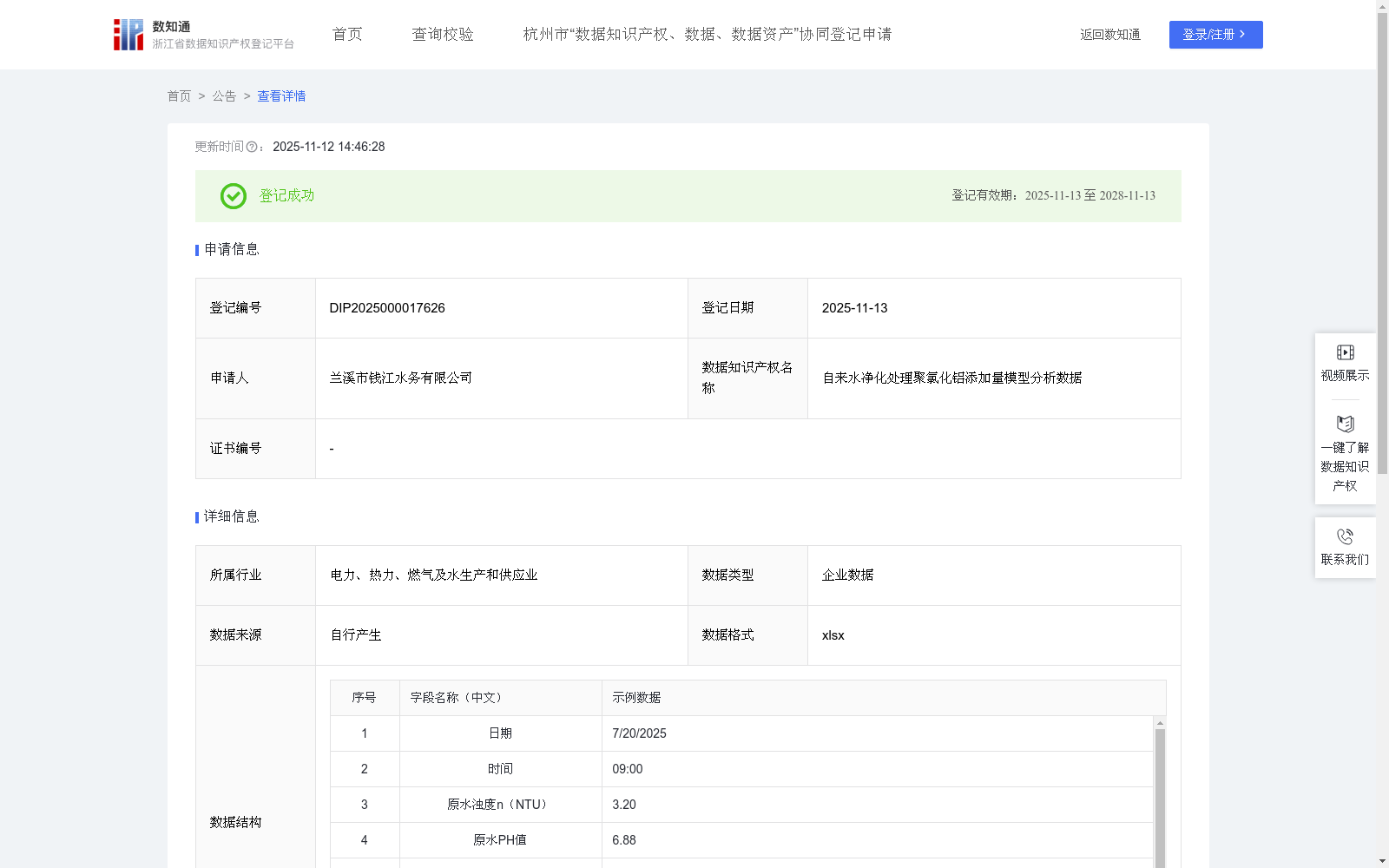
自来水净化处理聚氯化铝添加量模型分析数据
收藏资源简介:
聚氯化铝是水质净化领域常用的关键药剂,尤其在水处理的混凝阶段发挥重要作用。在自来水水处理生产过程中,浊度变化、PH 值波动与聚氯化铝药剂添加量有密切联系。它们共同构成反映工艺运行状态的核心数据链。可为产业链上的不同主体在生产、监管过程提供数据支撑: 1、为药剂生产厂家改进药剂生产工艺,优化药剂配方,提升药剂对复杂水质的适应能力,提高药剂释放效能提供支持。 2、水厂可依据原水、出水实时浊度与 PH 值变化,动态调整加药策略,建立 “水质 - 加药” 最优匹配模式,避免药剂浪费或用量不足,确保出水始终符合干净卫生的饮用标准,让用户喝上放心水。 3、|偏差率|≤2%可确保加矾量数据准确,水厂可避免因数据虚高或虚低导致成本核算不准。1、数据采集于本企业内部,每日每1小时采集:原水浊度(NTU)、原水PH值出厂水PH值、出厂水浊度(NTU)、出厂水余氯(mg/L)2、对采集到的数据进行预处理,去除异常值、统一格式。 3、根据企业历史数据进行训练,建立算法模型: 预测加矾量(L/h)=511.606 + 3.594*原水浊度(NTU)-24.033*原水PH值-30.743*出厂水PH值-65.658*出厂水浊度(NTU)-55.528*出厂水余氯(mg/L) 预测聚氯化铝添加量(L/h)=加矾量(L/h)/1.1(指定的系数)/1.2(密度) 偏差率 =(实际聚氯化铝用量(L/h)-预测聚氯化铝用量(L/h))/预测聚氯化铝用量(L/h)。计算结果保留2位小数,有可能会导致部分数据有近似误差。 4、数据运用:通过监控加矾量偏差率,将其控制在|偏差率|≤2%的范围内,可以实现成本的有效控制。水厂可以根据这个数据结果,制定成本预算和控制策略,在保证水质的前提下,降低聚氯化铝的使用成本。
Poly aluminum chloride (PAC) is a key coagulant commonly used in water purification, especially playing a critical role in the coagulation stage of water treatment. In the tap water treatment production process, changes in turbidity and fluctuations in pH value are closely correlated with the dosage of poly aluminum chloride. Together, they form the core data chain reflecting the operating status of the process, which can provide data support for different entities in the industrial chain during production and supervision: 1. For pharmaceutical manufacturers: This data can support them to optimize production processes, improve agent formulations, enhance the adaptability of products to complex water quality, and boost the release efficiency of the agent. 2. For water treatment plants: They can dynamically adjust the dosing strategy based on real-time changes in raw water and effluent turbidity and pH values, establish an optimal "water quality - dosing" matching model, avoid waste or insufficient dosage of the agent, ensure that the effluent consistently meets clean and hygienic drinking standards, and enable users to drink safe water. 3. Controlling the deviation rate within |≤2% can ensure the accuracy of alum dosing data, helping water plants avoid inaccurate cost accounting caused by excessively high or low reported data. The dataset processing workflow is as follows: 1. Data collection: Data is collected internally within the enterprise every 1 hour every day, including raw water turbidity (NTU), raw water pH value, effluent pH value, effluent turbidity (NTU), and effluent residual chlorine (mg/L). 2. Data preprocessing: Remove outliers and unify the format of the collected data. 3. Algorithm model establishment: Train an algorithm model based on the enterprise's historical data: Predicted alum dosage (L/h) = 511.606 + 3.594 × raw water turbidity (NTU) - 24.033 × raw water pH - 30.743 × effluent pH - 65.658 × effluent turbidity (NTU) - 55.528 × effluent residual chlorine (mg/L) Predicted poly aluminum chloride dosage (L/h) = Predicted alum dosage (L/h) / 1.1 (specified coefficient) / 1.2 (density) Deviation rate = (Actual poly aluminum chloride dosage (L/h) - Predicted poly aluminum chloride dosage (L/h)) / Predicted poly aluminum chloride dosage (L/h). The calculation results are rounded to 2 decimal places, which may introduce approximate errors in some data. 4. Data application: By monitoring the deviation rate of alum dosage and controlling it within the range of |deviation rate| ≤ 2%, effective cost control can be achieved. Water plants can formulate cost budgets and control strategies based on this data, reducing the usage cost of poly aluminum chloride while ensuring water quality.