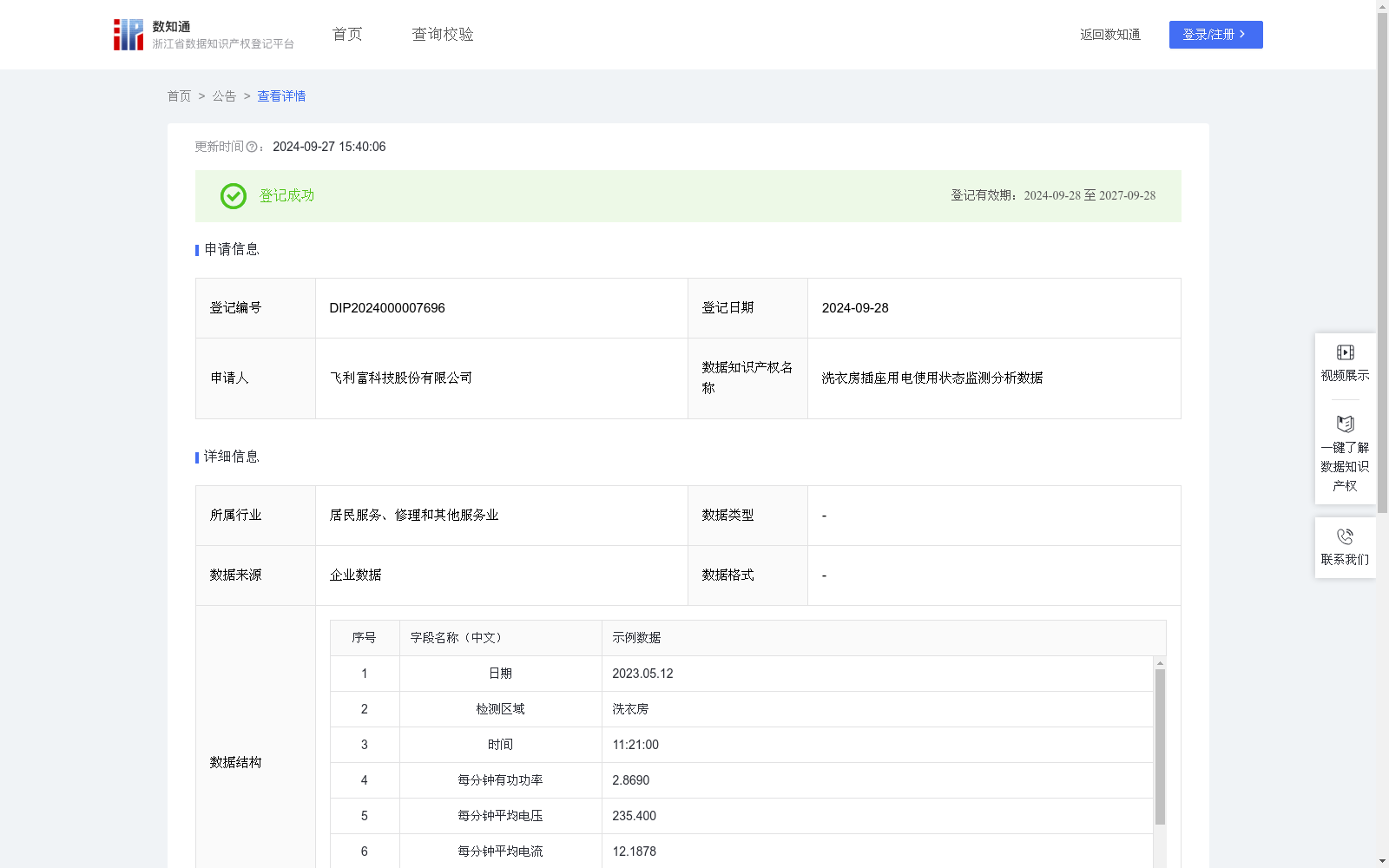
洗衣房插座用电使用状态监测分析数据
收藏资源简介:
对洗衣房使用的插座进行管理,采集插座的多个监测信息,包括:插座温度、插座所处环境的烟雾浓度、插座的电路信息;电路信息包括:功率、电压、电流。防止插座插排及用电设备出现用电危险,减少火灾隐患。对该数据分析可直接反馈和识别插座的使用状态是否正常,还可利用日常采集到的数据自动生成用电安全报告,对日常的隐患进行汇总分析,更加直观的了解隐患情况。数据来自于对洗衣房使用的插座进行日常使用数据监测和读取。对插座采集的数据包括:插座温度、插座所处环境的烟雾浓度、插座每分钟的平均功率、电压、电流,对读取到的数据进行预设范围计算分析。预设范围如:插座内的温度不大于50摄氏度,反馈值为0,否则为1;插座所处环境的烟雾浓度不大于100ppm,反馈值为0,否则为1;插座的功率不大于3.5kW,反馈值为0,否则为1;插座的电压不大于250V,反馈值为0,否则为1。对各反馈值进行叠加,得到总反馈值。根据总反馈值可以判断插座是否故障,若总反馈值为0,则插座状态正常;总反馈值为1,则插座状态异常;总反馈值大于1,则报警。将预设判断条件量化,可直观体现插座的使用状态,保证了插座的使用安全性。
This dataset is designed for managing sockets deployed in laundries, by collecting multiple monitoring metrics including socket temperature, smoke concentration in the socket's surrounding environment, and circuit-related information of the socket. The circuit information covers power, voltage and current. The core objectives of this dataset are to prevent electrical hazards from sockets, power strips and connected electrical equipment, and mitigate fire risks. Analysis of the collected data can directly provide feedback and identify the normality of the socket's operating state. Additionally, the daily collected data can be utilized to automatically generate electrical safety reports, conduct summary analysis of daily potential hazards, and enable a more intuitive understanding of the hidden danger situation. The data in this dataset is sourced from daily monitoring and reading of the operating data of sockets used in laundries. The collected socket data includes: socket temperature, smoke concentration in the socket's surrounding environment, and the average power, voltage and current of the socket per minute. The acquired data is analyzed against preset threshold rules as follows: 1. For internal socket temperature: if the value is no greater than 50°C, the feedback value is 0; otherwise, it is 1; 2. For surrounding smoke concentration: if the value is no greater than 100ppm, the feedback value is 0; otherwise, it is 1; 3. For socket power: if the value is no greater than 3.5kW, the feedback value is 0; otherwise, it is 1; 4. For socket voltage: if the value is no greater than 250V, the feedback value is 0; otherwise, it is 1. All individual feedback values are summed to obtain the total feedback value, based on which the socket's operating state can be determined: if the total feedback value is 0, the socket is in normal state; if the total feedback value is 1, the socket is in abnormal state; if the total feedback value is greater than 1, an alarm will be triggered. Quantifying these preset judgment criteria can intuitively reflect the socket's operating state, thereby ensuring the safety of socket usage.