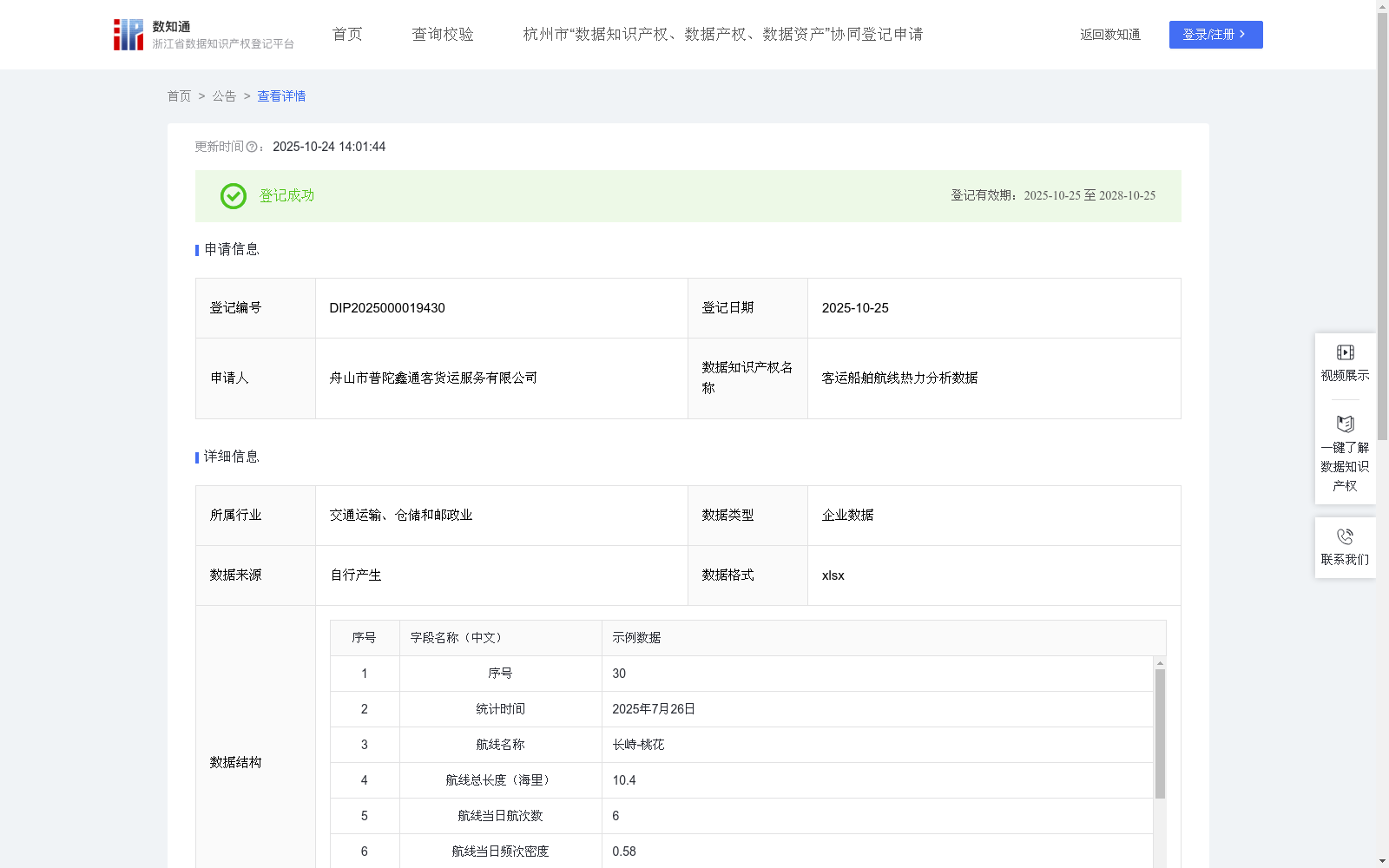
客运船舶航线热力分析数据
收藏资源简介:
一、适用条件与范围 适用于客运船舶航运企业,数据范围覆盖公司全部客运航线及每日全量航次动态。 二、适用对象 客运船舶航运企业的运营调度部门、市场规划部门,以及港口管理方、行业监管机构等外部合作伙伴。 三、解决的问题 解决航线运营效率评估粗放、资源(运力、泊位、人力)配置凭经验的问题,精准识别核心高价值航线与待优化潜力航线。 四、核心价值点 通过多维度算法(频次密度、区域权重、长度系数)量化航线真实热力,形成“高-中-低”三级分类,为精细化运营提供直接数据决策支持。 五、外部复用价值 为港口安排泊位与调度计划提供预测参考;为行业监管方分析区域航运网络活跃度与规划基础设施提供量化依据。1、数据采集:每日从公司内部的环岛客运船舶智能动态监控系统中提取全量的航线航次记录,采集字段包括航线名称、航线总长度(海里)、航线当日航次数。 2、数据处理:统计当日区域内所有发班的客运船舶航线数量,得出当日区域内航线总数。 3、算法加工: 航线每日频次密度=航线当日航次数/航线总长度; 航线当日区域内权重=航线当日航次数/当日区域内航线总数,本字段主要用于反映该航线在区域内的相对活跃度; 航线总长度系数=㏑(1+航线总长度),本字段主要为了反映航线的真实繁忙程度(航线热力权重指数),因为航线总长度越长,单位距离的运输热力越低,取对数可避免极端值影响,平衡航线长度带来的影响。加1是一个技术性操作,主要是为了保证系数始终大于1,因为 l㏑(1)=0,如果航线长度是1海里,㏑(1)=0,会导致航线总长度系数为0,分母为0在数学上是不允许的(除以0无意义),加1可确保即使最短的航线长度为1海里,系数也至少是1+0=1; 航线热力权重指数=航线当日航次数×航线当日频次密度×航线当日区域内权重/航线总长度系数; 航线热力权重指数排名的规则:把所有的航线热力权重指数从高到低进行排列,指数越高,排名越靠前。 航线热力等级划分的规则:按航线热力权重指数排名划档,排名在前20%为"高热力",排名在20%-70%为"中热力",排名在后30%为"低热力"。 4、数据应用 高热力(前20%):核心航线,资源优先保障; 中热力(中间50%):常规航线,维持运营; 低热力(后30%):潜力或优化航线,需关注。
1. Application Conditions and Scope Applicable to passenger shipping enterprises, with the data scope covering all the company's passenger shipping routes and full daily dynamic voyage records. 2. Target Applicants Operational scheduling departments, market planning departments of passenger shipping enterprises, as well as external partners such as port management authorities and industry regulatory agencies. 3. Solved Problems Address the issues of extensive assessment of route operation efficiency and empirical-based resource (shipping capacity, berths, manpower) allocation, and accurately identify core high-value routes and potential routes requiring optimization. 4. Core Value Quantify the true heat of routes through multi-dimensional algorithms (frequency density, regional weight, length coefficient), form a three-level classification of "High-Medium-Low", and provide direct data decision support for refined operations. 5. External Reusability Value Provide predictive reference for ports to arrange berths and dispatch plans; provide quantitative basis for industry regulators to analyze regional shipping network activity and plan infrastructure. 1. Data Collection Extract full route voyage records daily from the company's internal Intelligent Dynamic Monitoring System for Circular Island Passenger Ships. The collected fields include route name, total route length (nautical miles), and number of daily voyages on the route. 2. Data Processing Count the number of passenger shipping routes operated in the region on the day to obtain the total number of routes in the region on that day. 3. Algorithm Processing - Daily route frequency density = Number of daily voyages on the route / Total route length; - Daily regional weight of the route = Number of daily voyages on the route / Total number of routes in the region on the day. This field is mainly used to reflect the relative activity of the route within the region; - Total route length coefficient = ln(1 + Total route length). This field is mainly used to reflect the true busyness of the route (route heat weight index), as the longer the total route length, the lower the transportation heat per unit distance. Using the natural logarithm can avoid the impact of extreme values and balance the influence of route length. Adding 1 is a technical operation to ensure that the coefficient is always greater than 1, since ln(1)=0. If the route length is 1 nautical mile, ln(1)=0, which would make the total route length coefficient 0, leading to a mathematically invalid division by zero. Adding 1 ensures that even for the shortest route with a length of 1 nautical mile, the coefficient is at least 1+0=1; - Route heat weight index = Number of daily voyages on the route × Daily route frequency density × Daily regional weight of the route / Total route length coefficient; - Ranking rule for route heat weight index: Sort all route heat weight indexes in descending order, with higher indexes corresponding to higher rankings; - Route heat level classification rule: Divide grades based on the ranking of route heat weight indexes. The top 20% of the ranking are classified as "High Heat", 20%-70% as "Medium Heat", and the bottom 30% as "Low Heat". 4. Data Application - High Heat (Top 20%): Core routes, with priority resource guarantee; - Medium Heat (Middle 50%): Regular routes, maintain normal operations; - Low Heat (Bottom 30%): Potential or optimized routes, requiring close attention.