青藏高原水资源承载状态数据(2000-2020)
收藏资源简介:
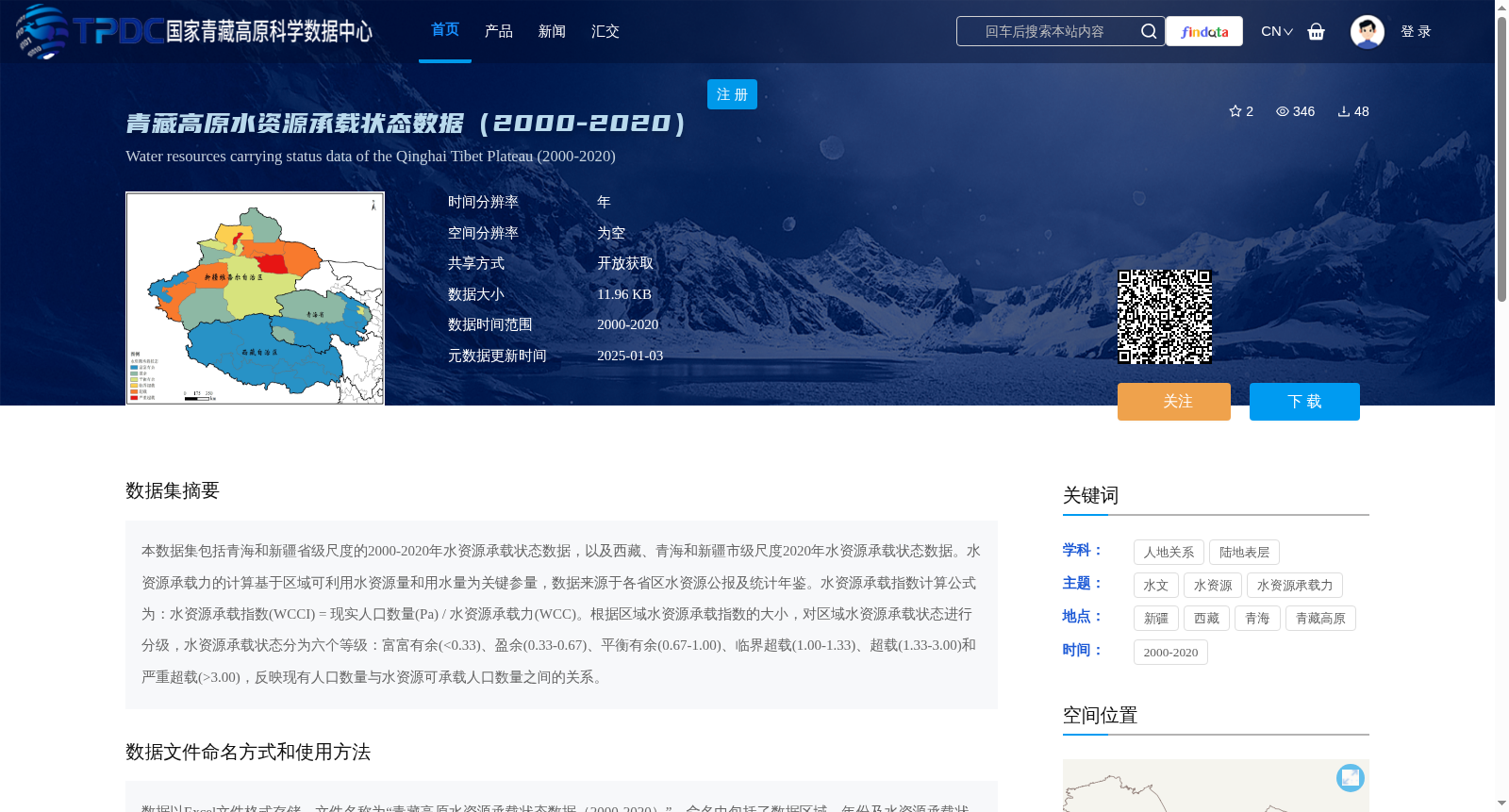
本数据集包括青海和新疆省级尺度的2000-2020年水资源承载状态数据,以及西藏、青海和新疆市级尺度2020年水资源承载状态数据。水资源承载力的计算基于区域可利用水资源量和用水量为关键参量,数据来源于各省区水资源公报及统计年鉴。水资源承载指数计算公式为:水资源承载指数(WCCI) = 现实人口数量(Pa) / 水资源承载力(WCC)。根据区域水资源承载指数的大小,对区域水资源承载状态进行分级,水资源承载状态分为六个等级:富富有余(<0.33)、盈余(0.33-0.67)、平衡有余(0.67-1.00)、临界超载(1.00-1.33)、超载(1.33-3.00)和严重超载(>3.00),反映现有人口数量与水资源可承载人口数量之间的关系。
This dataset includes water resources carrying capacity status data at the provincial scale for Qinghai and Xinjiang from 2000 to 2020, as well as municipal-scale water resources carrying capacity status data for Tibet, Qinghai, and Xinjiang in 2020. The calculation of water resources carrying capacity (WRCC) takes regional available water resources and water consumption as key parameters, with all data sourced from the water resources bulletins and statistical yearbooks of the respective provinces and autonomous regions. The formula for the water resources carrying capacity index (WCCI) is: WCCI = Actual Population (Pa) / Water Resources Carrying Capacity (WCC). Regional water resources carrying status is categorized into six grades based on the WCCI value: abundant surplus (<0.33), surplus (0.33–0.67), balanced surplus (0.67–1.00), critical overloading (1.00–1.33), overloading (1.33–3.00), and severe overloading (>3.00). This classification reflects the relationship between the actual local population and the population that can be supported by the regional water resources.