
Copper and Iron composition
收藏DataCite Commons2025-06-01 更新2024-08-18 收录
下载链接:
https://figshare.com/articles/dataset/Copper_and_Iron_composition/24637368/1
下载链接
链接失效反馈官方服务:
资源简介:
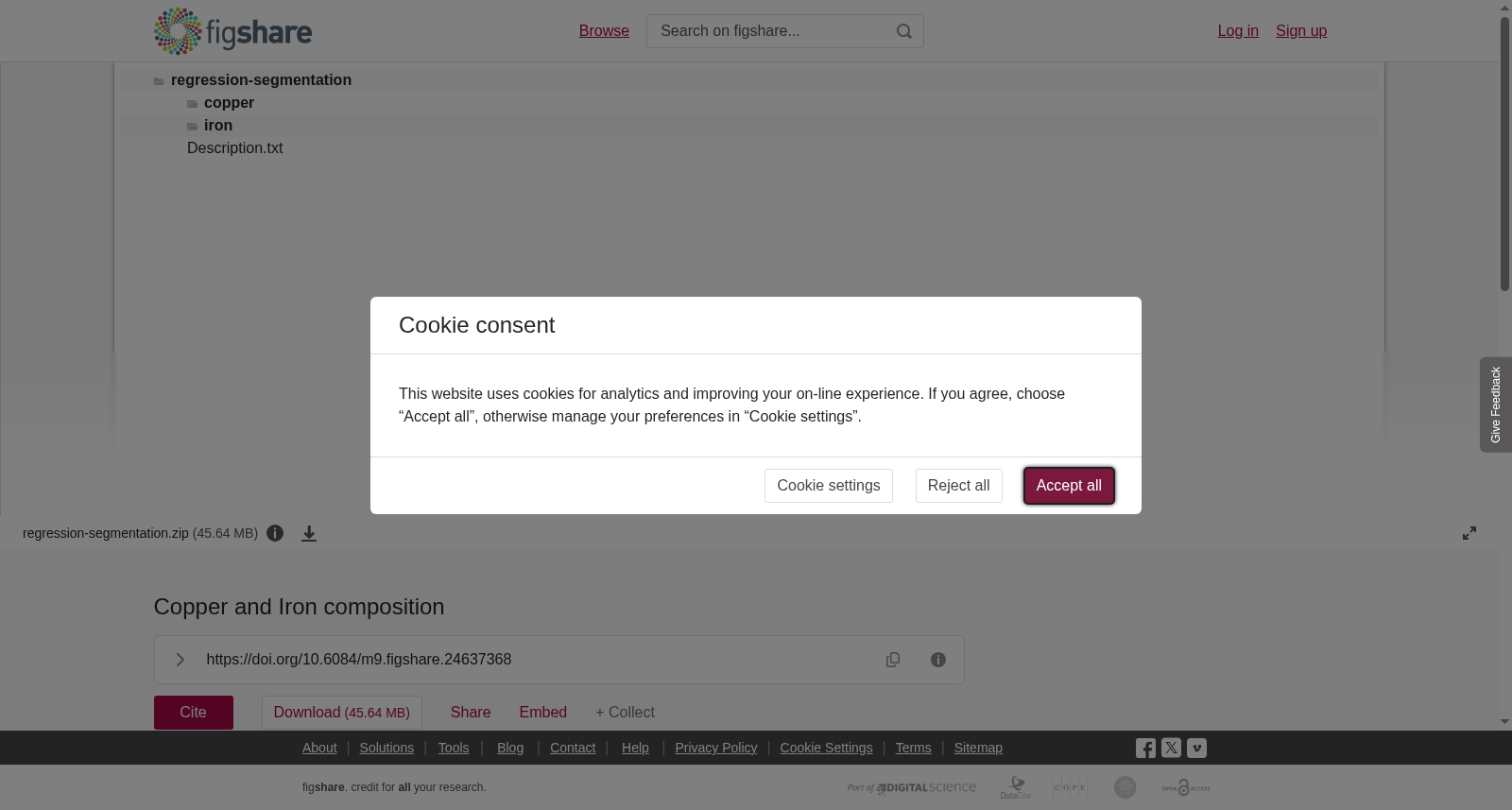
The data sets contain one folder dedicated to copper and one to iron. Each of them can be used for two distinct purposes: regression and image segmentation. For regression, the microscopical images from the "copper-images" and "iron-images" folders can be used directly. The file names contain the XRF approximation of elemental composition for several elements. These represent the ground truth. The string encoding has the following format:element1_value1__element2_value2__element3_value3 - object name__i.jpg Example: Cu_0.03__Fe_98.16__P_0.14__Si_1.49__6 - Cui roman - fier - inainte__1.jpgThis reads that the copper is 0.03%, iron composition is 98.16% etc. and the image is the first (last part, "__1", before ".jpg") from the object "Cui roman - fier - inainte". The images made for the same object will contain the same string for the object name. The information can be extracted using a string tokenizer.For image segmentation, the same images from "copper-images" and "iron-images" folders can be used together with the associated masks from "copper-labels" and "iron-labels". The label files have the same resolution and each pixel value corresponds to a certain class. The classes are provided in the text files "copper-codes.txt" and "iron-codes.txt". The file names of the images used for validation and test purposes are given in the text files "copper-valid.txt", "iron-valid.txt", "copper-test.txt", and "iron-test.txt", respectively. The data set is described in the article below. Results on the data can be found in the article, as well.Ruxandra Stoean, Nebojsa Bacanin, Catalin Stoean, Leonard Ionescu, Miguel Atencia, Gonzalo Joya, Computational Framework for the Evaluation of the Composition and Degradation State of Metal Heritage Assets by Deep Learning, Journal of Cultural Heritage, 64, pp.198-206, 2023, https://doi.org/10.1016/j.culher.2023.10.007.If you publish material based on the current database, please refer the paper above within the References.The study took part within the project Object PErception and Reconstruction with deep neural Architectures (OPERA) https://sites.google.com/view/pce-opera/.
该数据集包含两个专属文件夹,分别对应铜(copper)与铁(iron)样本,二者均可用于两项截然不同的任务:回归分析与图像语义分割。
针对回归分析任务,可直接使用"copper-images"与"iron-images"文件夹中的显微图像。文件名包含多种元素的X射线荧光光谱法(XRF)估算成分值,该值即为模型训练的真值。文件名采用如下字符串编码格式:element1_value1__element2_value2__element3_value3 - object name__i.jpg。示例:Cu_0.03__Fe_98.16__P_0.14__Si_1.49__6 - Cui roman - fier - inainte__1.jpg,该示例表示铜元素占比0.03%、铁元素占比98.16%、磷元素占比0.14%、硅元素占比1.49%,该图像来自名为"Cui roman - fier - inainte"的样本,是该样本的第1张图像(文件名后缀".jpg"前的"__1"即代表图像序号)。同一样本的图像会包含完全一致的对象名字符串,可通过字符串分词器(string tokenizer)提取文件名中的相关信息。
针对图像语义分割任务,可将"copper-images"与"iron-images"文件夹中的图像,与"copper-labels"和"iron-labels"文件夹中的对应掩码(mask)搭配使用。标签文件与原图分辨率一致,每个像素值对应一个特定类别。类别信息可在"copper-codes.txt"与"iron-codes.txt"文本文件中查询。用于验证与测试的图像文件名分别存储于"copper-valid.txt"、"iron-valid.txt"、"copper-test.txt"与"iron-test.txt"文本文件中。
本数据集对应的研究成果已发表于以下论文:Ruxandra Stoean、Nebojsa Bacanin、Catalin Stoean、Leonard Ionescu、Miguel Atencia、Gonzalo Joya,《基于深度学习的金属文物资产成分与劣化状态评估计算框架》,《Journal of Cultural Heritage》(《文化遗产期刊》),第64卷,第198-206页,2023年,DOI: 10.1016/j.culher.2023.10.007。使用本数据集开展研究并发表成果时,请在参考文献中引用上述论文。
本研究依托"基于深度神经网络的目标感知与重建(Object PErception and Reconstruction with deep neural Architectures, OPERA)"项目开展,项目网址:https://sites.google.com/view/pce-opera/。
提供机构:
figshare创建时间:
2023-11-27
搜集汇总
数据集介绍
以上内容由遇见数据集搜集并总结生成


