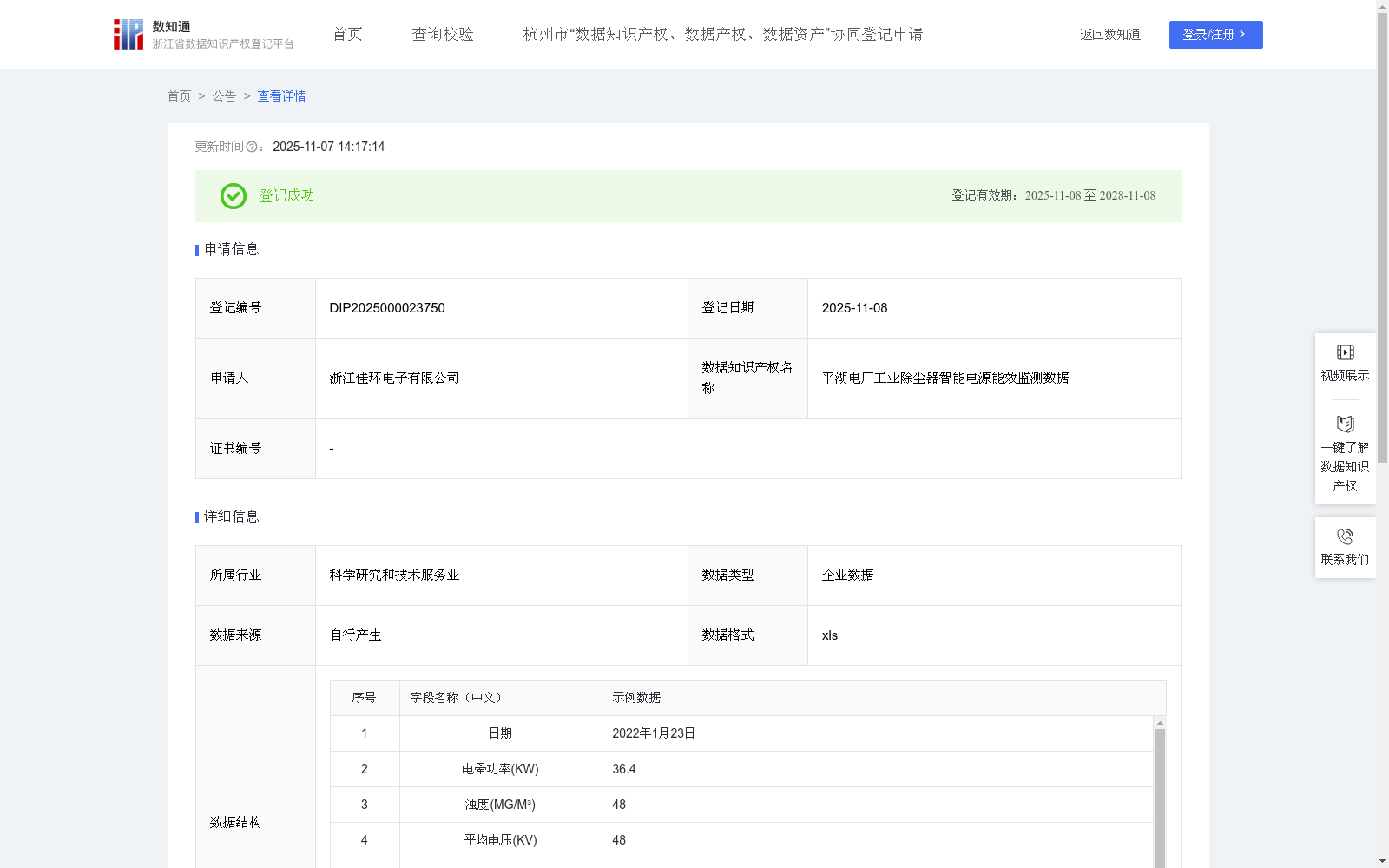
平湖电厂工业除尘器智能电源能效监测数据
收藏资源简介:
电除尘器因其除尘效率高、运行和维护费用低廉而广泛地适用于电力、冶金、石化、建材、机械、医药等行业中各种工业窑炉烟尘治理。特高频电源作为电除尘器的关键部件,具有工作频率高、体积小、重量轻、效率高等优点;在电除尘器中,特高频电源的应可以显著提高除尘效率,同时降低能耗。实时运行中,通过指数与预设阈值对比,动态调整电源输出(指数低则升压增流,高则降压限流),适配粉尘浓度变化;同时跟踪指数趋势,提前预警反电晕、电源老化等故障,还能量化评估设备/集群能效,建立分级标准。对行业而言,该数据破解“环保-能耗”矛盾,使电除尘器能耗降15%-25%,助力“双碳”;将传统经验运维转为数据驱动,统一运维标准,缩短人员培训周期;缩小粉尘排放波动,降低环保处罚与过度投资成本;更成为行业数字化基础,支撑设备数字孪生与企业服务转型,推动电除尘行业向精准、低碳、智能升级,推动了电除尘从“粗放运行”向“精准能效管控”的升级,在环保达标、节能降碳、智能化转型等方面具有不可替代的作用,符合国家“绿色制造”“数字经济”的发展战略。根据我司的JHGP高频电源(编号2313313543674716131)在发电厂的运行进行数据采集并分析,电场匹配指数 = (电晕功率 * 浊度) / (平均电压 * 平均电流)。 电晕功率*浊度,代表 “当前工况下的能量需求”浊度高(粉尘多)时,需要更高的电晕功率才能保证除尘效果,两者乘积直接体现 “负载与所需能量的匹配关系”。 平均电压 * 平均电流:近似等于电源的输出功率(电压* 电流 = 功率),代表“电源实际能提供的能量供给能力。 当 0.8阈值 ≤ 电场匹配指数 ≤1.2阈值:电源供给与工况需求匹配,无需调整,能耗与效率平衡,设备健康度高。 当电场匹配指数 < 0.8阈值:供给能力不足,需提升电源输出,电晕放电强度不足导致除尘效率下降;长期可能导致电极积灰加速; 当电场匹配指数 > 1.2阈值:供给过剩或需求异常,需降低电源输出或排查工况,且能耗浪费;过高电压可能引发电极击穿(拉弧),损伤电源。 根据电场匹配指数的 “能量需求” 与 “能量供给” 的比值,反映电源输出与电场负载的匹配度。
Electrostatic precipitators (ESPs) are widely applied in the power, metallurgy, petrochemical, building materials, machinery, pharmaceutical and other industries for flue gas treatment of various industrial kilns, thanks to their high dust removal efficiency and low operation and maintenance costs. As a key component of ESPs, ultra-high frequency (UHF) power supplies feature high operating frequency, compact size, light weight and high efficiency. Their application in ESPs can significantly improve dust removal efficiency while reducing energy consumption. In real-time operation, the power output can be dynamically adjusted by comparing the index with preset thresholds: boost voltage and current when the index is low, and reduce voltage and limit current when the index is high, to adapt to changes in dust concentration. Meanwhile, tracking the index trend enables early warning of faults such as back corona and power supply aging, and also allows quantitative evaluation of the energy efficiency of equipment/clusters and establishment of grading standards. For the entire industry, this dataset resolves the conflict between environmental protection and energy consumption, reducing ESP energy consumption by 15%-25% and supporting the "Double Carbon" goals. It transforms traditional experience-based operation and maintenance into data-driven practices, unifies operation and maintenance standards, and shortens staff training cycles. It also reduces dust emission fluctuations, lowers environmental protection penalties and excessive investment costs. Furthermore, it serves as the foundation for industry digitalization, supports equipment digital twin and enterprise service transformation, promotes the precise, low-carbon and intelligent upgrading of the ESP industry, and drives the transition of ESP operations from "extensive operation" to "precise energy efficiency control". It plays an irreplaceable role in meeting environmental protection standards, energy conservation and carbon reduction, and intelligent transformation, and aligns with the national development strategies of "Green Manufacturing" and "Digital Economy". Data collection and analysis are conducted based on the operation of our company's JHGP high-frequency power supply (serial number: 2313313543674716131) in power plants. The electric field matching index is defined as: (Corona Power * Turbidity) / (Average Voltage * Average Current). The product of Corona Power and Turbidity represents the "energy demand under current operating conditions". When turbidity is high (more dust), higher corona power is required to ensure dust removal effect; this product directly reflects the matching relationship between load and required energy. The product of Average Voltage and Average Current is approximately equal to the output power of the power supply (Voltage * Current = Power), representing the "actual energy supply capacity of the power supply". When 0.8×threshold ≤ Electric Field Matching Index ≤1.2×threshold: the power supply matches the operating condition demand, no adjustment is needed, energy consumption and efficiency are balanced, and the equipment health status is excellent. When Electric Field Matching Index < 0.8×threshold: the supply capacity is insufficient, the power output needs to be increased. Insufficient corona discharge intensity leads to reduced dust removal efficiency; long-term operation may accelerate electrode ash deposition. When Electric Field Matching Index >1.2×threshold: there is excess supply or abnormal demand, the power output needs to be reduced or the operating conditions need to be checked, which causes energy waste; excessively high voltage may cause electrode breakdown (arc discharge) and damage the power supply. The electric field matching index, based on the ratio of "energy demand" to "energy supply", reflects the matching degree between the power supply output and the electric field load.