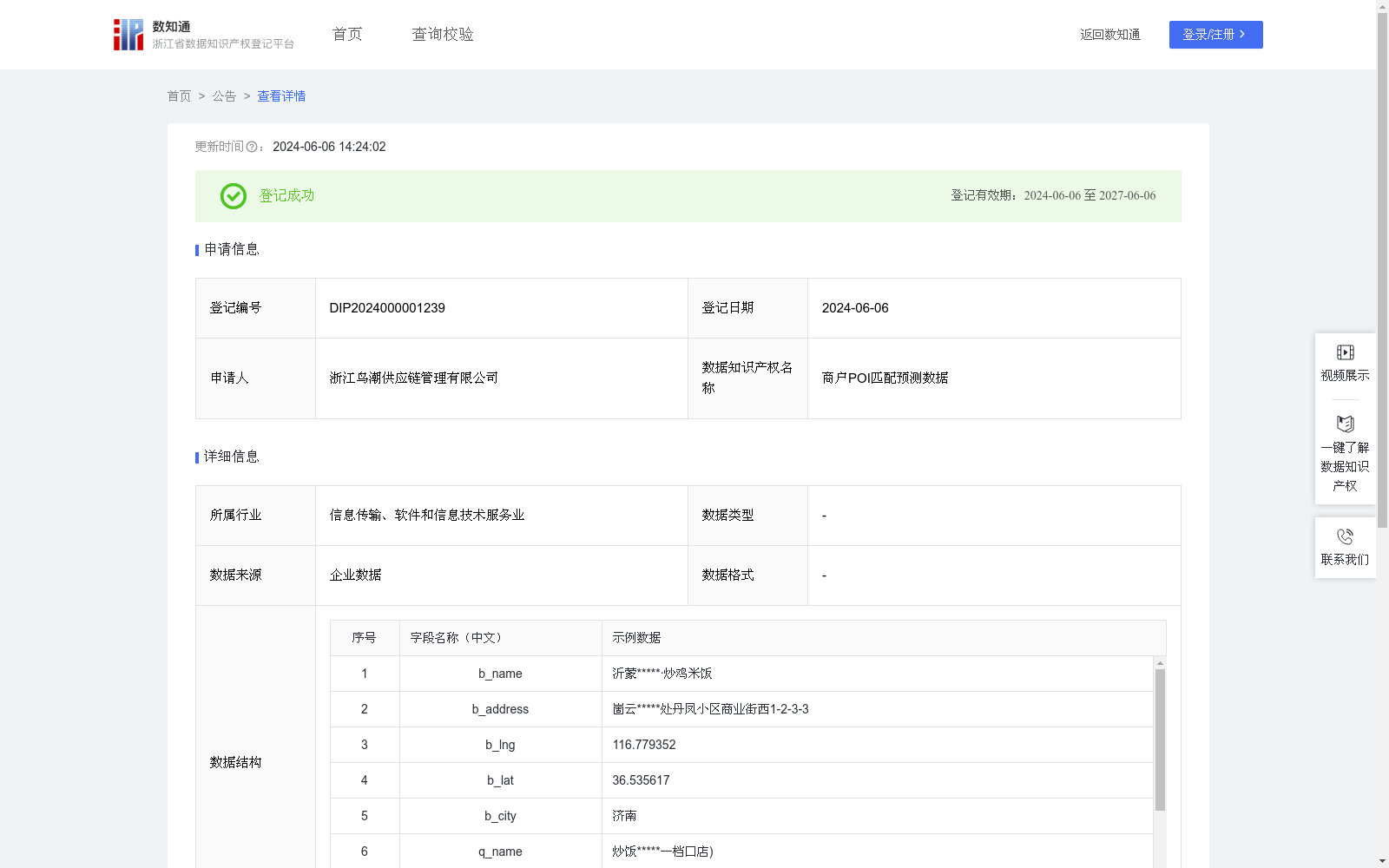
商户POI匹配预测数据
收藏资源简介:
本数据对于地图上POI零件进行匹配分析,帮助预测多个商户是否是现实世界的同一物理门店。POI零件匹配由信息处理、门店召回、模型预测三部分组成。1、商户信息规范化处理:对于商户POI的信息特征进行规范化处理,包括大小写转化、繁体简体转化、别名转化等,以保证门店信息格式一致;2、相似门店集召回:召回名称、经纬度相似的门店作为算法候选集合;3、模型预测:将名称(b_name、q_name)、地址(b_address、q_address)、经纬度(b_lng、b_lat、q_lng、q_lat)特征输入到BERT模型中得出相似门店的距离(dist),BERT模型会根据以上特征及距离进行综合打分(score),若分数大于0.5,则认为是现实世界的同一物理门店。
This dataset is designed for POI matching analysis on maps, aiming to predict whether multiple merchants correspond to the same physical store in the real world. The POI matching workflow consists of three stages: information processing, store recall, and model prediction. 1. Merchant information standardization: Standardize the information features of merchant POIs, including case conversion, conversion between traditional and simplified Chinese, alias normalization, etc., to ensure uniform formats of store information; 2. Similar store candidate recall: Recall stores with similar names and geographic coordinates as the algorithm's candidate set; 3. Model-based prediction: Input features including store names (b_name, q_name), addresses (b_address, q_address), and geographic coordinates (b_lng, b_lat, q_lng, q_lat) into the BERT model to calculate the similarity distance (dist) between candidate stores. The BERT model then generates a comprehensive similarity score (score) based on the aforementioned features and the calculated distance. If the score exceeds 0.5, the two stores are determined to be the same physical store in the real world.