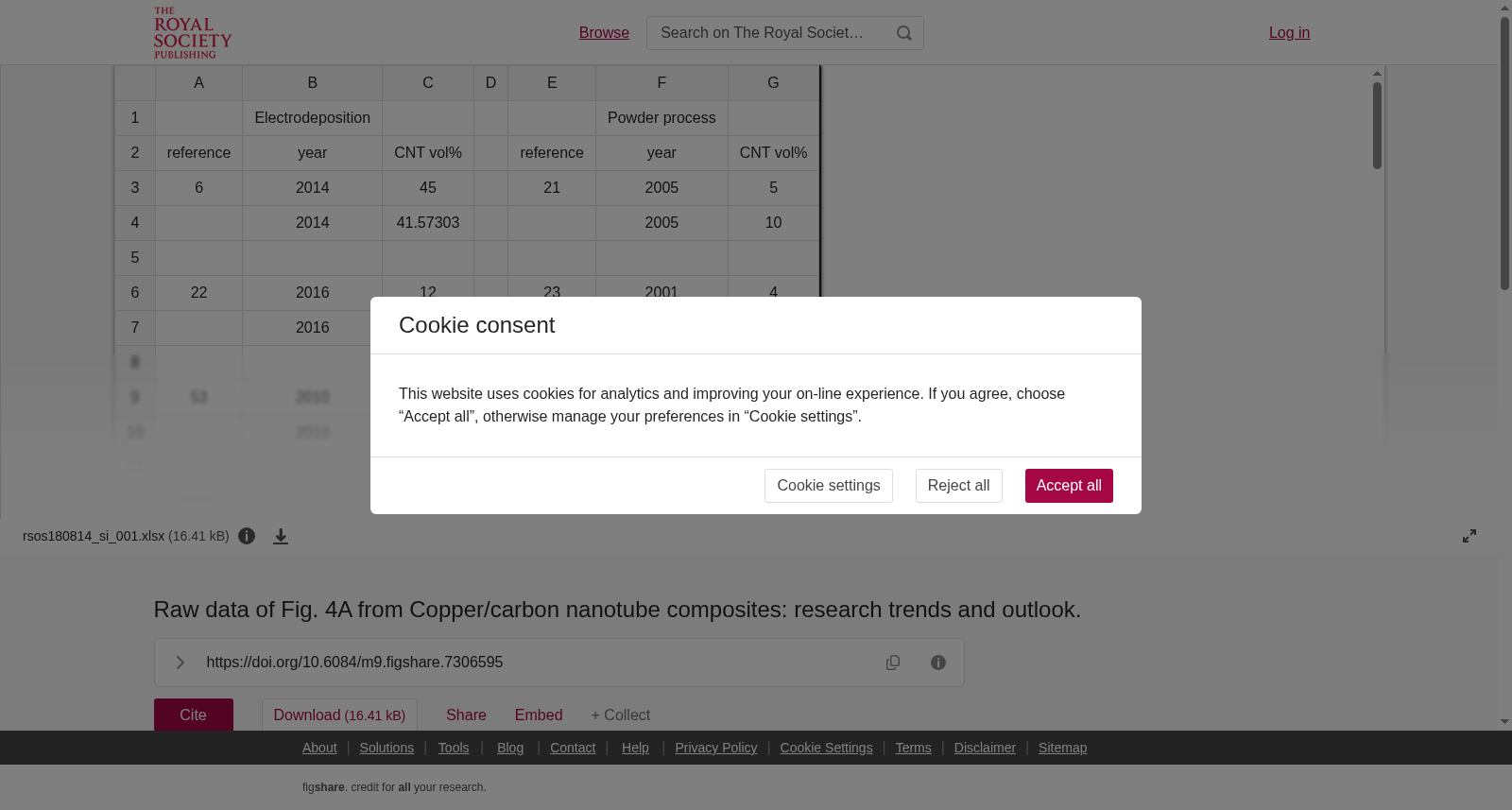
Raw data of Fig. 4A from Copper/carbon nanotube composites: research trends and outlook.
收藏资源简介:
We present research progress made in developing copper/carbon nanotube composites (Cu/CNT) to fulfil a growing demand for lighter copper substitutes with superior electrical, thermal and mechanical performances. Lighter alternatives to heavy copper electrical and data wiring are needed in automobiles and aircrafts to enhance fuel efficiencies. In electronics, better interconnects and thermal management components than copper with higher current- and heat-stabilities are required to enable device miniaturization with increased functionality. Our literature survey encouragingly indicates that Cu/CNT performances (electrical, thermal and mechanical) reported so far rival that of Cu, proving the material's viability as a Cu alternative. We identify two grand challenges to be solved for Cu/CNT to replace copper in real-life applications. The first grand challenge is to fabricate Cu/CNT with overall performances exceeding that of copper. To address this challenge, we propose research directions to fabricate Cu/CNT closer to ideal composites theoretically predicted to surpass Cu performances (i.e. <i>those containing uniformly distributed Cu and individually aligned CNTs with beneficial CNT–Cu interactions</i>). The second grand challenge is to industrialize and transfer Cu/CNT from lab bench to real-life use. Toward this, we identify and propose strategies to address market-dependent issues for niche/mainstream applications. The current best Cu/CNT performances already qualify for application in niche electronic device markets as high-end interconnects. However, mainstream Cu/CNT application as copper replacements in conventional electronics and in electrical/data wires are long-term goals, needing inexpensive mass-production by methods aligned with existing industrial practices. Mainstream electronics require cheap CNT template-making and electrodeposition procedures, while data/electrical cables require manufacture protocols based on co-electrodeposition or melt-processing. We note (with examples) that initiatives devoted to Cu/CNT manufacturing for both types of mainstream applications are underway. With sustained research on Cu/CNT and accelerating its real-life application, we expect the successful evolution of highly functional, efficient, and sustainable next-generation electrical and electronics systems.
本研究阐述了铜/碳纳米管复合材料(copper/carbon nanotube composites, Cu/CNT)的研发进展,旨在满足日益增长的轻量化铜基替代材料需求——这类材料需具备更优异的电学、热学与力学性能。汽车与航空航天领域亟需轻量化的铜质电气与数据布线替代材料,以提升燃油利用效率;电子器件领域则需要性能优于铜、具备更高电流与热稳定性的互连结构及热管理组件,以实现器件小型化与功能拓展。我们的文献综述结果令人鼓舞:目前已报道的Cu/CNT复合材料的电学、热学与力学性能已可与纯铜媲美,证实了该材料作为铜替代材料的可行性。 针对Cu/CNT复合材料在实际应用中替代纯铜的目标,我们明确了两大亟需解决的核心挑战。第一大挑战在于制备综合性能优于纯铜的Cu/CNT复合材料。为应对这一挑战,我们提出了研发方向,旨在制备更接近理论预测可超越纯铜性能的理想构型的Cu/CNT复合材料——即*基体铜均匀分散、碳纳米管(carbon nanotube, CNT)独立排列且二者间存在有益界面相互作用*的复合材料。第二大挑战在于实现Cu/CNT复合材料的工业化量产,推动其从实验室成果向实际应用转化。针对这一目标,我们明确并提出了相应策略,以解决细分与主流应用场景下的市场化相关问题。 当前已实现的最优Cu/CNT复合材料性能,已足以满足高端互连等高规格细分电子器件市场的应用需求。然而,将Cu/CNT复合材料作为铜替代材料应用于传统电子器件及电气/数据布线等主流场景,仍是长期目标,需通过契合现有工业生产体系的工艺实现低成本规模化量产。主流电子器件应用需实现低成本的碳纳米管模板制备与电沉积工艺,而数据/电气电缆则需开发基于共电沉积或熔融加工的制造工艺流程。我们注意到,针对上述两类主流应用场景的Cu/CNT复合材料工业化研发项目已在推进中(附相关案例)。随着对Cu/CNT复合材料研究的持续深入以及其实际应用的加速推进,我们期待高性能、高效率且可持续的下一代电气与电子系统能够成功实现迭代升级。