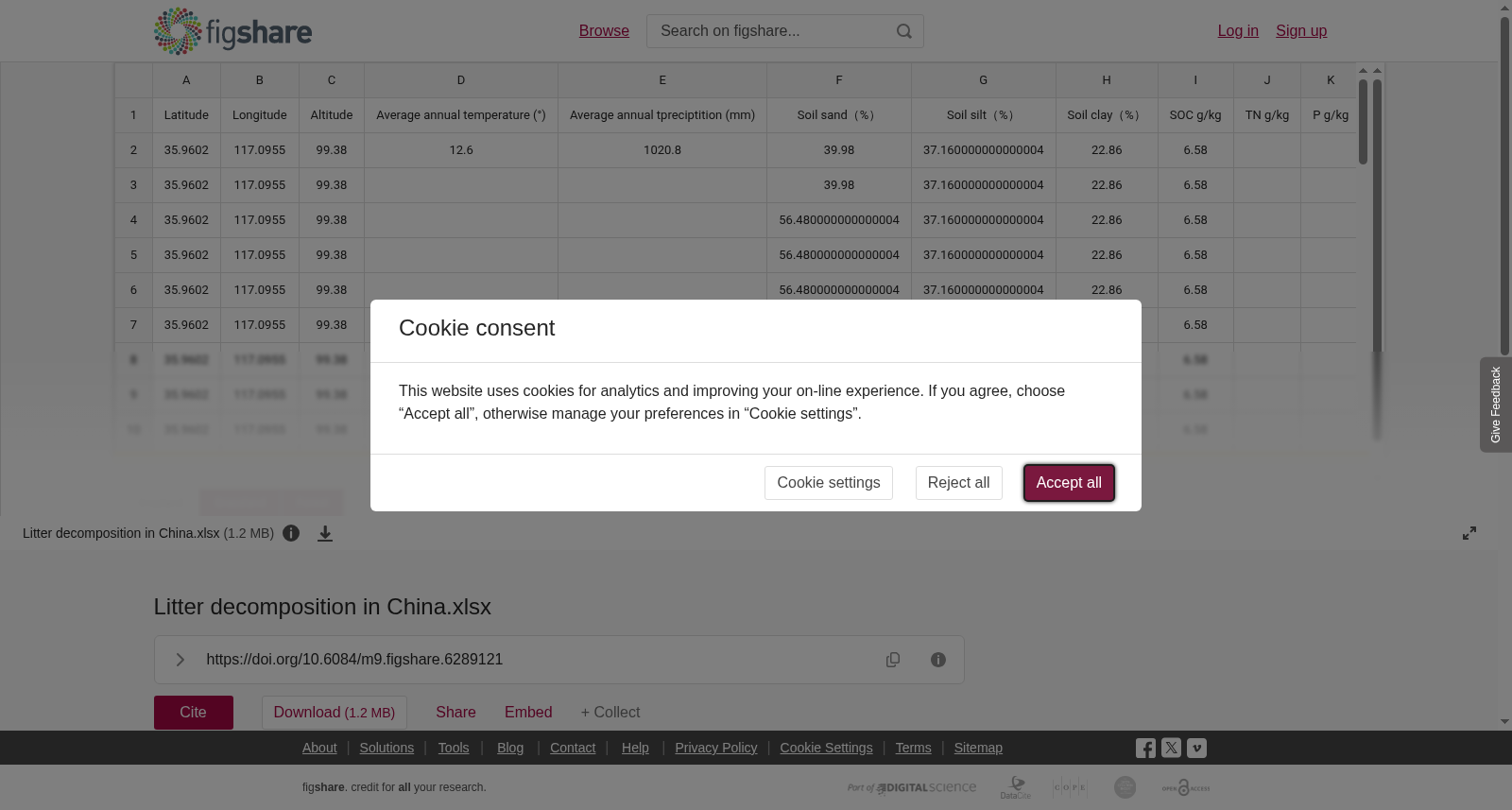
Litter decomposition in China.xlsx
收藏资源简介:
The feedback between litter and climate is partly determined by litter turnover time (LTT) that is affected by climate, litter and soil properties. However, the earth system models that simulate C-climate feedbacks are largely untested with respect to LTT and the interplay between these variables and LTT are rarely quantified. To investigate the direct and indirect effects of climate variables, litter quality, and soil properties on LTT, we obtained 1378 LTTs and their respective environmental variables from 246 published papers, which spanned forest, grassland, and cropland ecosystems. We analyzed the spatial pattern of LTT and investigated the direct and indirect effects of these variables on LTT. The mean LTT was longest in forest ecosystems, followed by grassland and cropland ecosystems. LLT varied significantly according to litter tissues (root, stem, and leaf), litter species, and climate zones. Mean annual temperature (MAT) and precipitation (MAP) best predicted LTT when we used negative exponential equations. Among these variables, the most influential variable on LTT was MAT for the forest litter and cropland litter, and MAP for grassland litter. Climate (MAT and MAP) accounted for more than half of the relative influence on LTT, followed by litter quality (litter tissues, carbon to nitrogen ratio of litter, and lignin content), and soil properties (soil organic carbon and sand content). Path analysis identified MAT negatively affected LTT both directly and indirectly through decreasing litter quality and soil properties. MAP negatively affected LTT by decreasing lignin content. Lignin content positively affected LTT both directly and indirectly through increasing soil organic carbon. <i>Synthesis</i>. Our results suggest that climate variables has contrasting effects on LTT and could mediate litter quality and soil properties to control LTT. These results highlight important implications for climate-smart soil management and aid the reliable model predictions.
凋落物与气候之间的反馈作用,部分由凋落物周转时间(Litter Turnover Time, LTT)所决定,而LTT本身又受到气候、凋落物属性与土壤属性的调控。然而,当前模拟碳-气候反馈的地球系统模型,在LTT相关维度上尚未得到充分验证,且上述变量与LTT之间的相互作用也鲜有量化研究。 为探究气候变量、凋落物质量及土壤属性对LTT的直接与间接影响,本研究从涵盖森林、草原与农田生态系统的246篇已发表文献中,收集得到1378组LTT数据及其对应的环境变量。本研究分析了LTT的空间分布格局,并探究了上述变量对LTT的直接与间接影响。 森林生态系统的平均LTT最长,其次为草原与农田生态系统。LTT随凋落物组织类型(根、茎、叶)、凋落物物种及气候带的不同呈现显著差异。当采用负指数方程进行预测时,年平均温度(Mean Annual Temperature, MAT)与年降水量(Mean Annual Precipitation, MAP)的预测效果最优。 在所有变量中,对森林凋落物与农田凋落物的LTT影响最大的变量为MAT,而对草原凋落物而言则为MAP。气候因子(MAT与MAP)对LTT的相对贡献占比超过一半,其次为凋落物质量指标(包括凋落物组织类型、凋落物碳氮比与木质素含量)以及土壤属性(土壤有机碳与砂粒含量)。 通径分析结果表明,MAT可通过降低凋落物质量与土壤属性,对LTT产生直接与间接的负向影响。MAP则通过降低木质素含量对LTT产生负向影响。木质素含量可通过提升土壤有机碳含量,对LTT产生直接与间接的正向影响。 <i>综合分析</i>。本研究结果显示,气候变量对LTT具有差异化影响,并可通过调控凋落物质量与土壤属性来作用于LTT。上述研究结果对气候智慧型土壤管理具有重要指导意义,同时有助于提升模型预测的可靠性。