electricsheepeurope/europe-worldbank-education
收藏资源简介:
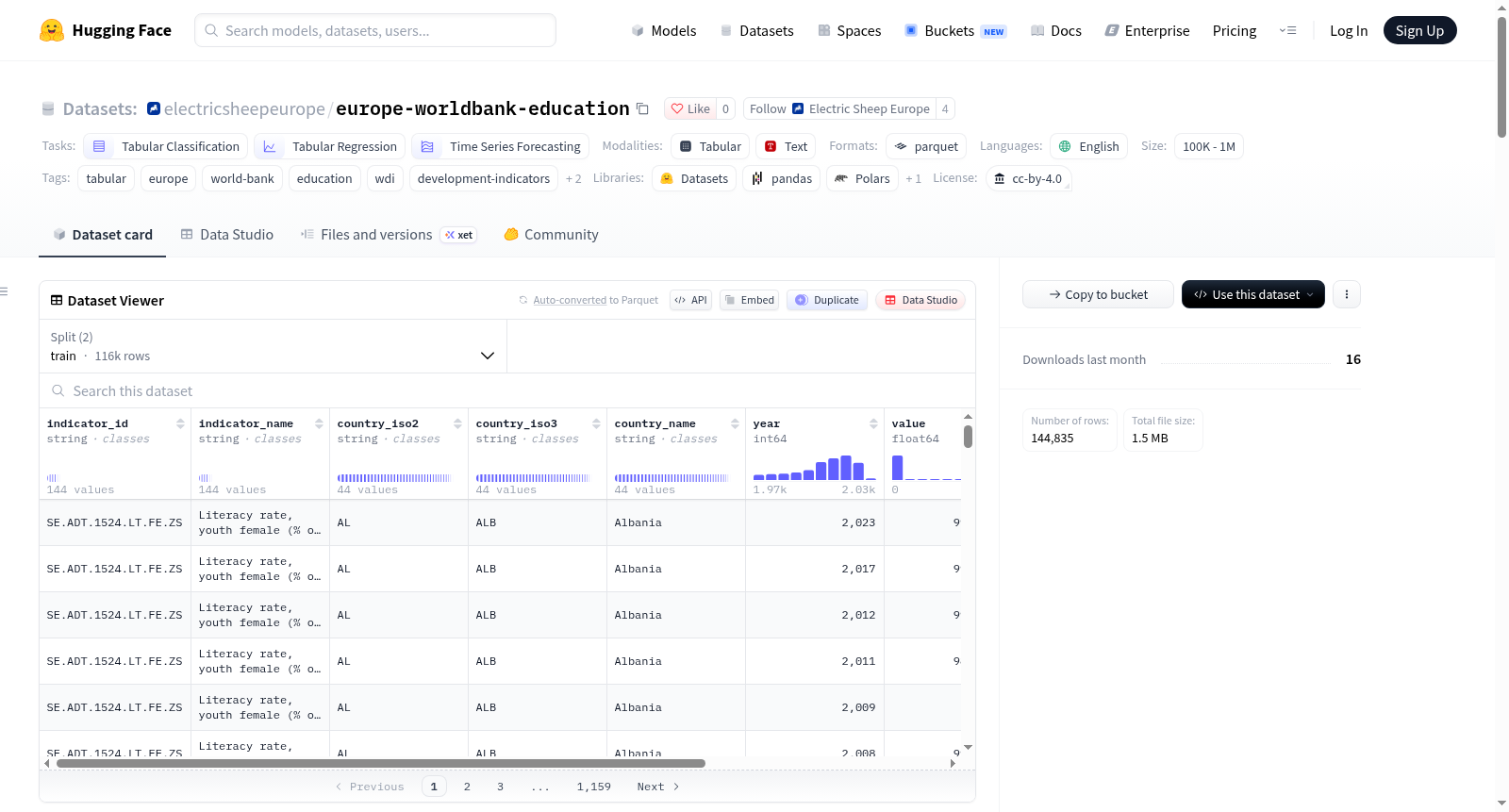
--- license: cc-by-4.0 language: - en task_categories: - tabular-classification - tabular-regression - time-series-forecasting multilinguality: monolingual size_categories: - 100K<n<1M tags: - tabular - europe - world-bank - education - wdi - development-indicators - time-series - country-level pretty_name: "Education — Europe (World Bank WDI)" --- # Education — Europe (World Bank WDI) 🇪🇺 **144,835 observations** · **44 Europe countries** · **1960–2025** · *Repackaged by [Electric Sheep Europe](https://huggingface.co/electricsheepeurope)*      ## TL;DR This dataset contains **144,835 observations** of `Education` data across **44 Europe countries**, spanning **1960–2025**, covering **164 distinct indicators**. ## About the source The World Bank's **World Development Indicators (WDI)** is the world's most-cited reference for global development data. It compiles officially-recognized international statistics from national accounts, government agencies, and partner organizations (IMF, WHO, FAO, UNESCO, ILO, UN agencies). The WDI covers over 1,400 indicators across 21 topics for 217 economies, with annual updates as new data become available. - **Source:** [World Bank](https://databank.worldbank.org/source/world-development-indicators) - **Publisher:** World Bank Group - **License:** [cc-by-4.0](https://creativecommons.org/licenses/by/4.0/) - **Topic:** Education ## Methodology Data is pulled directly from the World Bank's public API (`api.worldbank.org/v2`) for every indicator tagged to this topic across all countries in the region. Records with no observed value are dropped. Years are normalized to integers; values are coerced to float64. ## Geographic coverage 44 Europe countries · top rows shown below, sorted by row count: | Country | Rows | First year | Last year | |---------|-----:|-----------:|----------:| | `ESP` | 4,561 | 1960 | 2025 | | `GRC` | 4,351 | 1960 | 2025 | | `MLT` | 4,202 | 1960 | 2025 | | `ITA` | 4,173 | 1960 | 2025 | | `HUN` | 4,116 | 1960 | 2025 | | `NOR` | 4,104 | 1960 | 2025 | | `FIN` | 4,097 | 1960 | 2025 | | `SWE` | 4,058 | 1960 | 2025 | | `BGR` | 3,963 | 1960 | 2025 | | `DNK` | 3,912 | 1960 | 2025 | | `PRT` | 3,794 | 1960 | 2025 | | `AUT` | 3,769 | 1960 | 2025 | | `CHE` | 3,752 | 1960 | 2025 | | `ISL` | 3,674 | 1960 | 2025 | | `BEL` | 3,657 | 1960 | 2025 | | ... | _29 more countries_ | | | ## Indicators (sample) - `SE.ADT.1524.LT.FE.ZS` — Literacy rate, youth female (% of females ages 15-24) - `SE.ADT.1524.LT.FM.ZS` — Literacy rate, youth (ages 15-24), gender parity index (GPI) - `SE.ADT.1524.LT.MA.ZS` — Literacy rate, youth male (% of males ages 15-24) - `SE.ADT.1524.LT.ZS` — Literacy rate, youth total (% of people ages 15-24) - `SE.ADT.LITR.FE.ZS` — Literacy rate, adult female (% of females ages 15 and above) - `SE.ADT.LITR.MA.ZS` — Literacy rate, adult male (% of males ages 15 and above) - `SE.ADT.LITR.ZS` — Literacy rate, adult total (% of people ages 15 and above) - `SE.COM.DURS` — Compulsory education, duration (years) - `SE.ENR.PRIM.FM.ZS` — School enrollment, primary (gross), gender parity index (GPI) - `SE.ENR.PRSC.FM.ZS` — School enrollment, primary and secondary (gross), gender parity index (GPI) - _... and 154 more indicators_ ## Schema | Column | Type | Description | Example | |--------|------|-------------|---------| | `indicator_id` | `string` | World Bank WDI indicator code (e.g. `SP.POP.TOTL`) | `SE.ADT.1524.LT.FE.ZS` | | `indicator_name` | `string` | Human-readable indicator name | `Literacy rate, youth female (% of fem…` | | `country_iso2` | `string` | ISO 3166-1 alpha-2 country code | `AL` | | `country_iso3` | `string` | ISO 3166-1 alpha-3 country code (preferred join key) | `ALB` | | `country_name` | `string` | English country name as published by the World Bank | `Albania` | | `year` | `int64` | Year of observation (CE) | `2023` | | `value` | `float64` | Observed indicator value | `99.2099990844727` | | `unit` | `string` | Unit of measurement (often empty) | `` | | `obs_status` | `string` | World Bank observation-status flag (e.g. preliminary, estimated) | `` | ## Data quality & caveats - Records with null observations are filtered out at ingest. - Indicator coverage varies by country and year; not every (indicator × country × year) combination is present. - Some countries appear under multiple aggregate groupings in WB; this dataset is filtered to **individual sovereign states only**. ## Usage ```python from datasets import load_dataset ds = load_dataset("electricsheepeurope/europe-worldbank-education") df = ds["train"].to_pandas() print(df.head()) ``` ### Filter to one country ```python germany = df[df["country_iso3"] == "DEU"] ``` ### Time-series for a single indicator ```python sample = (df[df["indicator_id"] == "SE.ADT.1524.LT.FE.ZS"] .sort_values("year")) sample.plot(x="year", y="value", title="SE.ADT.1524.LT.FE.ZS") ``` ### Pivot to country × year matrix ```python matrix = (df[df["indicator_id"] == "SE.ADT.1524.LT.FE.ZS"] .pivot_table(index="year", columns="country_iso3", values="value")) print(matrix.tail()) ``` ## Citation ```bibtex @misc{europe_worldbank_education_2025, title = {Education — Europe (World Bank WDI)}, author = {World Bank Group}, year = {2025}, url = {https://databank.worldbank.org/source/world-development-indicators}, publisher = {HuggingFace Datasets, repackaged by Electric Sheep Europe}, howpublished = {\url{https://huggingface.co/datasets/electricsheepeurope/europe-worldbank-education}} } ``` ## License Released under [cc-by-4.0](https://creativecommons.org/licenses/by/4.0/). Original data © World Bank Group. When using this dataset, please cite both the original source above and the Electric Sheep Europe repackaging. ## About Electric Sheep Electric Sheep Europe is part of the Electric Sheep mission: a unified, ML-ready data layer for Europe on HuggingFace. We pull data from authoritative open sources, normalize the schemas, package as Parquet, and publish with consistent dataset cards so researchers and developers can use `load_dataset()` to start working in seconds. Browse the full collection: [huggingface.co/electricsheepeurope](https://huggingface.co/electricsheepeurope) --- _Provenance: ingested 2026-05-24 via the Electric Sheep pipeline. Source URL: https://databank.worldbank.org/source/world-development-indicators_
This dataset contains 144,835 observations of Education data across 44 Europe countries, spanning 1960–2025, covering 164 distinct indicators. The data is sourced from the World Banks World Development Indicators (WDI), the worlds most-cited reference for global development data. It includes various education-related indicators such as literacy rates, school enrollment rates, compulsory education duration, and gender parity indices. The dataset schema includes indicator_id, indicator_name, country_iso2, country_iso3, country_name, year, value, unit, and obs_status columns. Records with null observations are filtered out, and coverage varies by country and year. This dataset is designed for machine learning tasks including tabular classification, regression, and time-series forecasting.