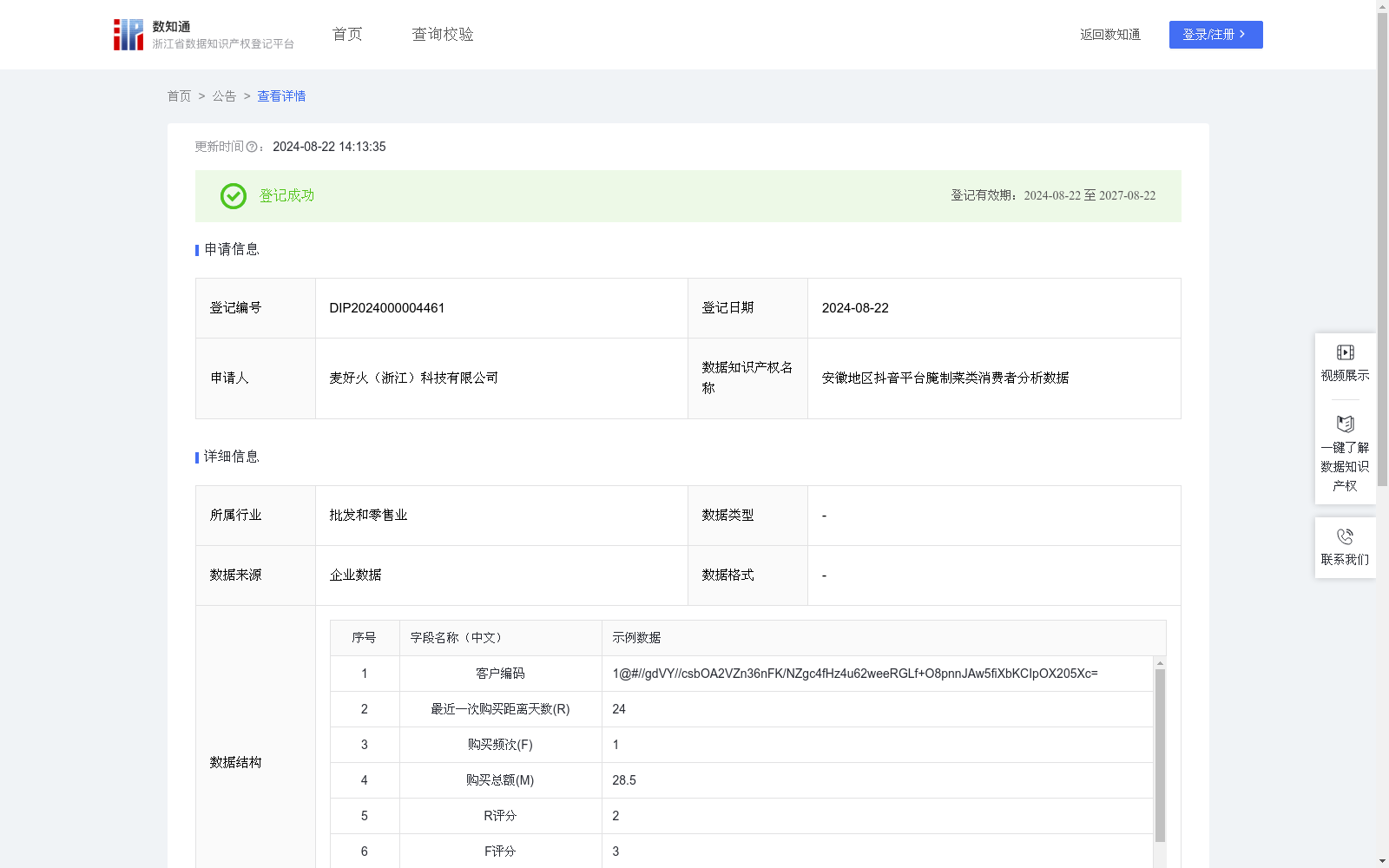
安徽地区抖音平台腌制菜类消费者分析数据
收藏资源简介:
本数据支持抖音平台安徽地区腌制菜类产品的电商零售客户分类运营,旨在为精准营销提供必要的客户粘度分类数据,精准营销的关键在于深入理解不同客户群体的需求、购买行为及偏好,从而制定个性化的营销策略。算法及规则说明: 客户分类的算法规则采用RFM数据模型排序、聚类的方法,通过对客户的消费频次和消费时间间隔、消费总金额的排序、聚类,对客户进行分类。 该数据统计包含以下: 1.数据来源:采集自本企业在抖音平台的销售数据 。 2.模型选择:RFM数据模型。通过对客户的消费频次聚类、消费总金额聚类、最近一次消费记录排序等方法获得多维度的客户粘度分类数据。 3.模型参数及优化:通过对参数调整,对R、F、M的数据进行评分,RFM综合评分=0.3*R评分+0.3*F评分+0.4*M评分,再根据RFM综合评分调优客户的分类结果,得分5分为A类,4~4.9分为B类,3~3.9分为C类,2~2.9分为D类,2分以下为E类;将客户分类运营所需的5类群体“A.高粘度客户、B.重要维系客户、C.潜力深耕客户、D.新客户、E.一般客户”为最终分类目标,基于消费频次、消费金额等不同维度获得的聚类分组成果,对聚类分组数量和分组阀值、以及维度权重进行人为干预,使客户分类趋于合理。
This dataset supports the e-commerce retail customer segmentation and operation for pickled vegetable products in Anhui region on the Douyin platform, aiming to provide necessary customer stickiness classification data for precision marketing. The core of precision marketing lies in deeply understanding the needs, purchase behaviors and preferences of different customer groups, so as to formulate personalized marketing strategies. Algorithm and rule description: The algorithm rules for customer segmentation adopt the sorting and clustering methods based on the RFM data model, by sorting and clustering customers' purchase frequency, consumption time interval and total consumption amount to classify customers. This dataset includes the following contents: 1. Data source: Collected from the sales data of our enterprise on the Douyin platform. 2. Model selection: RFM data model. Multi-dimensional customer stickiness classification data is obtained through methods such as clustering of customer purchase frequency, clustering of total consumption amount, and sorting of the latest consumption records. 3. Model parameters and optimization: By adjusting parameters, scores are assigned to the data of Recency (R), Frequency (F) and Monetary (M). The comprehensive RFM score is calculated as 0.3*R score + 0.3*F score + 0.4*M score. Then the customer segmentation results are optimized based on the comprehensive RFM score. Customers are divided into Category A with a score of 5, Category B with 4 to 4.9 points, Category C with 3 to 3.9 points, Category D with 2 to 2.9 points, and Category E with a score below 2. The final classification target is the five customer groups required for customer segmentation operation: "A. High-stickiness customers, B. Key retention customers, C. Potential deep-development customers, D. New customers, E. General customers". Based on the clustering grouping results obtained from different dimensions such as purchase frequency and consumption amount, manual intervention is conducted on the number of clustering groups, clustering thresholds and dimension weights to make the customer segmentation more reasonable.