
October 2023 data-update for "Updated science-wide author databases of standardized citation indicators"
收藏Mendeley Data2024-03-27 更新2024-06-30 收录
下载链接:
https://elsevier.digitalcommonsdata.com/datasets/btchxktzyw
下载链接
链接失效反馈官方服务:
资源简介:
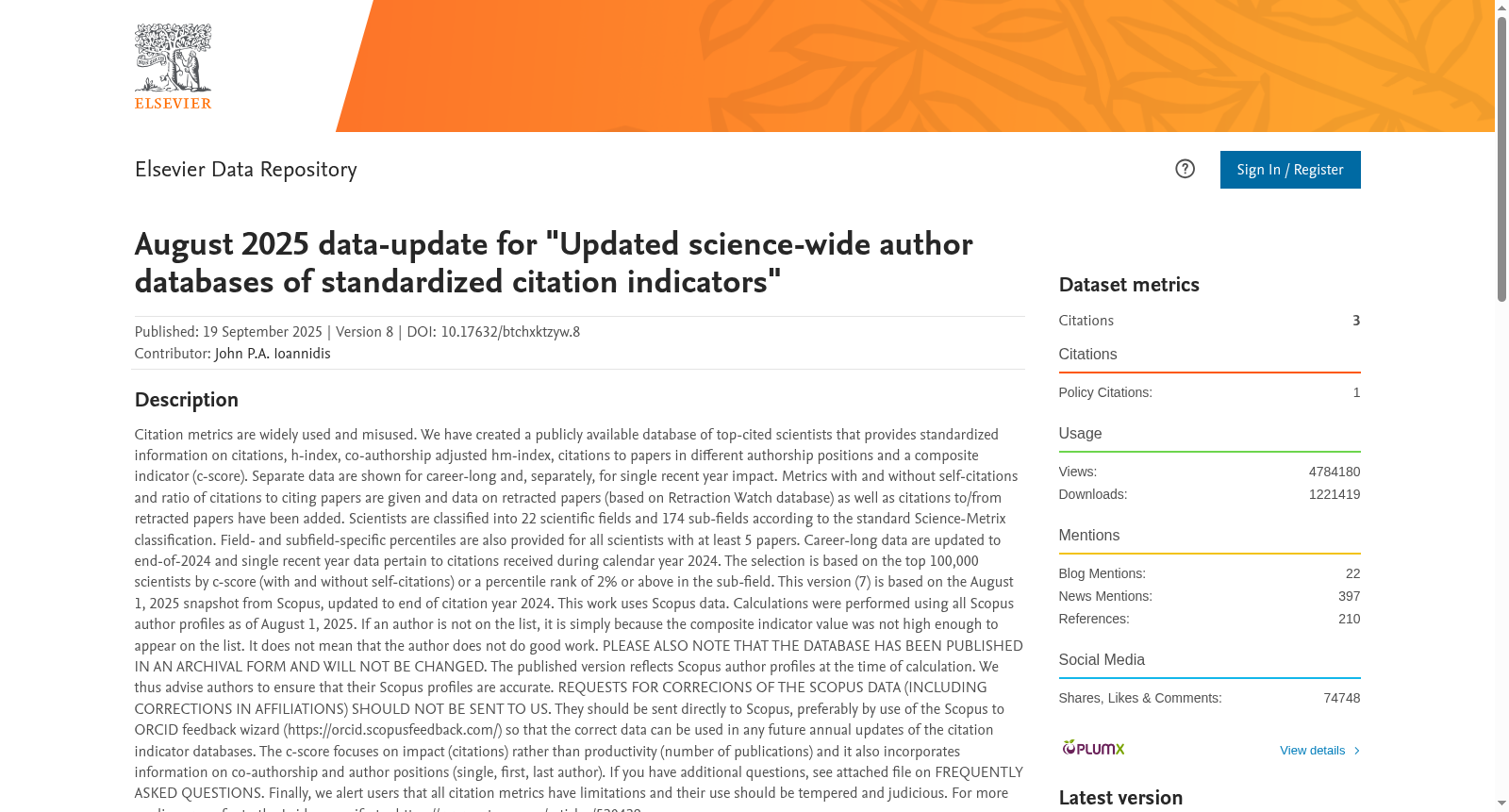
Citation metrics are widely used and misused. We have created a publicly available database of top-cited scientists that provides standardized information on citations, h-index, co-authorship adjusted hm-index, citations to papers in different authorship positions and a composite indicator (c-score). Separate data are shown for career-long and, separately, for single recent year impact. Metrics with and without self-citations and ratio of citations to citing papers are given. Scientists are classified into 22 scientific fields and 174 sub-fields according to the standard Science-Metrix classification. Field- and subfield-specific percentiles are also provided for all scientists with at least 5 papers. Career-long data are updated to end-of-2022 and single recent year data pertain to citations received during calendar year 2022. The selection is based on the top 100,000 scientists by c-score (with and without self-citations) or a percentile rank of 2% or above in the sub-field. This version (6) is based on the October 1, 2023 snapshot from Scopus, updated to end of citation year 2022. This work uses Scopus data provided by Elsevier through ICSR Lab (https://www.elsevier.com/icsr/icsrlab). Calculations were performed using all Scopus author profiles as of October 1, 2023. If an author is not on the list it is simply because the composite indicator value was not high enough to appear on the list. It does not mean that the author does not do good work. PLEASE ALSO NOTE THAT THE DATABASE HAS BEEN PUBLISHED IN AN ARCHIVAL FORM AND WILL NOT BE CHANGED. The published version reflects Scopus author profiles at the time of calculation. We thus advise authors to ensure that their Scopus profiles are accurate. REQUESTS FOR CORRECIONS OF THE SCOPUS DATA (INCLUDING CORRECTIONS IN AFFILIATIONS) SHOULD NOT BE SENT TO US. They should be sent directly to Scopus, preferably by use of the Scopus to ORCID feedback wizard (https://orcid.scopusfeedback.com/) so that the correct data can be used in any future annual updates of the citation indicator databases. The c-score focuses on impact (citations) rather than productivity (number of publications) and it also incorporates information on co-authorship and author positions (single, first, last author). If you have additional questions, please read the 3 associated PLoS Biology papers that explain the development, validation and use of these metrics and databases. (https://doi.org/10.1371/journal.pbio.1002501, https://doi.org/10.1371/journal.pbio.3000384 and https://doi.org/10.1371/journal.pbio.3000918). Finally, we alert users that all citation metrics have limitations and their use should be tempered and judicious. For more reading, we refer to the Leiden manifesto: https://www.nature.com/articles/520429a
引文计量指标(citation metrics)的应用与误用现象均较为普遍。我们构建了一个公开可用的顶尖被引科学家数据库,可为用户提供标准化的引文相关统计信息,包括h指数(h-index)、调整合著情况的hm指数(hm-index)、不同作者署名位置论文的被引次数,以及综合评价指标(c-score)。该数据库分别提供科学家整个学术生涯的计量数据,以及单年度学术影响力数据;同时涵盖纳入自引与排除自引的计量指标,以及被引文献与施引文献的比值。
科学家按照标准Science-Metrix分类体系(Science-Metrix classification)被划分为22个一级学科与174个二级学科。对于发表论文不少于5篇的所有科学家,我们还提供了对应学科及二级学科的百分位排名数据。学术生涯总数据更新至2022年末,单年度影响力数据则对应2022日历年期间获得的引文。
本数据库基于两项指标筛选前10万名科学家:一是按c-score(含自引与不含自引两种情况)排名,二是在所属二级学科中百分位排名不低于2%。本次发布的第6版数据基于爱思唯尔(Elsevier)于2023年10月1日提供的Scopus数据库(Scopus)快照,并更新至2022年引文统计年末。本研究使用了爱思唯尔通过ICSR实验室(ICSR Lab)提供的Scopus数据,所有计算基于2023年10月1日的Scopus作者档案完成。
未被纳入本数据库的科学家,仅因其综合评价指标分值未达到入选门槛,并不代表其学术成果不佳。请注意,本数据库已以存档形式发布,后续将不再更新。已发布版本的数据基于计算时的Scopus作者档案,因此我们建议用户确保其Scopus档案信息准确。
针对Scopus数据(包括机构归属信息)的更正请求请勿发送至本团队,应直接提交至Scopus,推荐通过Scopus与开放研究者与贡献者身份(ORCID)联动反馈向导(https://orcid.scopusfeedback.com/)提交,以便未来的引文计量数据库年度更新中使用修正后的准确数据。
c-score聚焦于学术影响力(被引次数)而非学术产出(论文数量),同时整合了合著情况与作者署名位置(独著、第一作者、通讯作者)相关信息。若您有更多疑问,请阅读三篇相关的《公共科学图书馆·生物学》(PLoS Biology)论文,以了解这些计量指标与数据库的开发、验证与使用方法,链接如下:https://doi.org/10.1371/journal.pbio.1002501、https://doi.org/10.1371/journal.pbio.3000384 及 https://doi.org/10.1371/journal.pbio.3000918。
最后,我们提醒用户,所有引文计量指标均存在局限性,使用时应保持审慎且合理。如需进一步阅读,可参考《莱顿宣言》(Leiden manifesto),链接为:https://www.nature.com/articles/520429a
创建时间:
2024-01-23
搜集汇总
数据集介绍
背景与挑战
背景概述
该数据集是一个公开的科学家标准化引文指标数据库,提供职业长期和单年影响的引文数据,包括h指数、合著调整指标和撤稿论文信息。数据基于Scopus更新至2024年底,使用Science-Metrix分类覆盖22个科学领域和174个子领域,旨在评估科学家的研究影响力。
以上内容由遇见数据集搜集并总结生成

暂无相关数据集


