
<b>The effect of conspecific presence on individual metabolic rates: the role of species’ social systems</b>
收藏DataCite Commons2025-04-23 更新2025-05-07 收录
下载链接:
https://figshare.com/articles/dataset/_b_The_effect_of_conspecific_presence_on_individual_metabolic_rates_the_role_of_species_social_systems_b_/28578914/1
下载链接
链接失效反馈官方服务:
资源简介:
<b>Abstract</b>Social animals may reduce their overall metabolic demand through group living due to a “calming effect”. However, it remains unclear whether the metabolic response of individuals to group members varies depending on the social system, and how individual sociability influences this response. We measured the metabolic rates of the territorial three-striped dwarf cichlid (<i>Apistogramma trifasciata</i>) and the shoaling cardinal tetra (<i>Paracheirodon axelrodi</i>) in the presence or absence of conspecifics, examining the relationship between individual sociability and metabolic rates, with a focus on how sociability influences the metabolic response to conspecific presence. Territorial cichlids exhibited increased standard metabolic rate (SMR) and routine metabolic rate (RMR) in response to the presence of conspecifics, while shoaling tetras showed unaltered RMR or SMR. We found no evidence linking individual sociability to metabolic rates, nor any indication that individual sociability influences metabolic responses to grouping in either species. The contrasting metabolic responses to grouping in these species demonstrate that the energetic consequences of social proximity depend on the species’ evolved social structure. Given the lack of effect of individual sociability on metabolic rates, we suggest that sociability and maintenance metabolism may evolve independently, without underlying genetic covariation. This study highlights the intricate relationship between group living and individual energy expenditure, indicating that a species' social system plays a significant role in determining the extent to which the calming effect serves as an adaptive element of group living.
摘要 群居动物可通过群体生活借助“镇静效应”降低整体代谢需求。然而,目前仍不清楚个体对同种同伴的代谢响应是否因社会系统而异,以及个体社交性如何影响该响应。本研究针对具领地性的三带短鲷(*Apistogramma trifasciata*)与群栖性宝莲灯鱼(*Paracheirodon axelrodi*),在有、无同种个体存在的条件下测定其代谢速率,探究个体社交性与代谢速率之间的关联,重点关注社交性如何影响同种个体存在时的代谢响应。具领地性的短鲷在有同种个体存在时,其标准代谢率(standard metabolic rate, SMR)与日常代谢率(routine metabolic rate, RMR)均有所升高;而群栖性宝莲灯鱼的RMR与SMR则无明显变化。本研究未发现个体社交性与代谢速率存在关联的证据,也未表明两种鱼类的个体社交性会影响其对群体生活的代谢响应。这两种鱼类对群体生活的代谢响应存在显著差异,表明社会亲近带来的能量代价取决于物种演化形成的社会结构。鉴于个体社交性对代谢速率并无显著影响,我们认为社交性与维持代谢可能独立演化,不存在潜在的遗传协变关系。本研究揭示了群居生活与个体能量消耗之间的复杂关联,表明物种的社会系统在决定“镇静效应”作为群居生活适应性特征的程度方面发挥着重要作用。
提供机构:
figshare创建时间:
2025-03-12
搜集汇总
数据集介绍
背景与挑战
背景概述
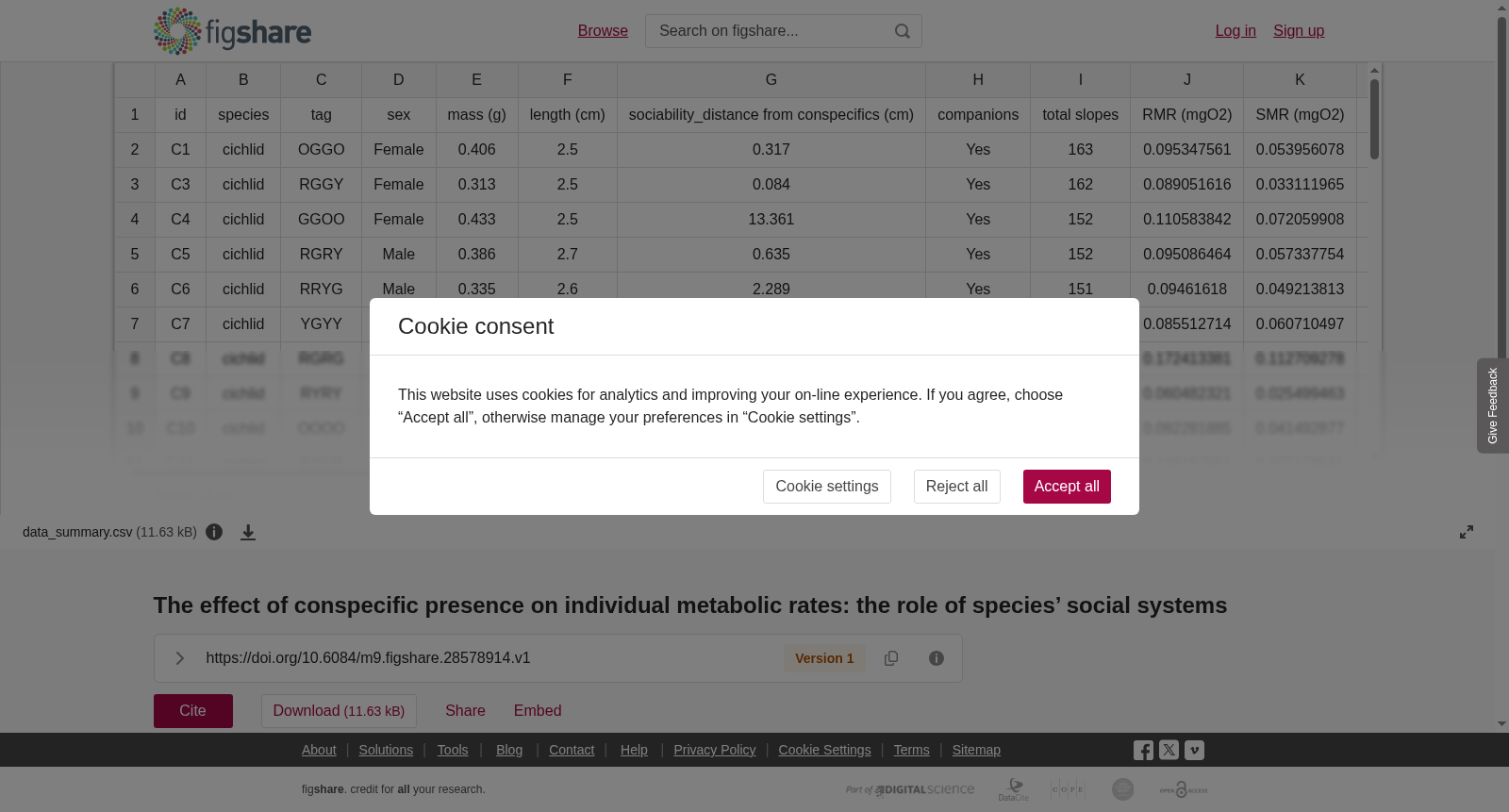
该数据集研究了同种个体存在对鱼类代谢率的影响,重点关注物种社会系统的作用。通过比较领域性三线短鲷和群居性红莲灯,发现社会系统显著影响代谢反应:领域性鱼类在同类存在时代谢率升高,而群居性鱼类则无变化。研究还表明个体社交性与代谢率之间无直接关联,提示社交性和维持代谢可能独立演化。
以上内容由遇见数据集搜集并总结生成

暂无相关数据集


