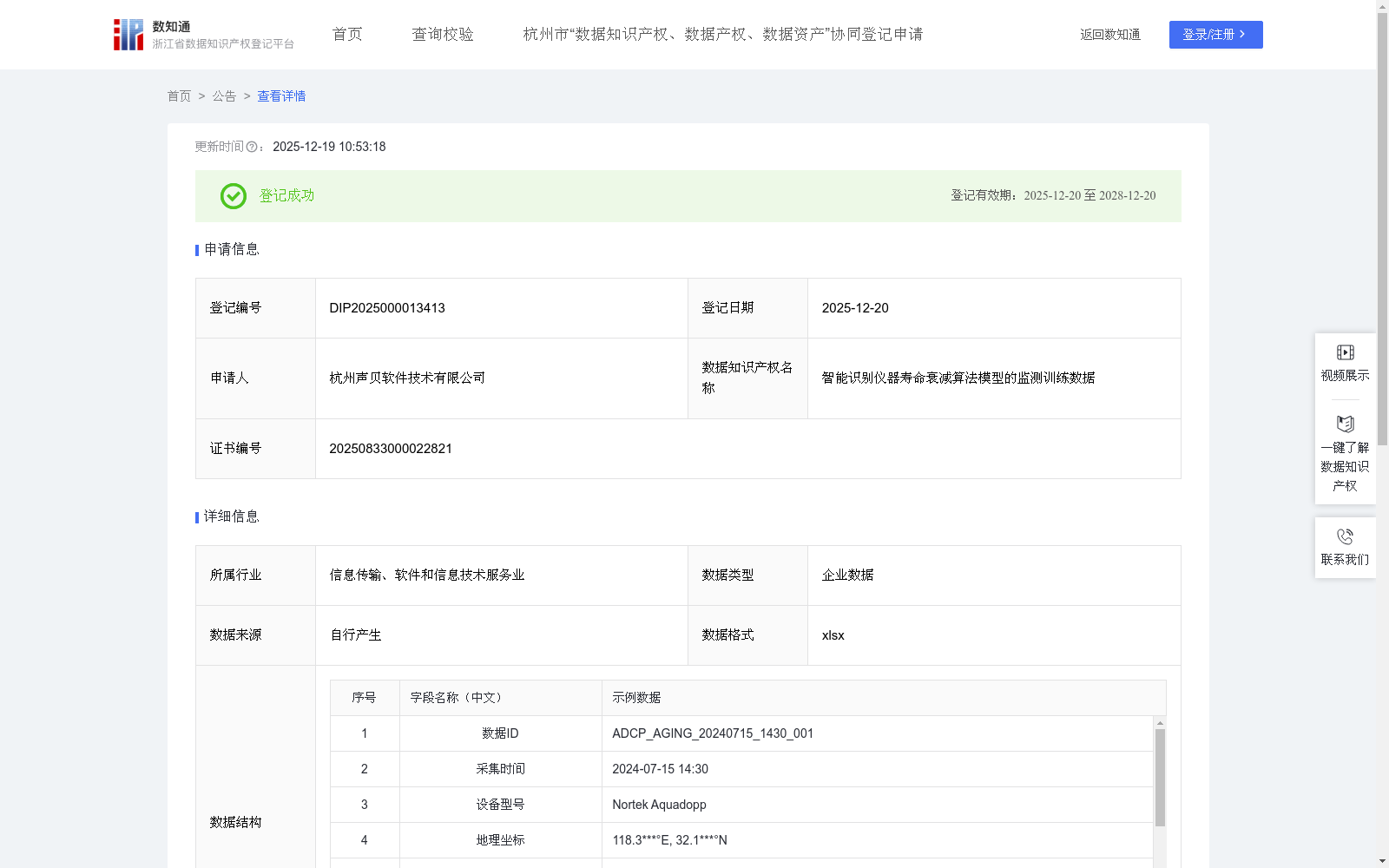
智能识别仪器寿命衰减算法模型的监测训练数据
收藏资源简介:
本数据集主要用于提升AI模型对ADCP设备寿命衰减状态的识别能力与精确性。通过对该数据集的训练,使AI模型能够精准识别性能衰退现象,并可应用于水文测量设备预防性维护、仪器更换周期优化及测量数据质量可靠性评估等场景。同时,本数据集可为设备全生命周期管理、智能维护决策等提供科学依据,提升水文观测系统的运行可靠性。 1.数据采集 通过企业自有ADCP设备自行采集监测数据,同步记录数据ID、采集时间、设备型号、地理坐标、累计工作时长、回波强度、信噪比、压力值、水温等数据。 2.数据预处理与加工 通过数据清洗剔除异常值,按7:2:1比例划分训练集/验证集/测试集。基于设备性能参数计算性能衰减指数,建立基线健康模型。设置多级标注体系: 一级标签:健康/衰减(依据核心指标偏离基线±10%判定) 二级标签:初期衰减(1-2项指标超限)/中期衰减(3-4项指标超限)/严重衰减(关键指标超限±30%) 3.模型选择与初始化 采用XGBoost与LSTM混合模型,初始化参数并优化超参数:学习率0.01-0.001动态调整,批量大小32-64动态调整,时间步长12-24动态调整;集成设备健康度评估模块。 4.模型训练 基于PyTorch实施分布式训练,采用混合精度训练(FP16)提升效率。设置训练时长,数据增强模拟不同老化场景,添加气泡干扰、生物附着、传感器腐蚀等特效。设置早停机制(patience=20),梯度裁剪:max_norm=1.0。 5.模型评估 在训练模型的过程中,使用验证集调整超参数,训练完成后在测试集上评估模型表现,评估指标包含: 基础性能指标:准确率、误报率 场景鲁棒性测试:气泡干扰检出率 并设置渐进式测试:单参数异常→多参数异常,标准环境→极端环境
This dataset is primarily designed to enhance the recognition capability and accuracy of AI models for identifying the life decay status of ADCP (Acoustic Doppler Current Profiler) equipment. Training on this dataset enables AI models to accurately identify performance degradation phenomena, and can be applied to scenarios such as preventive maintenance of hydrological measurement equipment, optimization of instrument replacement cycles, and assessment of the reliability of measurement data quality. Additionally, this dataset can provide scientific evidence for equipment full-life cycle management, intelligent maintenance decision-making, etc., improving the operational reliability of hydrological observation systems. 1. Data Collection Monitoring data is collected using the enterprise's own ADCP equipment, with simultaneous recording of data ID, collection time, equipment model, geographic coordinates, cumulative operating hours, echo intensity, signal-to-noise ratio, pressure value, water temperature and other related data. 2. Data Preprocessing and Processing Outliers are removed through data cleaning, and the dataset is divided into training set/validation set/test set at a ratio of 7:2:1. A performance decay index is calculated based on equipment performance parameters, and a baseline health model is established. A multi-level annotation system is set up: - Level 1 label: Healthy / Degraded (determined based on whether core indicators deviate from the baseline by ±10%) - Level 2 label: Initial degradation (1-2 indicators exceed the limit) / Intermediate degradation (3-4 indicators exceed the limit) / Severe degradation (key indicators exceed the limit by ±30%) 3. Model Selection and Initialization A hybrid XGBoost and LSTM model is adopted, with initial parameters set and hyperparameters optimized: dynamically adjusted learning rate of 0.01-0.001, dynamically adjusted batch size of 32-64, dynamically adjusted time step of 12-24; an equipment health assessment module is integrated. 4. Model Training Distributed training is implemented based on PyTorch, with mixed-precision training (FP16) adopted to improve efficiency. Training duration is set, and data augmentation is used to simulate different aging scenarios, adding effects such as bubble interference, biological fouling, and sensor corrosion. An early stopping mechanism (patience=20) is configured, and gradient clipping is performed with max_norm=1.0. 5. Model Evaluation During the model training process, the validation set is used to adjust hyperparameters. After training is completed, the model performance is evaluated on the test set. The evaluation metrics include: - Basic performance metrics: Accuracy, False Positive Rate - Scenario robustness test: Bubble interference detection rate Progressive testing is also set up: single parameter abnormality → multi-parameter abnormality, standard environment → extreme environment