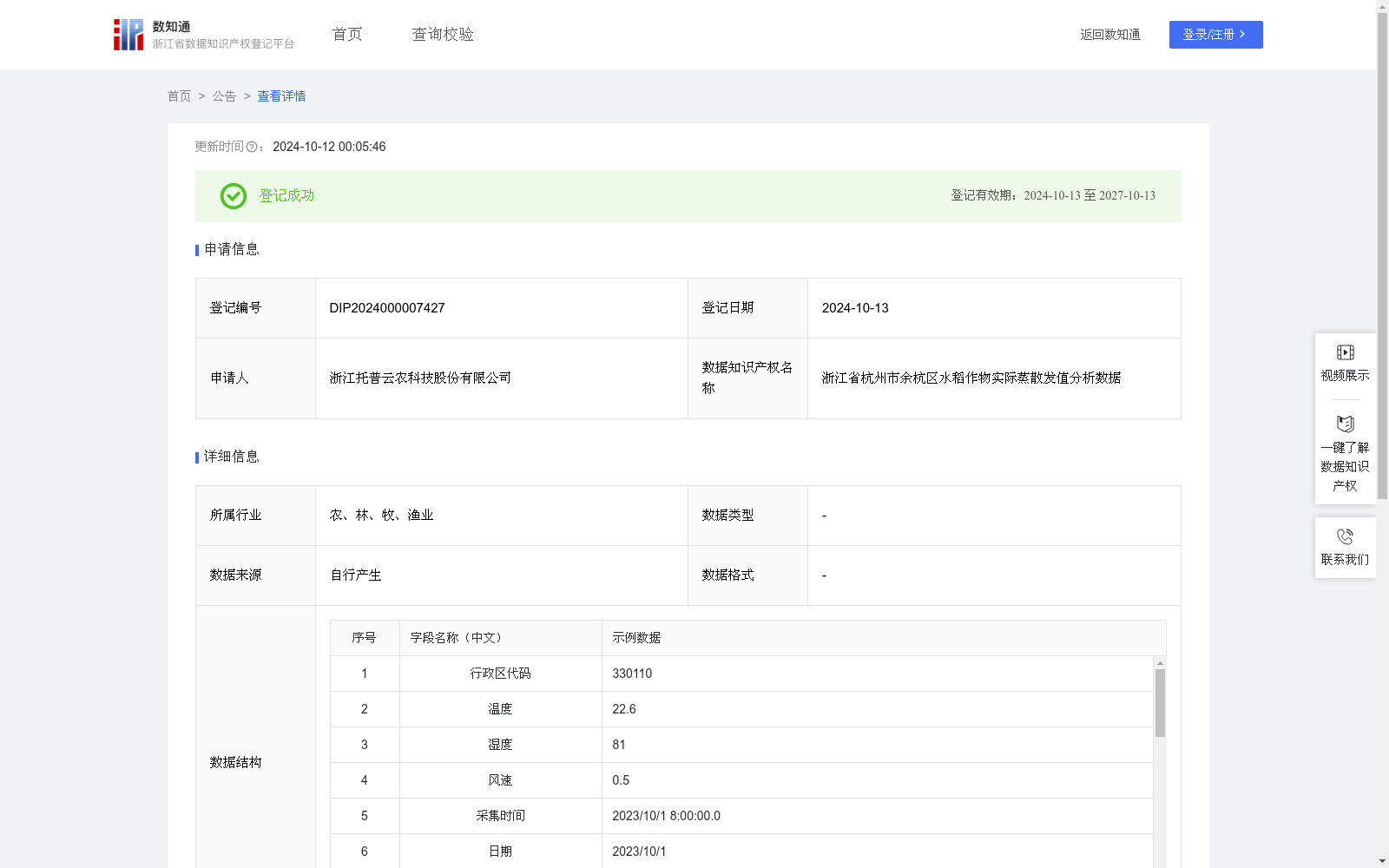
浙江省杭州市余杭区水稻作物实际蒸散发值分析数据
收藏资源简介:
通过浙江托普云农智慧农业气象站设备采集数据,分析浙江省杭州市余杭区水稻的作物实际蒸散发ETC值,通过对ETC数据分析得到水稻实际蒸发蒸腾情况,为灌溉和排水提供数据支撑,从而提高水稻的产量和质量。1、数据来源:通过浙江智慧农业气象站设备采集空气温度、湿度和风速数据,以一定采集周期上传即时数据。 2、数据处理:对采集到的数据进行去重、合并,按照区域分类、统计处理,计算出每日太阳净辐射量(W/m²)、平均温度(℃)、平均风速(m/s)、平均饱和蒸汽压(Pa)、环境湿度(%rh)、大气压值斜率、空气湿度常数,结合水稻作物系数KC值,计算作物实际蒸散发值ETC: ETC=(0.408*每日太阳净辐射量*大气压值斜率/(大气压值斜率+(空气湿度常数*(1+0.34*平均风速)))+900*平均风速/(平均温度+273.15)*(平均饱和蒸汽压-环境湿度)*空气湿度常数/(大气压值斜率+(空气湿度常数*(1+0.34*平均风速))))*KC。 3、数据应用:通过长期ETC数据跟踪与分析,实现对该区域水稻的蒸发蒸腾定量监测,为灌溉和排水提供数据支撑,从而提高水稻的产量和质量。
Data was collected using Zhejiang Top Cloud Agri smart agricultural meteorological station equipment to analyze the crop actual evapotranspiration (ETC) value of rice in Yuhang District, Hangzhou, Zhejiang Province. Analysis of ETC data reveals the actual evapotranspiration status of rice, providing data support for irrigation and drainage to improve rice yield and quality. 1. Data Source: Air temperature, humidity and wind speed data are collected via the aforementioned smart agricultural meteorological station equipment, with real-time data uploaded at fixed collection cycles. 2. Data Processing: Collected data is deduplicated, merged, classified by region and statistically processed. Then, daily solar net radiation (W/m²), mean air temperature (℃), mean wind speed (m/s), mean saturated vapor pressure (Pa), ambient humidity (%rh), atmospheric pressure slope and air humidity constant are calculated. Combined with the rice crop coefficient (KC), the crop actual evapotranspiration value (ETC) is computed using the following formula: ETC = (0.408 * Daily solar net radiation * Atmospheric pressure slope / (Atmospheric pressure slope + Air humidity constant * (1 + 0.34 * Mean wind speed)) + 900 * Mean wind speed / (Mean air temperature + 273.15) * (Mean saturated vapor pressure - Ambient humidity) * Air humidity constant / (Atmospheric pressure slope + Air humidity constant * (1 + 0.34 * Mean wind speed))) * KC 3. Data Application: Through long-term tracking and analysis of ETC data, quantitative monitoring of rice evapotranspiration in this region is achieved, providing data support for irrigation and drainage, thereby enhancing rice yield and quality.