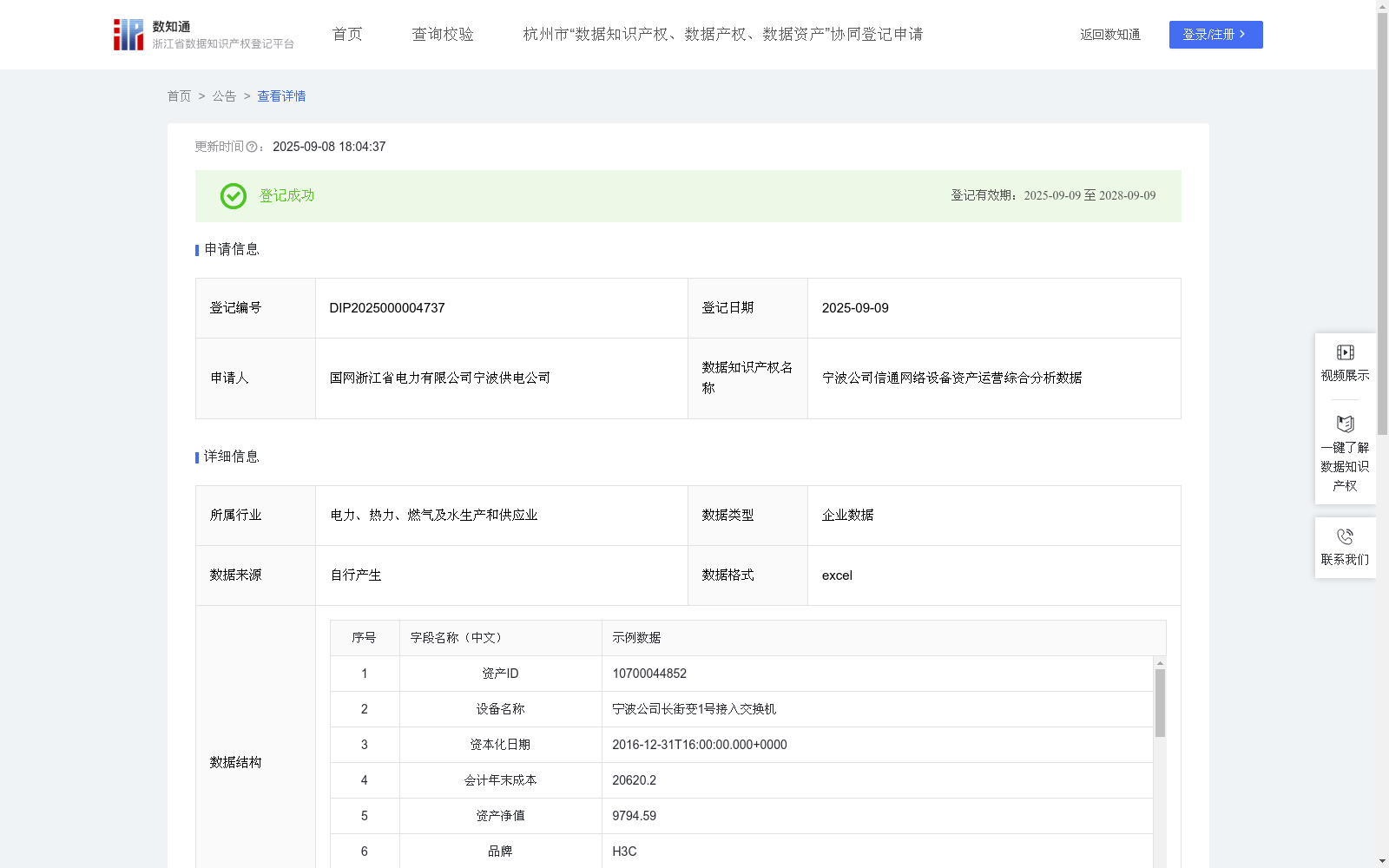
宁波公司信通网络设备资产运营综合分析数据
收藏资源简介:
在后续数据交易中,买方单位可从以下方面获取数据价值:一、市场需求分析与产品优化:通过分析设备品牌、型号分布(如华为S5700、H3C S5500)及运行年限数据,识别市场趋势,优化产品线布局,针对性开发兼容性升级方案。我方数据支撑:品牌/型号/运行年限/资本化日期。二、设备全生命周期管理:基于设备健康度、缺陷关联度及维护成本(含材料费、委外检修费)预测故障周期,提供主动维护服务包与备件方案,降低客户停机风险。我方数据支撑:健康度/缺陷关联度/维护成本。三、竞品对标与性能改进:对比设备运行年限、维护成本及业务承载率(CISCO设备稳定性对标),发现竞品优势,针对性改进产品设计。我方数据支撑:品牌/型号/运行年限/业务承载率/维护费用。四、成本效益分析与解决方案推荐:结合资产净值、维护成本与健康度评估设备经济性,推荐高性价比替换方案(如低净值高维护设备优先替换),提升服务附加值。我方数据支撑:资产净值/维护成本/健康度。五、差异化运维策略支持:依据ABC类运维标签匹配差异化服务响应,定制分级协议(如A类设备优先保障),优化资源分配。我方数据支撑:运维等级/重要等级/业务承载率。根据网络设备重要等级、设备健康度、缺陷关联度、运行年限、业务承载率、材料费、委外检修费用、委外常规费用、委外业务变更费用、委外其他费用、自营车辆费用、自营检修费用、自营常规费用、自营业务变更费用等重要核心指标,计算设备差异化运维和成本预算规划。 算法处理公式如下: 差异化运维:在差异化运维中采取百分制扣分制度,在原表内J列【缺陷关联度】评价的是设备历史检修次数,为此差异化运维计算方式=100-运行年限【运行超过5年,每超过1年扣2分,五年内不扣分】-设备健康度【设备健康不扣分、良好扣3分、 一般扣5分、较差扣8分】-缺陷关联度【表格J列缺陷关联度】-运维成本开支情况【(设备材料费+委外检修费+自营检修费)/((全量设备材料费+全量委外检修费+全量自营检修费)/设备总数),结果超过平均10%扣3分,超过平均20%扣5分,超过平均30%以上扣8分】-业务承载率【业务承载率超过50%,扣3分、超55%扣5分、超60%扣8分】。 经过计算后,计算设备评价结果分数低于60且运行年限超过5年,认定D类;重要等级大于等于5或者设备评价小于等于75认定为A类;重要等级 3及4 ,设备评价处于74-85认定为B类;其余认定为C类。成本预算规划: 设备成本预算规划=(委外检修费用+委外业务变更费用+委外常规费用+委外其他费用)*系数 差异化运维D类设备系数为0.5 差异化运维C类设备系数为1 差异化运维B类设备系数为1.2 差异化运维A类设备系数为1.5; “资本化日期” 是用于明确数据结构中那些随时间变化的多字段(如资产净值、会计年末成本等)所对应的统计时间节点的字段。
In subsequent data transactions, the buyer can obtain data value from the following aspects: 1. Market Demand Analysis and Product Optimization: Analyze data on device brand, model distribution (e.g., Huawei S5700, H3C S5500) and service life to identify market trends, optimize product line layout, and develop targeted compatibility upgrade solutions. Our data supports: brand, model, service life, capitalization date. 2. Full Life Cycle Management of Equipment: Predict fault cycles based on device health, defect correlation, and maintenance costs (including material fees and outsourced maintenance fees), provide proactive maintenance service packages and spare parts plans to reduce customer downtime risks. Our data supports: health, defect correlation, maintenance costs. 3. Competitor Benchmarking and Performance Improvement: Compare device service life, maintenance costs and service bearing rate (benchmarking against Cisco device stability) to identify competitor advantages and improve product design in a targeted manner. Our data supports: brand, model, service life, service bearing rate, maintenance costs. 4. Cost-Benefit Analysis and Solution Recommendation: Evaluate equipment economy by combining net asset value, maintenance costs and health, recommend cost-effective replacement plans (e.g., prioritize replacing low-net-asset-value, high-maintenance-cost devices) to enhance service added value. Our data supports: net asset value, maintenance costs, health. 5. Differentiated Operation and Maintenance Strategy Support: Match differentiated service responses based on ABC-type operation and maintenance tags, customize hierarchical agreements (e.g., priority guarantee for Class A devices) to optimize resource allocation. Our data supports: operation and maintenance level, importance level, service bearing rate. Based on key core indicators including network device importance level, device health, defect correlation, service life, service bearing rate, material fees, outsourced maintenance fees, outsourced regular fees, outsourced business change fees, outsourced other fees, self-operated vehicle fees, self-operated maintenance fees, self-operated regular fees and self-operated business change fees, differentiated equipment operation and maintenance and cost budget planning can be calculated. ### Differentiated Operation and Maintenance A 100-point deduction system is adopted for differentiated operation and maintenance. Column J in the original table [Defect Correlation] evaluates the historical maintenance times of the device. The calculation formula for differentiated operation and maintenance is as follows: Differentiated Operation and Maintenance Score = 100 - Service Life Deduction [deduct 2 points for each year exceeding 5 years, no deduction within 5 years] - Device Health Deduction [no deduction for excellent health, 3 points for good, 5 points for average, 8 points for poor] - Defect Correlation Deduction [Defect Correlation value from Column J of the table] - Maintenance Cost Expenditure Deduction [(device material fees + outsourced maintenance fees + self-operated maintenance fees) / ((total material fees of all devices + total outsourced maintenance fees + total self-operated maintenance fees) / total number of devices); deduct 3 points if the result exceeds the average by 10%, 5 points if exceeds by 20%, 8 points if exceeds by more than 30%] - Service Bearing Rate Deduction [deduct 3 points if service bearing rate exceeds 50%, 5 points if exceeds 55%, 8 points if exceeds 60%]. ### Equipment Classification After calculation: - Devices with a score lower than 60 and service life exceeding 5 years are classified as Class D; - Devices with importance level ≥5 or device evaluation score ≤75 are classified as Class A; - Devices with importance level 3 or 4 and device evaluation score between 74 and 85 are classified as Class B; - The remaining devices are classified as Class C. ### Cost Budget Planning Equipment cost budget planning = (outsourced maintenance fees + outsourced business change fees + outsourced regular fees + outsourced other fees) * coefficient. The coefficients for different differentiated operation and maintenance classes are: - 0.5 for Class D devices; - 1 for Class C devices; - 1.2 for Class B devices; - 1.5 for Class A devices. "Capitalization date" refers to the field that specifies the statistical time node for time-varying multi-fields in the data structure (such as net asset value, year-end accounting costs, etc.).