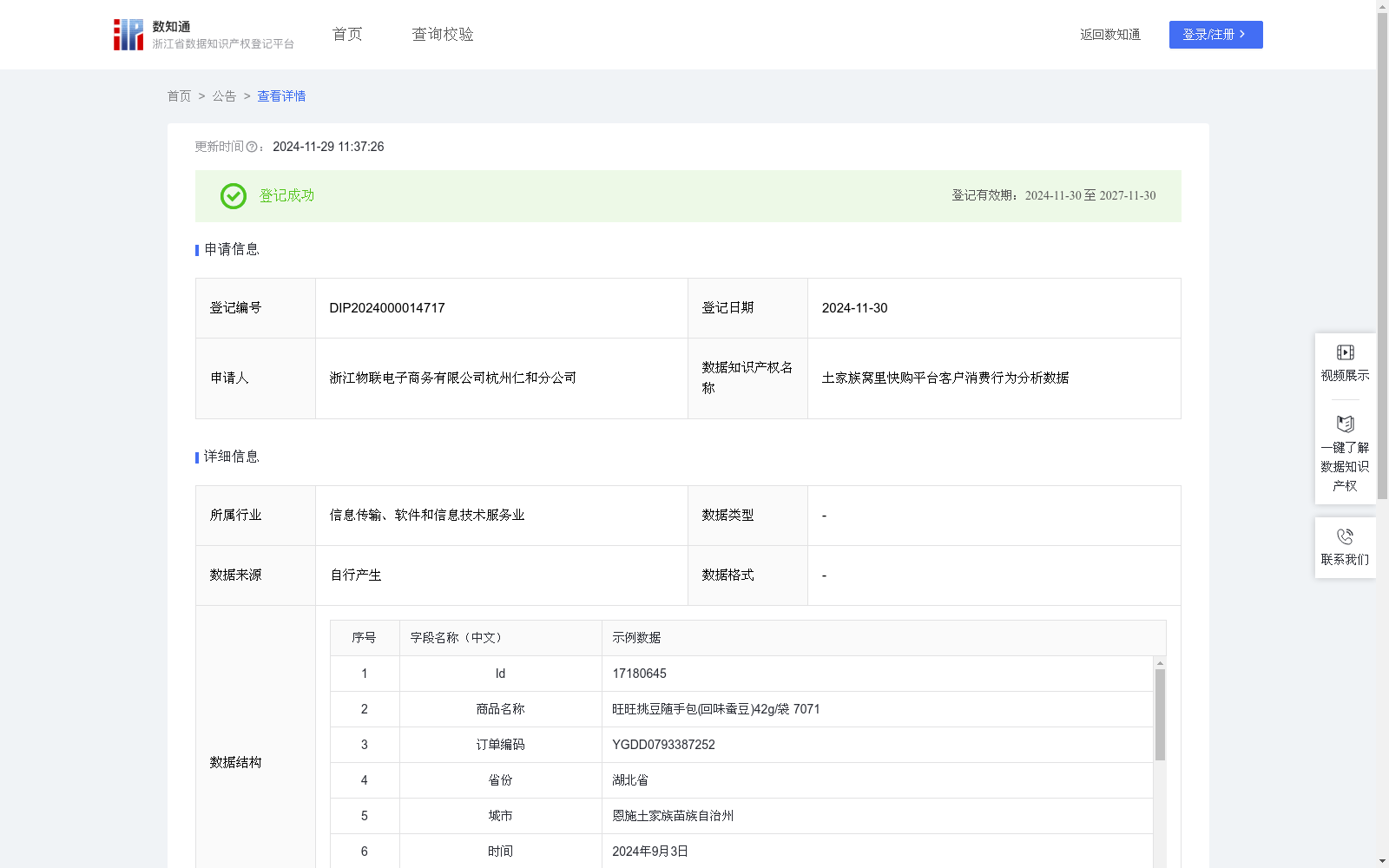
土家族窝里快购平台客户消费行为分析数据
收藏资源简介:
通过对窝里快购平台土家族地区的用户进行用户画像,根据算法获得用户价值分析,根据分析制定营销策略,提高用户粘性和忠诚度。RFM模型可以与用户属性数据结合,实现精细化的客户细分和精准营销。此外,通过分析用户RFM综合评分的变化趋势,平台可以预测用户生命周期价值,优化用户留存策略。RFM模型通过计算土家族地区用户最近一次消费时间(R)、消费频率(F)和消费金额(M)这三个维度来评估用户价值。R 维度,根据时间(用户最后支付时间)距离分析时间(2024年10月18日)的天数(D),划分为5个等级: 0≤D≤5为5分,5<D≤10 为4分,10<D≤20 为3分,20<D≤30为2分,D >30为1分;F 维度,根据用户在过去180天订单数量(C),划分为5个等级: 0≤C≤5为1分,5≤C≤10 为2分,10≤C≤20 为3分,20≤C≤30为4分,C≥30为5分;M 维度,根据用户在过去180天消费金额(G),划分为5个等级,G≥3000为5分,3000≤G<2000为4分,1000≤G<2000为3分,500≤G<1000为2分,0≤G<500为1分。RFM综合评分(X)=R+F+M,再根据RFM综合评分(X)对客户进行分类,0≤X<1为新客户,1≤X<2为种子客户,2≤X<4 为潜力客户,4≤X<6为重要客户,X ≥6为核心客户
This study conducts user profiling for users in the Tujia ethnic region on the Wolikuaigou platform, performs algorithm-driven user value analysis, and formulates marketing strategies based on the analysis to enhance user stickiness and loyalty. The RFM model, when combined with user attribute data, enables refined customer segmentation and precise marketing. Furthermore, by analyzing the changing trends of users' overall RFM scores, the platform can predict user lifetime value (ULV) and optimize user retention strategies. The RFM model evaluates user value by calculating three dimensions for users in the Tujia ethnic region: Recency (R), Frequency (F), and Monetary value (M). For the Recency (R) dimension, the number of days (D) between the user's last payment time and the analysis cutoff date (October 18, 2024) is calculated, and users are divided into 5 levels: 5 points for 0≤D≤5, 4 points for 5<D≤10, 3 points for 10<D≤20, 2 points for 20<D≤30, and 1 point for D>30. For the Frequency (F) dimension, based on the number of orders placed by the user in the past 180 days (C), users are divided into 5 levels: 1 point for 0≤C≤5, 2 points for 5≤C≤10, 3 points for 10≤C≤20, 4 points for 20≤C≤30, and 5 points for C≥30. For the Monetary value (M) dimension, based on the total consumption amount of the user in the past 180 days (G), users are divided into 5 levels: 5 points for G≥3000, 4 points for 2000≤G<3000, 3 points for 1000≤G<2000, 2 points for 500≤G<1000, and 1 point for 0≤G<500. The overall RFM score (X) is calculated as X = R + F + M, and users are categorized based on their overall RFM score (X): new customers for 0≤X<1, seed customers for 1≤X<2, potential customers for 2≤X<4, important customers for 4≤X<6, and core customers for X≥6.