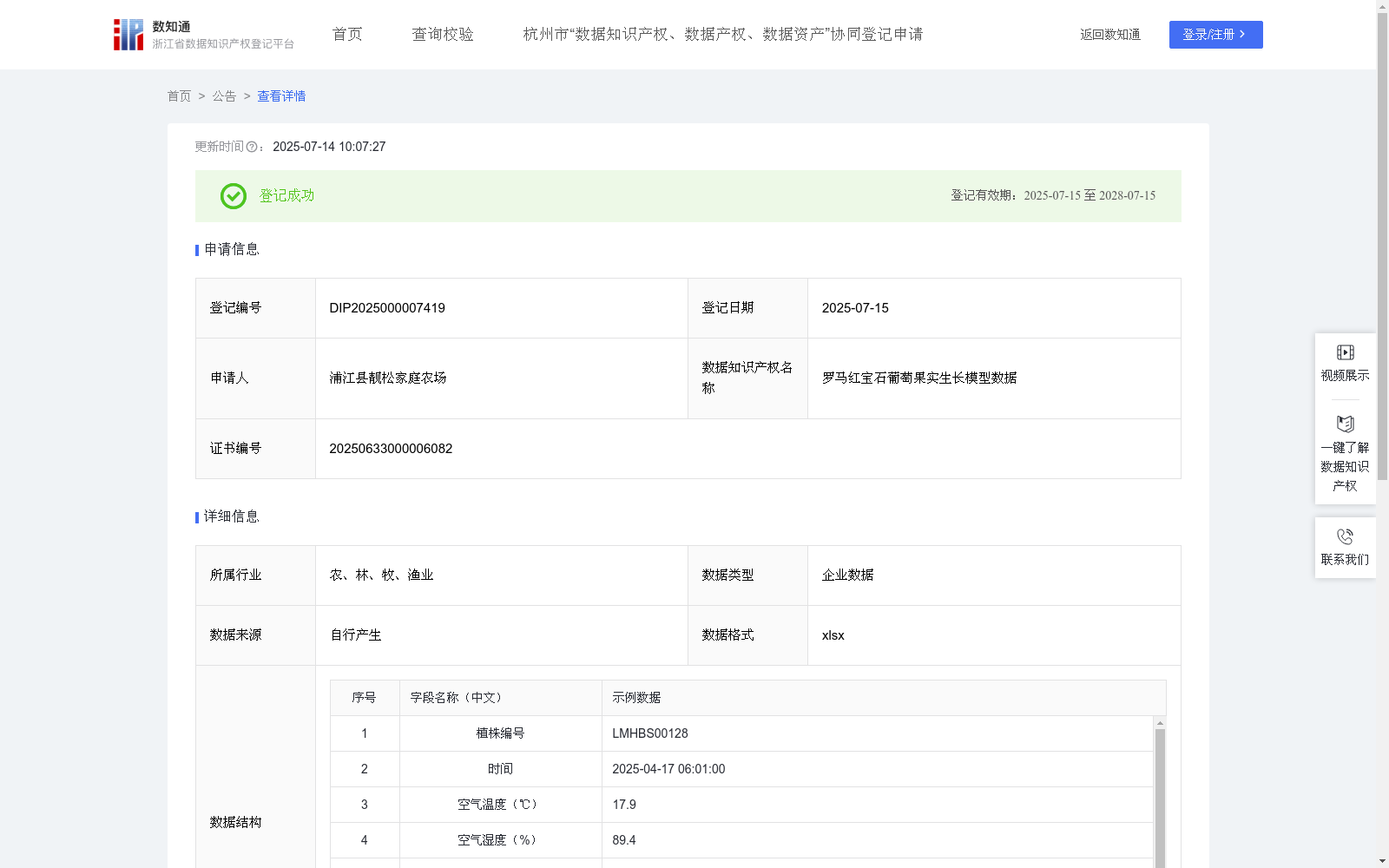
罗马红宝石葡萄果实生长模型数据
收藏资源简介:
在果实生长发育进程中, 气候对果实的生长发育影响较大。通过监测:空气温度、空气湿度、土壤温度、土壤湿度、光照各指标,建立气象因子对罗马红宝石葡萄果实生长的MLR模型。可以更科学地预测和掌握果实在不同时期的发育水平,研究结果可精确模拟和预测果实直径,对适时进行果树灾害防御、灌溉施肥、生长环境调控等提供重要参考和数据支持。1、在果实进入生长期,采用线性位移传感器、空气远程检测仪和土壤水分传感器连续自动监测空气温度、空气湿度、土壤温度、土壤湿度、光照。传感器与物联网监测系统连接,同一品种葡萄,随机选取一株,选择生长在外部中间位置的葡萄果实进行测量,每5分钟自动记录果实直径(mm)。果园内物联网监测系统每5分钟可以采集以下环境气象要素:空气温度(℃)、空气湿度(%)、土壤温度1A(℃)、土壤湿度1A(%)、外置1 光照(Lux)。 2、对采集到的数据进行去除无效值、降噪、标准化处理。 建立MLR模型预测果实直径,通过最小二乘法在模型拟合过程中计算得出: 果实直径预测值(mm)=0.0000035*空气温度(℃)+0.0000025*空气湿度(%)+0.0000035*土壤温度1A(℃)+0.000004*土壤湿度1A(%)+0.000000035*外置1 光照(Lux)+5分钟前的果实直径实际值(mm)
During the growth and development of grape fruits, climate exerts a substantial impact on their growth progression. By monitoring key indicators including air temperature, air humidity, soil temperature, soil moisture and light intensity, a Multiple Linear Regression (MLR) model was established to quantify the effects of meteorological factors on the growth of Roman Ruby grape fruits. This work enables more scientific prediction and understanding of the developmental level of fruits at different growth stages. The research outcomes can accurately simulate and predict fruit diameter, providing critical reference and data support for timely orchard disaster prevention, irrigation and fertilization, and growth environment regulation. 1. During the fruit growth phase, linear displacement sensors, remote air detectors and soil moisture sensors are employed to continuously and automatically monitor air temperature, air humidity, soil temperature, soil moisture and light intensity. These sensors are connected to an Internet of Things (IoT) monitoring system. For grapevines of the same variety, one vine is randomly selected, and grape fruits growing in the middle position of the outer canopy are chosen for measurement. The fruit diameter (mm) is automatically recorded every 5 minutes. The IoT monitoring system in the orchard can collect the following environmental meteorological parameters every 5 minutes: air temperature (℃), air humidity (%), soil temperature 1A (℃), soil moisture 1A (%), and External 1 Light intensity (Lux). 2. The collected data are preprocessed via invalid value removal, noise reduction and standardization. An MLR model is constructed to predict fruit diameter, which is calculated using the least squares method during model fitting as follows: Predicted fruit diameter (mm) = 0.0000035 * Air temperature (℃) + 0.0000025 * Air humidity (%) + 0.0000035 * Soil temperature 1A (℃) + 0.000004 * Soil moisture 1A (%) + 0.000000035 * External 1 Light intensity (Lux) + Actual fruit diameter 5 minutes ago (mm)