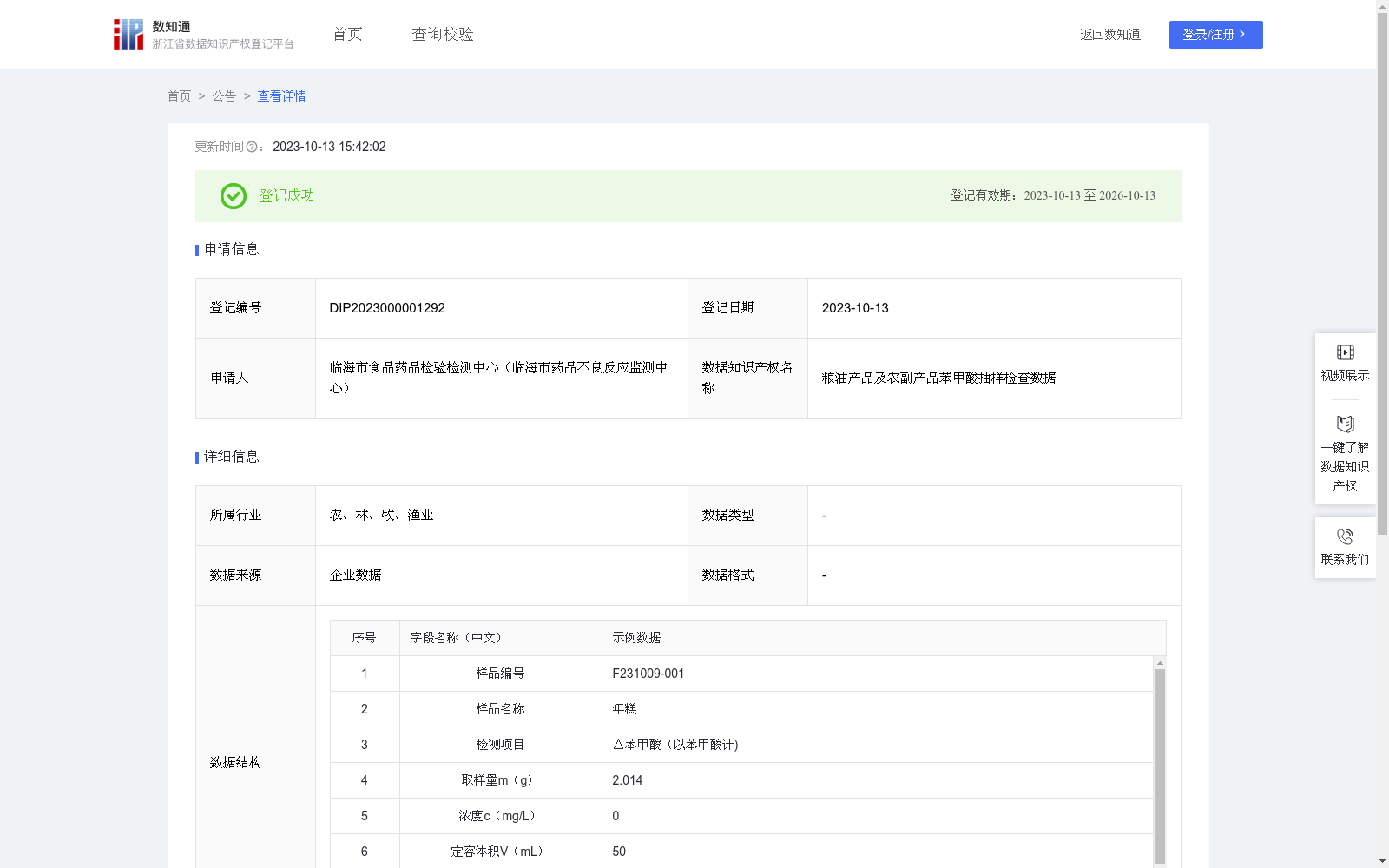
粮油产品及农副产品苯甲酸抽样检查数据
收藏资源简介:
为了避免食品安全事故发生,根据食品安全法的要求,我单位对临海市各农贸市场开展抽样检测,得出样品中的苯甲酸的含量。检测数据对比国标GB 5009.28-2016 《食品安全国家标准 食品中苯甲酸、山梨酸和糖精钠的测定》第一法 液相色谱法中标定的数据要求,可得出该样品是否合格。该项数据关乎消费者食品安全,有着不可忽视的重要性。1.算法规则:对我市各农贸市场的抽检产品的检测值按照如下公式进行计算:X=(ρ×V)/(m ×1000),式中:X为试样中待测组分含量,单位为克每千克(g/kg);ρ为由标准曲线得出的试样液中待测物的质量浓度,单位为毫克每升(mg/L);V为试样定容体积 ,单位为毫升(mL);m为试样质量 ,单位为克(g);1000为换算系数 。可得检查项目的含量数据。 2.数据分析:将以上检测数据对比国标GB 5009.28-2016 第一法 液相色谱法中标定的数据要求,在限定值内的为合格,超出限定值的为不合格。
To prevent food safety incidents, in compliance with the requirements of the Food Safety Law, our testing unit conducted sampling inspections on various farmers' markets in Linhai City to obtain the benzoic acid content in the collected samples. By comparing the test data with the calibration data requirements specified in Method 1 (Liquid Chromatography) of the National Standard GB 5009.28-2016 *National Food Safety Standard: Determination of Benzoic Acid, Sorbic Acid and Saccharin Sodium in Foods*, we can determine whether the samples are qualified. This data is closely related to consumer food safety and has a non-negligible importance. 1. Algorithm Rules: The test values of the sampled products from farmers' markets in our city are calculated using the following formula: $X = frac{ ho imes V}{m imes 1000}$ Where: X is the content of the analyte in the sample, with the unit of grams per kilogram (g/kg); $ ho$ is the mass concentration of the analyte in the sample solution obtained from the standard curve, with the unit of milligrams per liter (mg/L); V is the constant volume of the sample solution, with the unit of milliliters (mL); m is the mass of the test sample, with the unit of grams (g); 1000 is the unit conversion factor. The content data of the test items can be obtained through this calculation. 2. Data Analysis: The aforementioned test data is compared against the calibration data requirements specified in Method 1 (Liquid Chromatography) of the National Standard GB 5009.28-2016 *National Food Safety Standard: Determination of Benzoic Acid, Sorbic Acid and Saccharin Sodium in Foods*. Samples with results within the specified limits are deemed qualified, while those exceeding the limits are deemed unqualified.